FACT CHECKED
In the digital transformation era, formulaic, out-of-the-box employee training isn’t enough to fast-track employee learning & development (L&D) and bridge digital skills gaps.
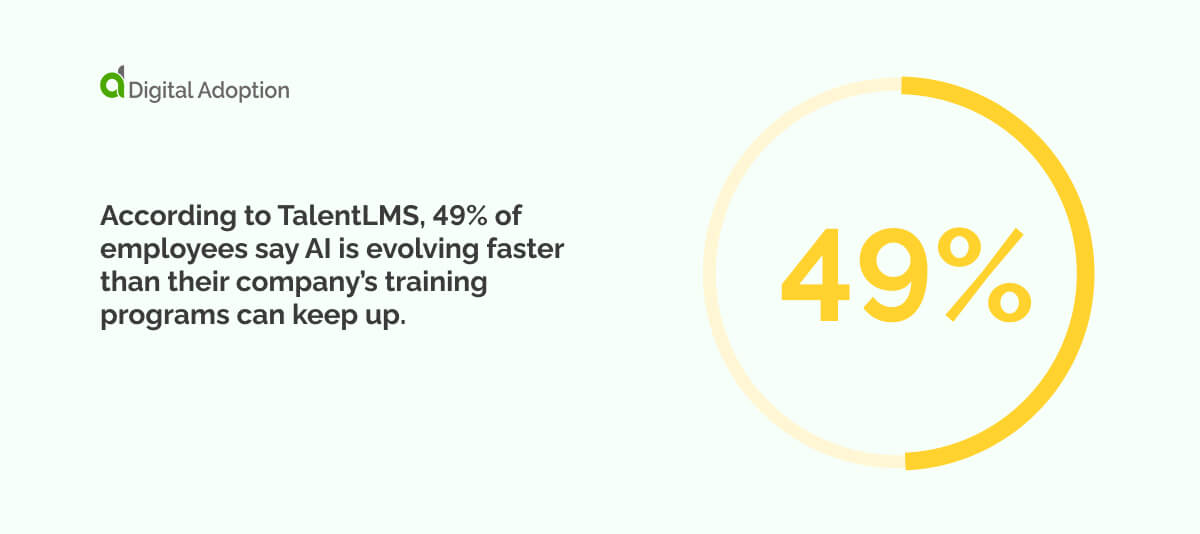
According to TalentLMS, 49% of employees say AI is evolving faster than their company’s training programs can keep up. The best results emerge from a thoughtfully planned process that considers the right way to go about it—and how not to.

In this article, we’ll look at the top employee training do’s and don’ts every manager should consider to curate highly relevant employee experiences. Regardless of how much training employees receive, good managers and leaders understand that authentic employee development hinges on quality experiences over quantity.
Following these do’s and don’ts will help managers strategize a future-ready training plan template designed to enhance employee performance in people-first organizations.
What is employee training?
Employee training is any process, program, or instruction provided by organizations to their employees to improve or gain new knowledge, skills, and performance capabilities.
This can include formal training programs, courses, and directives, such as employee onboarding, as well as more informal training projects and activities, like employee gamification.
Employee training is typically a structured, planned process that includes learning and development (L&D) activities. These are aimed at strengthening workplace responsibilities, along with personal skills development and career growth potential.
Why is employee training important?
Employee training is important for sustaining employee capabilities, performance, and organizational development.
Gallup reports global employee engagement declined to 21% in 2024, with lost productivity estimated at $438 billion worldwide.
Employees are the backbone of any business, and success depends on how well-equipped and engaged the people driving progress are. According to SHRM, employees who experience great onboarding are 69% more likely to stay for three years, and structured programs strengthen retention by 58%.
In every industry, AI, along with other tech innovations, is transforming long-standing business processes. AI is automating many roles and, in some cases, can work much more efficiently than their human counterparts.
McKinsey estimates that by 2030, automation could displace 400-800 million people worldwide, showing that concern about the future workforce is not unwarranted.
This shouldn’t be disheartening for the current workforce, as a brand new frontier of knowledge workers will be needed to guide and orchestrate these transformations. This is backed up by the World Economic Forum, which says, “AI will create 70 million new roles.”
Sustaining L&D is the responsibility of both the organization and the individual. For organizations, comprehensive employee training programs equip the entire company—from entry-level to the C-suite—to navigate future changes.
For individuals, training sharpens the skills needed to work in highly energized environments. As roles and responsibilities overlap across departments, consistently updating knowledge is key to reaffirming relevance in current and future positions.
10 Employee training do’s
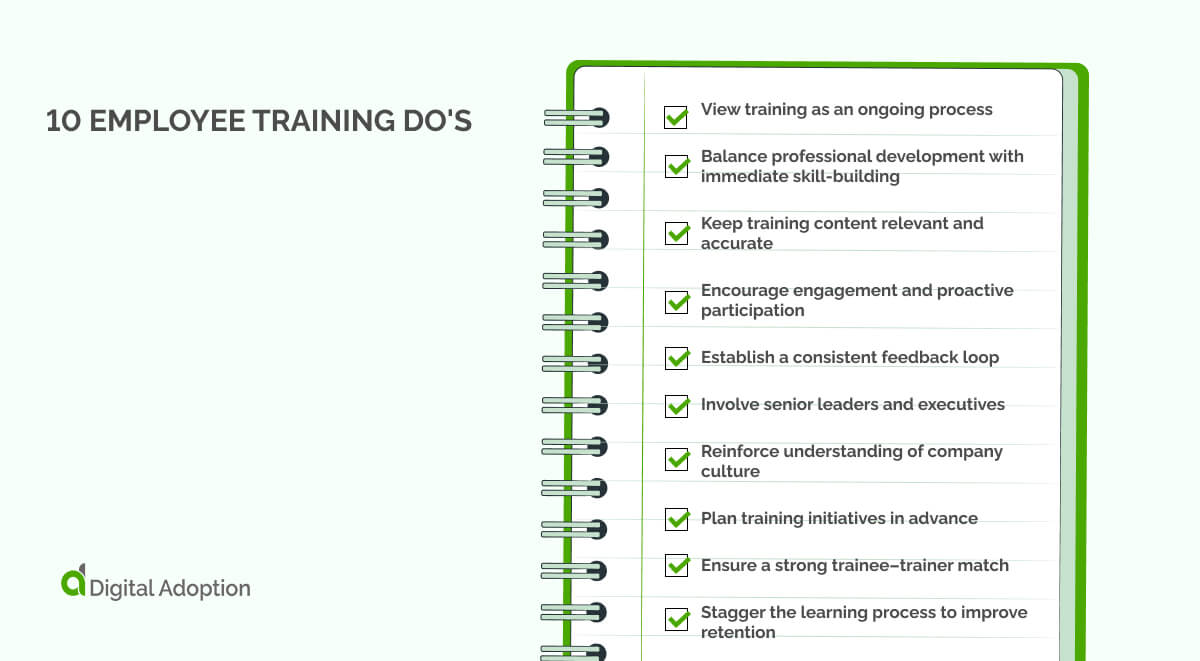
Let’s kick this list off with the essential must-haves in any successful employee training process. These insights have been selected from diverse sources of expert knowledge, where this advice has driven real results.
As a manager, it’s important to have a bird’s-eye view of the dos and don’ts of employee training. This will serve as a roadmap for managers to strategize the most effective actions in line with these foundational rules.
1. View training as an ongoing process
Training can’t be viewed as a one-time deal. It isn’t simply about ticking off static performance KPI’s on paper to meet goals and keep upper management happy. Genuine growth and development occur when training is viewed as an ongoing process. Not something achieved at once, but rather incremental and repetitive.
Employee development isn’t over once onboarding is complete; the employee lifecycle should be punctuated with learning and training phases, complete with set milestones and achievement thresholds.
Opening a two-way feedback system allows important information about their role, performance, skills, and pain points to flow in both directions. Tailoring employee satisfaction survey questions can provide precise feedback that helps managers understand employees’ mindsets and motivations at any time.
Training courses and materials also need to be reviewed and updated regularly to ensure they remain relevant to inevitable business shifts, such as AI adoption.
2. Balance professional development with immediate skill-building
Employee training isn’t just about bridging immediate skills gaps to selfishly advance company growth. Employee performance thrives when learning and development opportunities fuel both their current and future potential.
Investing in upskilling should support an employee’s ability to complete future responsibilities across evolving roles, while also directly heightening efficiency in their specific role.
Investing in digital tools such as a digital adoption platform (DAP) can accelerate user onboarding for firms looking to increase adoption. This can help sharpen employees’ digital proficiency. Practical, hands-on training allows them to learn through real-world scenarios, which is important for getting a real feel for job expectations.
Ultimately, holistic employee L&D schemes that explore all learning avenues lead to higher employee retention and motivation.
3. Keep training content relevant and accurate
With the pace of change across business and society today, every passing week sees even the latest training campaigns at risk of becoming irrelevant.
A revolving door of tech innovations continues to trickle into all business sectors, from endless enterprise applications to cloud software and AI tools. This means businesses looking to remain agile and leverage these solutions must ensure their workforce can successfully adapt to them.
This means designing and updating training campaigns regularly, ensuring they feed into organizational goals. It requires researching the latest industry trends and market shifts to anticipate and plan for major impacts on how the workforce operates.
For example, blanket technology adoption programs that don’t hone in on solutions that solve a specific business problem can see learning become redundant and investments wasted.
4. Encourage engagement and proactive participation
Our next piece of advice is to fuel engagement and participation at the individual level. When employees are intrinsically motivated, they perform way better than when motivated by superficial rewards.
Communicate the value of knowledge building and the benefits they can achieve by engaging in learning and development. These skills not only help them excel in their current role but also prepare them for future career paths.
Proactive employees who take initiative in their learning process build a sense of personal stake that helps underpin performance. This goes beyond one-on-one meetings and feedback sessions to include more direct opportunities, such as out-of-office events, skill-building conferences, and collaborative workshops that thrive on team-building.
Research also shows that “highly motivated employees are often more productive and better performers than their unmotivated colleagues.”
5. Establish a consistent feedback loop
As mentioned, training should be viewed as an ongoing process that ends only when employees leave the organization. Throughout the time, a consistent feedback loop must be maintained to ensure communication about evolving responsibilities is translated.
This can come in the form of training survey questions that provide essential data on how employees view training. It gives managers and leaders direct evidence of how employees view training processes, what’s working, and where things could improve.
Setting up feedback has the added benefit of letting employees know that their opinions are valued and incorporated, helping them build a positive view of company culture.
Inadequate communication can leave countless employee concerns unchecked and questions unanswered. This can lead to important issues slipping under the radar when employees feel there is no feedback system to voice concerns.
6. Involve senior leaders and executives
If business leaders and C-suite executives aren’t actively involved in supporting employee L&D, the impacts are negatively felt. Research shows that “leadership lapses can result in lower production, higher attrition, and lower well-being of employees.”
Avoiding these risks means involving senior leaders and executives (at least in part) in achieving successful training outcomes. All senior leaders were once in entry-level positions and have gone through essential skill-building stages in their careers. Prompting this advice when designing training programs will help align best practices across all levels.
Gauge advice, tips, and strategies they employed to level up their skills and progress in training. They could contribute an informal ‘dos and don’ts’ list, much like this article, so that employees have insights directly from leadership.
7. Reinforce understanding of company culture
Company culture gives employees a sense of what it’s like to work for a company.
A strong company culture sets the standard for how people and dynamics interact in the workplace, how problems are approached, and how successes are celebrated. Establishing a strong company culture for your employees—new and existing—will reinforce positive sentiments about their roles and justify their contributions to the company.
What vibes do employees get from working at your company? Does it deal with conflicts with an iron fist, or does it prefer collaborative crisis meetings? What are the company’s core values and mission statement? Can your employees align with them and feel positively about doing good work?
Setting up a strong company culture nurtures environments that motivate employees to perform better, rather than treating it as just an office you clock in and out of every day with little care.
8. Plan training initiatives in advance
With the unpredictability of today’s business arena, training programs that don’t anticipate tomorrow’s business and employee needs are already outdated. Training programs should be designed, tweaked, and revisited proactively, not just in response to sudden external shifts.
To understand what needs updating, trainers should always have an ear to the ground for the latest training methods, tools, and concepts, and adjust program specs accordingly. The techniques used can all affect how an employee learns. Employing the wrong tools and misassigning roles can happen when training isn’t planned.
Training large groups or many employees at once requires managing many moving parts and can quickly become derailed without proper planning. When training is well-planned, employees can ensure they’re assigned the right tasks that meet deadlines and align with the company’s larger objectives.
9. Ensure a strong trainee–trainer match
Without an ease of mentorship and collaboration between the trainee and trainer, even the most intricately designed programs can’t help.
Trainers play a major role in defining learning experiences for trainees and are at the forefront of practical learning and development. If trainers aren’t good communicators, essential knowledge may fail to translate, and if they’re too rigid, mistakes may be ostracized. Matching trainees with the right trainer is pivotal to bringing out the best in learners.
Selecting those proficient or qualified in the learning subject doesn’t automatically make the best trainers. Trainers need patience and to communicate their availability, accessibility, and support for all learners. Trainees should be guided through a positive learning experience and act as a catalyst for knowledge expansion.
10. Stagger the learning process to improve retention
When learners have too much piled on them, it can stall their capacity to meaningfully engage with the content. Research shows that higher cognitive overload leads to greater anxiety and avoidance behavior.
The mind cannot process high volumes of information at once, so throwing trainees into the deep end of training isn’t recommended. Instead, talent managers and program designers should stagger the learning process to give learners time to navigate the process.
The learning process, according to psychology, occurs across four main stages:
- Unconscious Incompetence (Ignorance)
- Conscious Incompetence (Awareness)
- Conscious Competence (Learning)
- Unconscious Competence (Mastery)
Training experts believe that the best results are achieved when learners receive a mix of verbal communication, shown examples, and practical experience.
Slowing down and ensuring each learning stage is punctuated by these principles will prevent steps from being rushed and ensure learners have complete knowledge of the subject.
10 Employee training don’ts
Let’s move into the second half of this article, where we’ll explore 10 employee training ‘don’ts’ and highlight negative examples trainers should avoid when designing and delivering learning.
1. Overlook alignment with overall business goals
While L&D should extend beyond improving immediate, job-specific skills, neglecting to align training design with the larger business objective actively inhibits progress.
Employee training in a business context is about improving an employee’s capabilities and performance in their role. If learners are absorbing content that doesn’t sharpen their ability to achieve their objectives, it’s a waste of resources and time.
Leadership and stakeholders should reaffirm the company’s long-term objectives and goals, while emphasizing company culture and setting expectations for employees at all levels. The manager’s and trainers’ roles are to teach employees the practical methods and skills needed to advance these goals.
Also, trainers and managers need to design training programs that balance overarching goals and department or role-specific objectives, which often compete and overlap.
2. Forget to measure training effectiveness and results
Don’t forget to measure the impact of training to determine whether it is achieving results.
Failure to measure the effectiveness of training is like moving without a destination in mind and expecting to reach it. Without assessments and evaluations of training, trainers can’t see who’s performing well, who’s struggling, what content is engaging, or which is stifling flow.
They also can’t measure the impact on business results or gauge trainee sentiment. Trainers need to set up mechanisms to measure training progress. This can include a digital adoption platform (DAP) to track user adoption, as well as evaluating test results, user success rates, assessments, feedback surveys, and questionnaires.
Using diverse methods to measure training will provide quantitative results in the form of raw data and ROI reports, as well as qualitative data, such as what’s driving employee frustration or motivation.
3. Overlook employee skills gaps assessment
How can training generate real results if trainers aren’t even sure of what learners know?
Understanding your learners’ current knowledge capacity enables course designers to pinpoint skills gaps and close them through targeted training.
With the rise of AI adoption and digital technology, the skills gap is widening faster than ever before, with digital literacy faltering.
The World Economic Forum says that trends such as broadening digital access and tech innovation will impact jobs while fueling demand for skills in AI, cybersecurity, and technological literacy.
Monitoring learning outcomes through a needs analysis and defining KPIs will help identify skills gaps and set benchmarks for targets. Use this to proactively tailor learning to ensure each experience supports every individual.
4. Rely only on theory and knowledge-based training
Trainers and managers shouldn’t rely on theoretical and knowledge-based learning as a sole indicator of progress.
ResearchGate reveals that theory-based teaching often overlooks diverse learning styles (visual or auditory), causing many students to disengage or struggle to understand.
While theory underpins academic and scientific norms, practical, hands-on learning styles can strengthen soft skills, such as creativity, collaboration, and critical thinking. Learners can become disengaged and passive when relying too heavily on lecture-based instructions used in traditional training.
Instead of simply delivering raw information, trainers should get a feel for the practical applications through interactive simulations, scenario-based exercises, and real-world problem-solving tasks.
Incorporating collaborative projects, peer learning, and on-the-job practice allows learners to translate theory into action and build confidence through experience.
5. Forget to use multiple training formats
In-person, instructor-led, self-paced, and theory-based training creates a diverse experience across multiple formats. Different training formats like these should be used in tandem to achieve optimal learning outcomes.
This allows employees to get a feel for their preferred learning methods, become familiar with new tools and applications, and create a blended learning experience through a mix of eLearning, virtual training, and face-to-face sessions.
When employees are given flexibility in how they absorb information, their capacity to retain knowledge increases, and performance and productivity improve.
6. Bypass a Training Needs Analysis (TNA)
This entry focuses more on a technical oversight that should be part of every employee training program design. Bypassing a Training Needs Analysis (TNA) is akin to searching in the dark for a problem you cannot see.
Consider a TNA a metaphorical flashlight for illuminating hidden areas for improvement. It’s a way of determining the skills and talents an organization needs to succeed, as well as the skills an employee currently possesses.
Conducting a TNA is a foundational part of any robust training program. It involves defining organizational goals, conducting assessments, surveys, and interviews to inform learning requirements and training design.
A TNA also gives essential information on an employee’s current competencies and capabilities, enabling resources to be allocated effectively and training to be tailored to each individual.
7. Neglect diverse and engaging learning experiences
Touched on previously, accommodating flexible learning styles is known to reap the best results. Rigid training of yesteryear was mostly lecture-based and instructor-led.
Today, learning experiences can be immersive, interactive, and highly engaging.
Employee gamification, for example, incorporates learning via mobile app games or DAP software. Gamified elements like rewards and digital tokens are earned when successful learning is achieved. A slot machine-style progress tracker could randomly award bonus points or badges for completing modules.
Virtual reality (VR), augmented reality (AR), and other extended reality technologies could transform training through unprecedented immersive experiences that throw learners into simulations they can interact with and engage with physically.
When fun is incentivized in compelling experiences, it can fuel intrinsic motivation to learn and pay attention. Highly captivated employees stay engaged and work towards objectives, where new knowledge translates into practical work improvements.
8. Forget the user experience (UX)
The importance of a sound digital employee experience when training can’t be overlooked. Away from practical, in-person training, a large portion of L&D today occurs online. For users to engage and learn free from distraction, these digital spaces need to be fluid and easily navigable.
Streamlining the user experience (UX) will fall under the control of training software designers and talent program developers, who’ll need to ensure that navigating user interfaces (UIs) is as easy as possible.
Even the most well-crafted content can fall flat if the interface is cluttered, navigation is confusing, or visuals are outdated. This can distract from the material, leading to frustration and lower retention.
Training should feel intuitive and fluid, with clear progress indicators, accessible content, and responsive layouts that adapt to any device. When employees can move effortlessly through modules, their focus stays on learning rather than logistics.
Prioritizing UX ensures training feels purposeful, enjoyable, and accessible.
9. Use outdated technologies, tools, or strategies
Our penultimate piece of advice is that training built on outdated systems, tools, data, and strategies does more harm than good.
Using outdated digital tools, applications, or software means training is never truly relevant, no matter how capable a learner is. The pace of innovation today (both digital and cultural) keeps outdated processes one step behind.
For new learners to excel, their knowledge and skills must be up to date and aligned with modern workflows. When tools feel slow or disconnected from daily use, attention slips, and learning feels pointless.
If the organization has shifted primarily to cloud infrastructure, why maintain traditional in-person training programs rather than scalable, cloud-based learning platforms? Training should reflect how people actually operate, which means using current software, live data, and practical workflows.
10. Encourage workplace competition or favoritism during training
Our last thing to avoid during employee training is enabling a culture of competition or favoritism to occur.
Company culture directly impacts training outcomes. When tension and rivalry are used to drive performance, it often creates toxicity instead. While light, friendly competition can build morale, it must be handled carefully. Evaluating employees against one another breeds distraction and misplaced motivation.
Displaying favoritism toward one trainee for a win, while cold-shouldering another for a loss, is unethical. Instead, maintain a fair, transparent system of merit where achievements are recognized objectively, progress is measured consistently, and every learner feels equally valued and motivated to improve.
How can you ensure your employee training delivers the best results?
Employee training is a nuanced subject with lots of moving parts. If this article has taught you anything, it’s to approach training with a people-first mindset, one that balances skills, curiosity, and engagement to create learning that sticks and inspires.
Developing employees goes well beyond a list of dos and don’ts. However, by taking note of the principles outlined here, you can design programs that feel practical, meaningful, and human.
Leaders who show up and guide by example ensure that real employee needs are molded through training. Having one foot in strategy and the other in empathy helps create relevant learning experiences that stand the test of time. Or at least until the next training cycle, because as stated, the best programs always evolve with employees.
And remember, the journey doesn’t end here. Every insight, tweak, and moment of curiosity can spark the kind of growth that keeps both employees and organizations ahead and eager for a more prosperous future.
People Also Ask
-
What are the different types of employee training?Employee training comes in many forms. It can be hands-on learning, online courses, mentoring, or workshops. Some programs build technical skills, while others focus on teamwork or communication. Companies also use safety and compliance training to meet industry rules. Mixing these methods keeps learning practical, interesting, and easy to use at work.
-
How can organizations measure the effectiveness of employee training?Training works best when employees can use what they’ve learned. Companies can check this through surveys, quizzes, and feedback. Tracking progress, performance, and confidence levels also helps. If employees make fewer mistakes, work faster, or feel more capable, it’s a clear sign the training made a real difference.
-
How does employee training differ from employee onboarding?Onboarding helps new hires get comfortable, meet their team, and learn the basics of their job. Training goes further by improving skills and performance as they grow. Onboarding is the welcome stage, while training keeps people learning, adapting, and building confidence throughout their time at the company.