FACT CHECKED
To cultivate customer loyalty and repeat business, you need to follow a strategic sales roadmap that includes adopting a sales engagement platform.
According to research, 92% of sales development organizations view sales engagement platforms as mission-critical, and companies that engage customers effectively outperform competitors by 23%.

Navigating sales engagement pricing during the tech buying process, however, can be difficult. Before selecting software, how can you ensure vendors are the right fit and that solutions align with organizational goals?
Companies without targeted sales engagement risk stifling customer outreach, pipeline, and sales-cycle productivity. It also lowers win rates and forecasted potential and heightens the risk of losing customers to more proactive competitors.
This article explores sales engagement pricing, covering why sales engagement is important, essential solution features, and how to ensure investments deliver the intended ROI, among other topics.
What is a sales engagement platform (SEP)?
A sales engagement platform (SEP) is a centralized software used by sales teams to streamline the sales process and improve customer outreach and engagement.
Sales and marketing personnel use these tools to strengthen communication and outreach with prospects. It emphasises a multi-channel approach that includes email, text messages, phone calls, virtual or in-person meetings, and social media interactions.
SEPs integrate with a company’s sales and marketing tools and CRM customer insights to automate and accelerate sales outreach.
This involves integrations with CRM, email, and social engagement tools, allowing data to sync across systems. Data syncs also enable automation capabilities, such as auto-triggering follow-ups after a prospect interaction or updating CRM records when outreach activity is logged.
SEPs also inform real-time updates to daily sales workflows. They can absorb live activity data from other tools and automatically adjust values without human intervention. This ensures sales reps can make accurate, relevant decisions by leveraging the latest information.
Why are sales engagement platforms important?
SEPs strengthen sales efficiency and allow teams to capture data across every customer touchpoint. Their importance becomes clearer when viewed through a pricing lens, as the growth demands needed to level up sales require higher investments.
The price of an SEP directly affects the readiness and agility of your sales process and determines the amount of risk you’re exposed to. Different pricing between platforms unlocks different service levels and product accessibility.
Core and entry-level SEPs are cost-effective and provide basic functions, but do not offer enhanced services such as data syncing, AI automations, or cadence logic.
As sales processes intensify, operational risks increase, requiring greater outreach, workflow automations, monitoring, and data logging. This drives buyers toward higher tiers, usage, or support needs.
Enterprise-level SEPs come at a higher price point, particularly for organizations scaling sales workflows that require more data storage and security protocols, governance frameworks, and cross-departmental collaboration.
This is key for organizations undergoing digital transformation, as customer success is reflected in the effectiveness of their sales operations and engagement capabilities.
Higher budgets mean greater protections and lower risk. This cost is justified when haphazard sales processes and engagement capabilities are shown to affect revenue continuity negatively.
What is the difference between sales engagement platforms (SEPs) and customer relationship management (CRM) platforms?
Both sales engagement platforms (SEPs) and customer relationship management (CRM) platforms are critical assets in an IT stack. To reduce confusion among their intersecting capabilities, below we explore the key differences between SEPs and CRMs:
| Comparison area | Sales engagement platform (SEP) | CRM |
| Main purpose | Dedicated outreach and communication | Central customer record |
| Primary use | Automates emails, calls, and follow-ups | Tracks contacts and deals |
| Outreach tools | Built for high-volume outreach | Not built for high-volume outreach |
| Automation | Emphasizes automation to scale outreach | Relies on manual actions and added licences |
| Data ownership | Updates CRM records | Stores customer information |
| Best suited for | Early customer discovery and engagement | Comprehensive customer view |
Sales engagement platform (SEP)
A Sales engagement platform is a dedicated outreach and communication platform used in the sales process. It focuses on actions that connect businesses with prospects, typically at the start of the customer discovery process. It emphasizes automation to strategically scale outreach, including cold emailing, scheduling meetings, making calls, conducting follow-ups, and updating CRM records.
Customer relationship management (CRM) platform
CRMs act as a central record for customer information and sales activity. They store contact details, deal status, buying preferences, and purchase history. Unlike SEPs, CRMs are not built for high-volume outreach and often rely on manual actions, added licences, and usage limits.
CRMs also integrate with other key business applications, such as enterprise resource planning (ERP), sales engagement, and marketing software, to provide a comprehensive view of the customer.
What features should sales engagement platforms include?
Understanding core SEP features clarifies what the platform supports day-to-day. It also helps connect outreach, collaboration, and existing tools, so engagement stays consistent and easier to manage. Here are the key features to look out for:
- Cold email campaigns: Supports sending email sequences at scale, with timing and follow-ups handled automatically. Reps spend less time chasing replies and more time responding to interest, while outreach stays consistent.
- LinkedIn sequences and messaging: Allows sales teams to include LinkedIn touches alongside emails and calls. This keeps outreach varied, helping prospects recognize the sender and engage without feeling spammed or over-contacted.
- Integration with calling tools or sales dialers: Connects email workflows to calling tools, enabling reps to quickly move from messages to live conversations. Call activity is logged, reducing admin and keeping outreach history accurate.
- Team collaboration within the platform: Gives shared visibility into outreach activity, responses, and next steps. Managers can guide activity without micromanaging, while reps avoid duplicate contact from the same playbook.
- Connects with existing sales stack: Links with CRM, marketing, and other sales tools to keep data in sync. This prevents double entry, keeps records up to date, and ensures outreach reflects the latest customer information.
- Personalized prospect messaging: Makes it easier to tailor messages using role, company, or timing cues. Personalization remains scalable, keeping outreach relevant without requiring manual rewriting for every prospect.
How to choose the right sales engagement platform (SEP)?
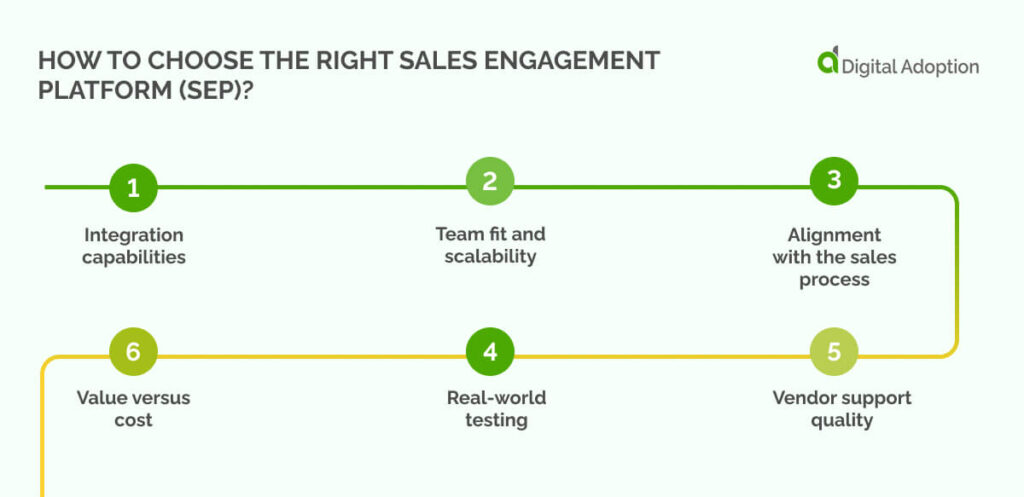
Choosing a sales engagement platform is harder than it first appears. Many tools look similar on the surface, but differences in setup, daily use, and long-term support can quickly affect how effective outreach feels once the platform is in place. Here’s how to choose a sales engagement platform for your needs:
Integration capabilities
SEPs should integrate with existing tools, especially CRMs and cold-calling software. When systems share data, records tend to remain accurate, reducing the time spent updating information and making activity easier to manage.
Remember that some tools connect once, then quietly drift out of sync as updates roll out. A dependable platform keeps those links stable over time, without regular checks or manual fixes becoming part of the routine.
Team fit and scalability
The right platform should feel easy to use at the start and remain manageable as usage grows. Adding new users or increasing outreach should not introduce complexity or slow things down, even as activity levels rise.
Ease of use is most apparent when someone joins mid-quarter and needs to move quickly. If the platform feels clear without formal training, it is more likely to scale without slowing people down.
Alignment with the sales process
A strong SEP reflects how outreach already transpires, from first contact through to booked meetings. When the structure mirrors existing stages, it supports consistent activity without forcing changes that interrupt established habits.
It’s important to note that processes rarely stay fixed for long, especially as markets shift. A platform should adjust as steps change, rather than locking activity into a structure that becomes outdated and restrictive.
Value versus cost
Pricing only makes sense when viewed alongside what is included. Limits on users, messages, or features can change the actual cost over time, so it is worth understanding how expenses grow as usage increases.
Price seldom reflects effort on its own. Time lost navigating limits, managing exceptions, or working around restrictions often becomes the real expense over months of use.
Real-world testing
Using a SEP in a real-world setting quickly reveals how it performs in day-to-day operations. The setup effort, feature clarity, and tracking accuracy become apparent only once outreach is live, rather than during a demonstration.
Busy days tell a different story than controlled trials or software walkthroughs. Running live outreach side by side exposes delays, blind spots, and friction that only appear under real conditions.
Vendor support quality
Support quality shapes the long-term experience more than sales conversations do. Clear employee onboarding, timely responses, and functional guidance help resolve issues quickly and keep the platform useful well beyond the initial rollout.
Support becomes most visible after the first issue returns. Clear context, shared history, and continuity matter when the same problem resurfaces weeks later.
How much does sales engagement software cost?
The table below shows a pricing overview for leading sales engagement platforms, based on free access, lowest paid entry points, and highest listed plans. It is designed to help compare cost direction and commitment at a glance, rather than reflect exact tier structures.
All prices are shown in USD. Final pricing varies based on contract terms, user volume, and billing cycle, and should always be confirmed directly with the vendor.
| Company size | Monthly base fee | PEPM range |
|---|---|---|
| Small businesses (up to 100 employees) | $7 – $49 per month | $7 – $58 per user per month |
| Medium-sized businesses (100–500 employees) | $50 – $450 per month | $50 – $74 per user per month |
| Enterprise (500+ employees) | $450 – $1,000+ per month | $58 – $100+ per user per month |
What are the most popular sales engagement platforms?
With a clear ballpark for sales engagement software costs across business sizes, we can now examine the pricing of the most widely adopted solutions on the market.
All prices are shown in USD and are based on the latest publicly available research. Pricing is subject to change at the vendor’s discretion and should be confirmed directly with the provider for the most accurate, up-to-date quotes.
| Platform | Entry-Level | Mid-Level | Enterprise-Level |
| ActiveCampaign | $15 per month | $49 – $79 per month | $145 per month |
| Apollo.io | $49 per user per month | $79 per user per month | $119 per user per month |
| Close | $35 per seat per month | $99 per seat per month | $139 per seat per month |
| Groove (by Clari) | $50 per user per month | Custom | Custom |
| HubSpot Sales Hub | $9 per month per seat | $90 per month per seat | $150 per month per seat |
| Outreach | N/A | Custom | Custom |
| Reply | $49 per user per month | $89 per user per month | $139+ per user per month |
| Salesforce (Sales Engagement) | $50 per user per month | Custom | Custom |
| Salesloft | N/A | N/A | Custom |
| ZoomInfo Sales | N/A | $1,250 – $2,500 per month *Calculated per annum) | $2,900 – $3,750+ per month *Calculated per annum) |
Ensuring your SEP investment decisions support software ROI
When evaluating a sales engagement platform, the question isn’t just about price or feature lists; it’s whether the investment drives measurable returns.
Tools that don’t deliver clearer results risk becoming cost centres instead of performance drivers. According to Gartner, only 11% of sales organizations succeed in driving commercial outcomes during transformational change. This is often because they adopt technology without linking it to tangible results or seller adoption goals.
A meaningful software ROI decision starts with defining what “value” looks like for your team: faster conversions, better forecasting, or more accurate pipeline signals. Tools should replace manual work, reduce friction, and surface insights that influence decisions, not just generate activity. Look for early digital adoption patterns and outcomes, and be prepared to adjust the scope or processes if the results don’t materialize.
Prioritizing tools that measurably impact revenue and seller behaviour ensures your SEP choice is a strategic investment rather than a short-lived experiment.
People Also Ask
-
How do trial periods or pilot programs affect overall cost assessment?Trial periods expose how the platform behaves once real outreach begins. They highlight setup time, usability gaps, and feature limits that pricing pages rarely show. Seeing how much effort is required early helps estimate long-term cost more accurately, before contracts lock decisions in.
-
What ROI metrics should teams track to justify the investment?Focus on signals that reflect progress, not volume. Look at response quality, meetings booked, time saved on manual updates, and how quickly new users become confident. These measures show whether the platform improves outcomes and efficiency, rather than simply increasing activity.
-
How does vendor support or add-on services influence total spend?Support and add-ons often shape the real price over time. Paid onboarding, premium assistance, or locked features can raise costs after launch. Understanding what help is included, what costs extra, and when it becomes necessary prevents budget creep later.