FACT CHECKED
Every business wants to operate in a way that fulfills its full potential. This is easier said than done, as sweeping digital transformation and increased adoption of digital tools further complicate process norms.
Without consistent processes to support these changes, efforts to evolve and grow are undermined, leaving organizations struggling to scale or operate with confidence.

This article explores SOPs, dissecting what they are, how to write one, and the essential components for creating a water-tight document.
What is a standard operating procedure (SOP)?
Standard operating procedures (SOPs) are foundational rules and instructions that ensure consistent, uniform performance across all processes.
In organizations, SOPs outline the methods a process or activity must be performed and followed by employees. These procedures provide unambiguous instructions for achieving process standardization and operational consistency.
They also ensure compliance with legal regulations that protect organizations from risk. This helps establish clear methods for other essential workplace business practices.
SOPs are essential for every modern business across industries, including finance, IT, cloud ops, manufacturing, healthcare, pharmaceuticals, and biotech.
Why are standard operating procedures (SOPs) important?
SOPs are non-negotiable to ensure compliance with laws and regulations and to uphold business policy and standards.
Strict legal stipulations and governance requirements primarily drive the need for SOPs, which serve as a safety net to mitigate legal risks and compliance breaches.
Research shows that unclear SOPs create task ambiguity that drains productivity, undermines morale, increases stress, and ultimately lowers work quality.
For example, if SOPs are not followed during data lifecycle management, the risk of leaks and cybersecurity vulnerabilities increases. Or if a team lacks an SOP for shutting down equipment during an electrical fire, staff may take ad hoc or conflicting actions, increasing the risk of injury, damage, and escalation of conflict.
Skipping SOP measures such as access controls, validation checks, or encryption creates gaps that attackers or internal errors can exploit.
SOPs are also essential for ensuring workplace safety and adherence to ethical practices, outlining appropriate courses of action in the event of emergencies, issue resolution, and problem-solving.
Operational continuity depends on having clear, consistent ways of working, not only in complex, multilayered environments but across organizations of every size.
What are the essential components of an SOP?
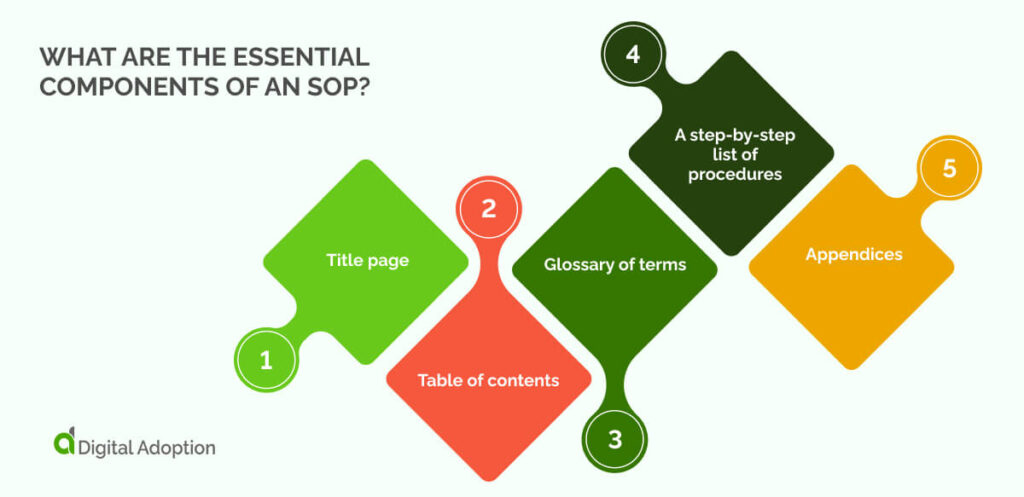
Before we explore the steps involved in writing a formal SOP, let’s look at how the document should be structured. While it may seem straightforward, overlooking this step can lead to confusion, inconsistency, and gaps in execution. A formal SOP should include the following key components:
- Title page: This formally outlines the procedure title and provides a clear layout of information. This can include its version number, author, and approval date so teams can confirm they are using the most current document.
- Table of contents: A structured index that helps teams quickly locate sections, ensuring the SOP is easy to navigate and reducing time lost searching for critical instructions.
- Glossary of terms: A brief reference clarifying technical language, acronyms, and role definitions so readers interpret the procedure consistently and avoid operational ambiguity.
- A step-by-step list of procedures: A precise sequence of actions presented in clear, ordered steps, giving teams an unambiguous roadmap for execution and reducing variation across users.
- Appendices: Supporting materials (forms, checklists, templates, or diagrams) that reinforce the procedure and give teams the tools needed to execute it correctly and consistently.
How to write a standard operating procedure?
Let’s now explore the actual requirements of writing a standard operating procedure (SOP).
These steps cover the entire creation process, from pre-planning and outlining the document to post-implementation updates:
| Step | Example |
| Define the goal | Reduce errors when handling customer data |
| Set the scope | Covers support teams using the CRM system |
| Gather information | Review current workflows and legal rules |
| Choose the format | Step list with screenshots for guidance |
| Identify dependencies | Access to systems and manager approval |
| Identify the audience | New hires and experienced agents |
| Create the outline | Steps ordered as the task happens |
| Draft the SOP | Clear actions anyone can follow |
| Review and update | Quarterly check after system changes |
Define the goal
Before any work begins, it’s essential to determine which tasks genuinely require an SOP. Is this a short-term or one-off project that demands a temporary structure? Or a long-term, business-critical process, such as adopting digital technology, that requires a formal procedure?
Is the objective to increase operational resilience, codify best practices, or meet regulatory requirements? Figuring out what the goal is reinforces its importance to stakeholders and highlights why a formal SOP is needed and why it’s being pursued.
Set the scope
What processes are your SOP for? If they inform the same processes across different departments, is a whole new set of SOPs required? Understanding where SOPs are and aren’t applicable helps define their limits before drafting. Define the process boundaries, the teams involved, and the environments or systems it governs.
If entry-level teams and the C-suite perform the same actions but at different risk levels, should there be a single SOP or separate versions tailored to each? Map the exact activities, roles, and systems in scope, and exclude anything peripheral.
Gather information
SOPs draw on quantitative and qualitative data to ensure the document is grounded in evidence. This means reviewing manuals, business systems, compliance frameworks, and legal requirements, while examining current processes to pinpoint gaps or segments needing clearer definition.
Interviews with experts and practical on-the-job perspectives reveal undocumented practices and practical constraints. The goal is to capture a full picture of how the process actually operates before formalizing it into a structured procedure.
Determine the SOP format
A single, uniform SOP format may not be clear or usable for every team or skill set. Choose the format carefully to avoid causing confusion, limiting understanding, or excluding certain groups from the process.
Consider the nature of the process and your audience when choosing a format. When you select the right format, you cater to your employees’ learning preferences. It also enhances overall comprehension.
Identify the dependencies
Identify the systems, inputs, approvals, and prerequisites required to perform the procedure. Dependencies often include other SOPs, software tools, safety steps, or compliance standards.
Mapping them beforehand prevents operational bottlenecks and ensures the procedure aligns with upstream and downstream workflows. It also clarifies what must be in place before the task can be executed safely and consistently.
Identify the audience
An SOP only works if it reflects the reality of the people using it. Identify who will follow the procedure, their level of experience, and the context in which the task is performed.
A frontline employee, a chief business officer (CBO), and an auditor each need different levels of detail. Defining the audience upfront prevents overcomplication, removes assumptions, and ensures the procedure supports clear execution.
Create the outline
A clear outline is an unmissable step and helps keep the SOP focused and usable. Break the process into logical stages, ordering steps exactly as they occur in practice.
Group related actions together and flag decision points where judgment or escalation is required. This structure should be the backbone of the document, making it easier to follow and maintain while reducing the risk of unclear responsibilities.
Draft the SOP
Write the SOP using direct, unambiguous language that leaves no room for interpretation. Each step should describe a single action, who performs it, and the expected outcome.
Avoid broad guidance and focus on what must happen, not what should happen. Clear drafting reduces variation and means employees rely on the document rather than informal knowledge.
Review and update
An SOP is only reliable if it reflects how work is performed in the environment in which it operates. Review drafts with the people who perform the process and those accountable for its outcomes.
Always check for gaps, outdated steps, or unnecessary complexity. Once approved, revisit the SOP regularly to account for system changes, policy updates, or new risks. Ongoing review is the only way to keep procedures trusted and consistently followed.
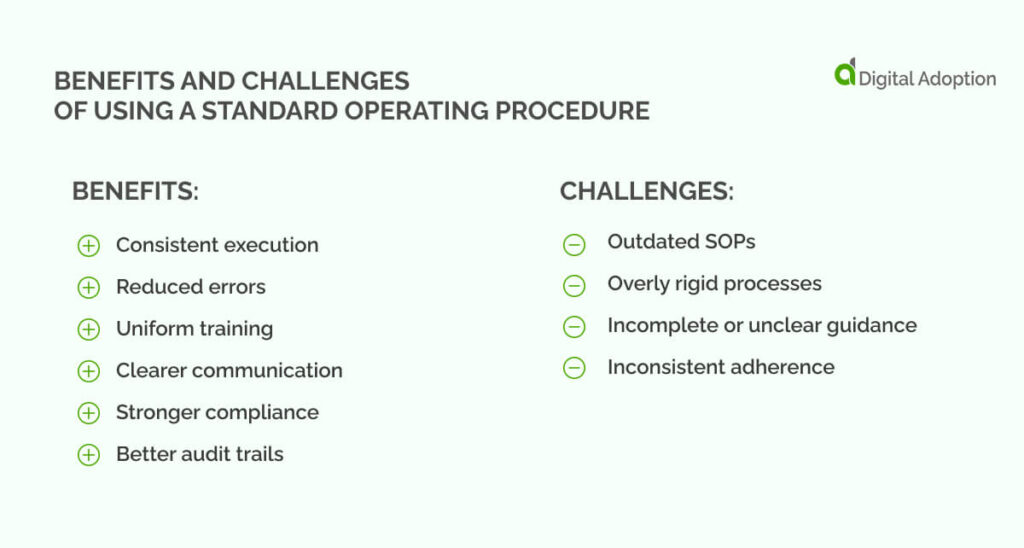
What are the benefits of using a standard operating procedure?
When processes are documented and followed consistently, organizations gain the stability needed to operate reliably at scale and adapt without digital disruption:
- Consistent execution: Results remain stable because people follow the same agreed-upon steps, even as teams expand, shift, or work is handed off.
- Reduced errors: Clear procedures remove uncertainty, which slashes mistakes caused by assumptions or incomplete knowledge.
- Uniform training: Everyone is trained against the same reference, so learning is faster and less dependent on who is available.
- Clearer communication: Responsibilities and actions are documented once and understood consistently across teams and roles.
- Stronger compliance: Controls are built into everyday tasks, reducing the risk of skipping steps under pressure.
- Better audit trails: Documented procedures show how work is meant to be done and make it easier to prove it was followed
What are the challenges of using a standard operating procedure?
At the same time, new procedures can introduce digital friction if they are poorly designed or left unmanaged, making it just as important to understand where they can fall short:
- Outdated SOPs: Procedures often fall out of sync with systems, policies, or regulations, making them unreliable in real use.
- Overly rigid processes: Fixed steps that ignore context can block judgment and slow execution when conditions change.
- Incomplete or unclear guidance: Gaps or ambiguity force employees to decide for themselves, increasing inconsistency and risk:
- Inconsistent adherence: When enforcement varies, procedures lose authority and become easy to bypass.
- Training gaps: Employees are expected to follow procedures they were never properly shown or reinforced
Getting SOP documentation right
All businesses will need an SOP document at one point. Whether to inform daily processes or support the implementation of AI tools, standard operating procedures are the lifeblood of repeatable operations at scale.
Many will falter in the early stages, failing to take into account crucial information that supports and feeds into wider needs and strategies. To avoid this, take a holistic approach and speak to employees at every stage of the process you are writing the SOP for.
This way, you can be sure that you’re covering all aspects while giving your SOP room to grow and be manipulated by the people using it.
Remember to leave room for accountability and ask what should happen when processes fail or need further support. Having a contingency plan in place never hurts and helps prevent your SOP from faltering under pressure or added scrutiny.
People Also Ask
-
What’s the difference between a policy, a standard, a procedure, and a control?These terms describe different layers of how work is governed. A policy sets direction by outlining intent and expectations. A standard narrows that intent into specific rules or requirements. A procedure then explains how the work is actually carried out. Controls sit alongside this structure to ensure procedures are followed and to identify issues when they occur.
-
What core advantages does an SOP manual deliver?An SOP manual brings structure to day-to-day operations. It creates consistency in how work is performed, regardless of who is involved. It lowers error rates and shortens onboarding time by reducing ambiguity. Over time, it also preserves institutional knowledge and supports compliance by making processes visible and reliable.
-
How frequently should SOPs be revisited or updated?SOPs are not static documents. They should be reviewed regularly and revisited whenever tools, regulations, or operating models evolve. If teams begin to bypass documented steps, it usually signals that the SOP no longer reflects how work actually happens.