

 FACT CHECKED
AI is advancing fast, and “One-shot prompting” is a new, important method that is changing how AI works.
Traditional AI needs extensive training and examples. One-shot prompting is different. It allows AI to deliver suitable answers from just one input.

This matters in fast-paced industries where efficiency counts. AI’s quick learning can transform many fields, making one-shot prompting a hot topic.
Research presented at the ACM Web Search and Data Mining Conference found that techniques like one-shot prompting can boost large language models’ (LLMs) understanding of structured data by 6.76%, showing the power of advanced prompts in improving AI performance.
This article will explore one-shot prompting in depth. We’ll see why it’s important for AI and machine learning. Real-world examples will show its use across industries and compare it to other prompting methods.
What is one-shot prompting?
One-shot prompting is a machine learning technique where an AI model is given a single example of a task before being asked to perform similar tasks.
This approach contrasts with few-shot or zero-shot learning. In one-shot prompting, the model receives one demonstration of the desired input-output pair, which serves as a template for subsequent queries.
This method leverages the model’s pre-existing knowledge and ability to generalize, allowing it to understand the task’s context and requirements from just one example.
One-shot prompting is particularly useful when training data is limited or when quick adaptation to new tasks is needed. However, its effectiveness can vary depending on the complexity of the task and the model’s capabilities.
Why is one-shot prompting important?
AI engineers are innovating and developing task-specific AI. Careful prompts are key; they help AI understand inputs accurately.
This opens new possibilities, and AI can now handle unexpected tasks and become more adaptable.
The market for this technology is growing fast. Experts predict massive growth. From $200 million in 2023, it could reach $2.5 trillion by 2032. That’s a 31.6% yearly increase.
One-shot prompting excels at clear tasks. It needs just one well-crafted prompt. Other methods use multiple steps. One-shot prompting is simpler.
Engineers can create reliable templates. These consistently produce accurate outputs, and no constant adjustments are needed. It’s efficient and direct.
This method stands out. It gets results with less effort, requiring fewer steps and less computing power.
One-shot prompting is a smart choice. It saves time and resources, allowing organizations to use AI more effectively. It doesn’t need frequent retraining, and manual adjustments are minimal.
Businesses benefit greatly and can create new value in various areas. One-shot prompting optimizes AI business functions, allowing companies to do more with less.
Examples of one-shot prompting
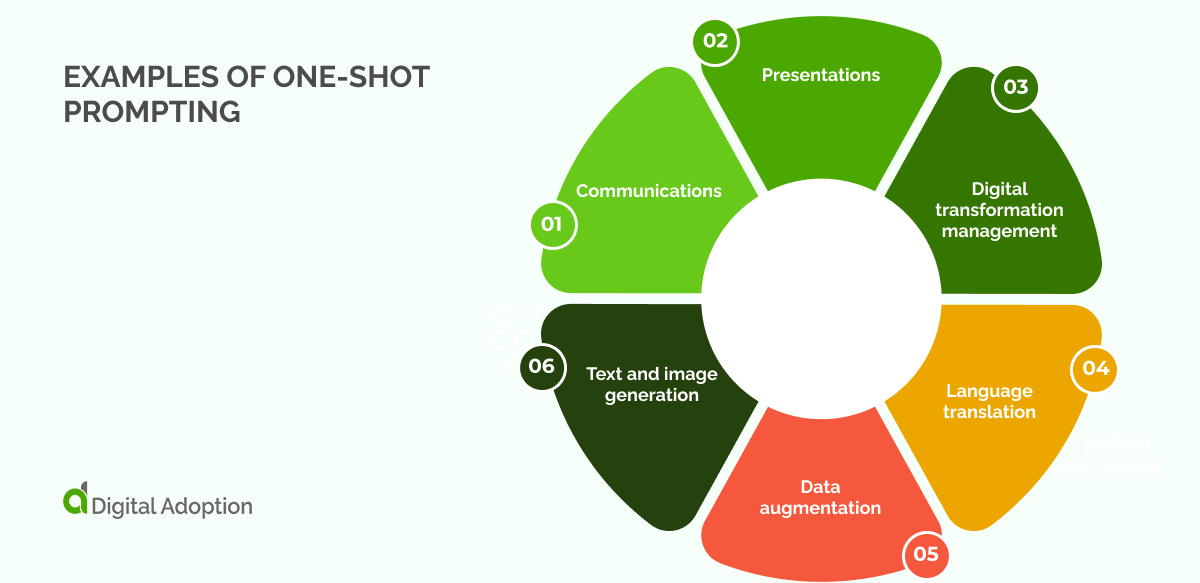
One-shot prompting has vast potential and can enhance AI in many ways.
Popular AI models include ChatGPT, Gemini, Claude, Llama, and Mistral. These are faster and more accurate than others.
These AI platforms are causing big changes. How can they do more with just one prompt?
Let’s explore some examples.
Communications
One-shot prompting helps with business writing. The AI quickly grasps tone, purpose, and format. The prompt provides context, and the AI then creates a suitable response.
Example prompt: “Write a formal follow-up email. Thank clients for the meeting. Summarize key points. Show the benefits of moving forward. Suggest a contract timeline.”
This single prompt guides the AI. It specifies tone, content, and next steps. The AI understands these parts. It creates a polished response. No further explanation is needed.
Presentations
AI can now create presentation outlines quickly. One-shot prompting makes this possible. A clear, prompt structure is crucial. The AI then maps out slides and content efficiently.
Example prompt: “Create a five-slide sales review outline. Include: introduction, revenue analysis, market trends, team performance, challenges, and future actions.”
This prompt is comprehensive. It specifies slide count and topics. The AI recognizes common presentation patterns. It produces a logical, structured outline. No additional input is required.
Digital transformation management
One-shot prompts are useful in digital transformation management. They can instantly generate timelines, tasks, or updates. The AI understands workflow structures. It provides clear, actionable results from one input.
Example prompt: “Develop a mobile app project timeline. Include research, design, coding, testing, and launch phases. Estimate timeframes for each.”
The AI recognizes app development stages, uses its knowledge to estimate timelines, and understands project durations and dependencies—all from a single prompt.
Language translation
One-shot prompts excel in translation tasks. A single input guides the AI. It interprets content and translates with appropriate tone and context.
Example prompt: “Translate to formal French: ‘We’re excited to offer our new product line. It’s designed to boost your efficiency and cut costs.”
The AI doesn’t translate word-for-word. It considers the formal business tone. It adjusts for language differences. The translation maintains the original meaning. Cultural nuances are respected.
Data augmentation
Data augmentation often needs varied examples. One-shot prompting helps here. It lets AI create diverse examples, improving dataset robustness.
Example prompt: “Create five variations of this review: ‘This vacuum cleaner is powerful, quiet, and easy to use.'”
The AI identifies key points. It creates variations with similar sentiments. It uses different phrases and structures. The dataset is augmented without losing meaning. The results are immediately usable.
Text and image generation
One-shot prompts streamline content creation, including text and image generation for marketing. The AI understands requirements and produces creative outputs accordingly.
Example prompt: “Write a post promoting an eco-friendly water bottle. Focus on sustainability. Describe an image: a recycled bottle in a natural setting.”
The AI grasps the promotional purpose, focusing on eco-friendly themes. It generates suitable copy and creates a fitting image description, all of which happens in one step.
One-shot prompting use cases
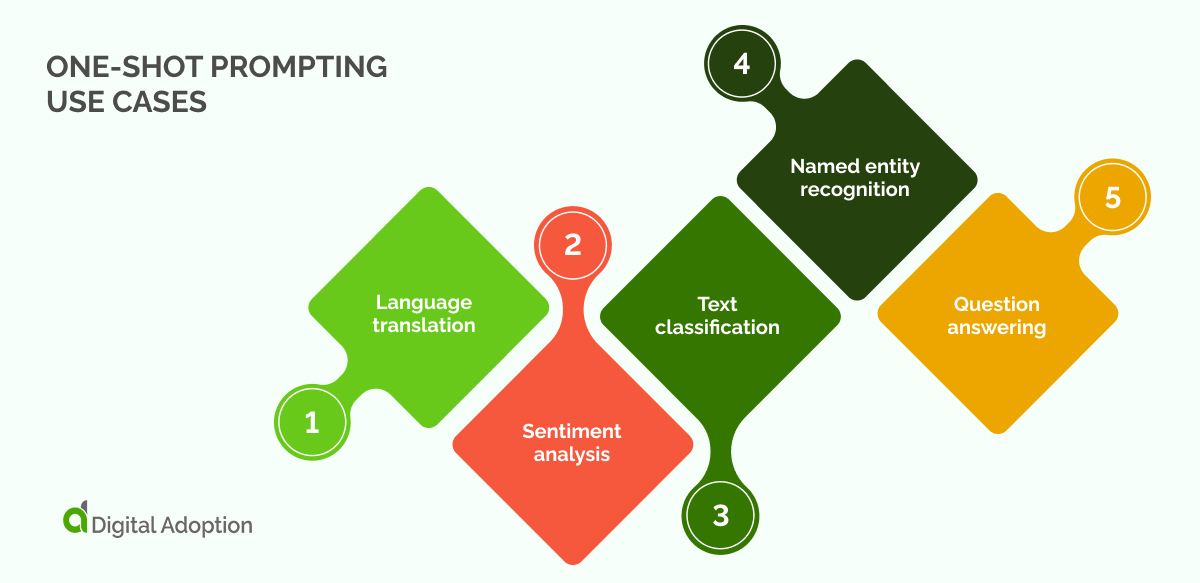
One-shot prompting has many applications. Each technique targets specific needs. These solutions are widely applicable once fine-tuned.
Let’s explore top use cases for one-shot prompting.
Language translation
One-shot prompting has transformed translation. AI can now adapt quickly to new language pairs and handle specialized domains well.
Just one example allows AI to grasp context and nuances, making translations more accurate and appropriate. This is valuable for expanding businesses, and quick content localization is crucial in new markets.
Online stores benefit greatly. They can translate product descriptions fast, and brand messaging stays consistent globally. Diplomatic communications also improve. One-shot prompting aids in the real-time translation of sensitive content.
This agility in translation has a big impact and improves cross-cultural communication. This often speeds up global business operations.
Sentiment analysis
One-shot prompting enhances sentiment analysis. Businesses can gauge public opinion better. Customer satisfaction insights become more accurate.
A single classification example is powerful. AI adapts to industry jargon and context, leading to more precise insights.
Social media monitoring has become more effective, and brands can analyze reactions quickly. New product launches get immediate feedback, and marketing campaigns are assessed faster.
The financial sector also benefits when market sentiment analysis becomes rapid, news articles are processed efficiently, and financial reports aid investment decisions.
Customer service also improves because feedback is categorized automatically. Issues are prioritized more effectively, and responses are targeted more effectively.
Text classification
One-shot prompting has greatly improved text classification. Documents across various fields can be categorized rapidly.
Just one example is enough. AI applies classification criteria to large text volumes, saving time and resources in data organization.
Legal contexts benefit significantly, and case documents are categorized quickly. Relevant legal precedents are identified faster.
Content management systems improve. Articles are tagged and organized efficiently, which enhances searchability and user experience.
Healthcare institutions use this, too. Medical records, research papers, and patient feedback are classified swiftly, streamlining information retrieval and analysis.
This democratizes advanced capabilities. Organizations of all sizes can access powerful text classification.
Named entity recognition
One-shot prompting has transformed Named Entity Recognition (NER). AI can now identify and categorize named entities with minimal setup.
This is crucial for information extraction, making unstructured data more manageable.
Journalism uses this effectively. Key people, organizations, and locations in news articles are quickly identified, making fact-checking easier.
Financial institutions leverage this for compliance. They extract relevant entities from documents efficiently, and risk management improves.
Scientific research accelerates. Papers quickly identify genes, proteins, and chemical compounds. Literature reviews also become faster, and hypothesis generation improves.
One-shot NER adapts to specific domains easily. This enhances information extraction across diverse fields.
Question answering
One-shot prompting has revolutionized question-answering systems. AI provides accurate, relevant responses with minimal training.
Customer support transforms, and chatbots adapt to new inquiries quickly. Response times improve, and customer satisfaction increases.
Education also benefits greatly. Adaptive learning systems are created easily. They answer student queries across various subjects. Learning experiences become personalized.
Research and development teams work faster. Information retrieval from technical documents improves.
Healthcare sees significant improvements. Medical professionals can access information quickly, and vast databases have become more manageable.
Knowledge becomes more accessible across industries. Information sharing improves. Problem-solving capabilities are enhanced.
One-shot vs. zero-shot vs. few-shot prompting
AI training uses various prompt engineering methods. These include one-shot, few-shot, zero-shot, and chain prompting.
Each method tests different input training approaches. They aim to create versatile AI solutions. Let’s explore these in detail.
One-shot prompting
This method uses a single example. The AI completes actions based on this one reference. It balances zero-shot and few-shot approaches.
Goal: Guide AI with one input. Maintain relevance and accuracy.
Zero-shot prompting
This asks AI to respond without examples. It relies on existing knowledge. It’s fast and simple. However, accuracy may drop in complex situations.
Goal: Generate responses without prior examples. Use pre-existing training only.
Few-shot prompting
This gives AI several examples. It helps recognize patterns. Responses are more refined. Accuracy is high, but more input is needed.
Goal: Provide context and examples. Produce refined, relevant outputs.
One-Shot vs. Zero-Shot vs. Few-Shot Prompting: Comparison Table
One-shot prompting sits between two related techniques — zero-shot and few-shot prompting — each suited to different tasks and model behaviors. Understanding where one-shot fits helps you choose the right approach before you write a single token.
| Dimension | Zero-Shot | One-Shot | Few-Shot |
| Examples provided | 0 | 1 | 2 or more |
| Best for | Well-defined, common tasks | Moderate complexity, format-sensitive tasks | Nuanced, ambiguous, or specialized tasks |
| Token cost | Lowest | Low | Higher |
| Output consistency | Variable | Moderate | High |
| Risk of overfitting to example | None | Low | Moderate |
| Typical use case | Summarization, Q&A | Classification, translation, formatting | Code generation, legal drafting, data extraction |
Zero-shot prompting relies entirely on the model’s pre-trained knowledge. It works well for straightforward tasks — “Summarize this paragraph” — but struggles when format or tone precision is required.
One-shot prompting provides a single example that anchors the model’s output format and style. This is often enough to improve consistency without dramatically increasing prompt length or cost.
Few-shot prompting provides multiple examples, which is ideal when the task is complex, the output format is strict, or the domain is specialized. The trade-off is higher token consumption and a risk of the model overfitting to the style of the examples rather than the underlying instruction.
For most content-generation, classification, and translation tasks, one-shot prompting offers the best balance of quality and efficiency.
One-Shot Prompting: Prompt Templates & Code Examples
Seeing one-shot prompting in practice is the fastest way to internalize the technique. Below are two ready-to-use templates — one in plain-English prompt format, one as a Python code example using the OpenAI API.
Plain-English Template — Sentiment Classification
`
Classify the sentiment of the following customer review as Positive, Negative, or Neutral.
Example:
Review: “The onboarding was seamless and the support team responded within minutes.”
Sentiment: Positive
Now classify this review:
Review: “The software crashed twice during my first week and I lost unsaved work.”
Sentiment:
`
Python Example — OpenAI Chat Completions
“`python
from openai import OpenAI
client = OpenAI()
response = client.chat.completions.create(
model=”gpt-4o”,
messages=[
{
“role”: “system”,
“content”: “You classify customer reviews as Positive, Negative, or Neutral.”
},
{
“role”: “user”,
“content”: (
“Example:\n”
“Review: ‘The onboarding was seamless and support responded within minutes.’\n”
“Sentiment: Positive\n\n”
“Now classify:\n”
“Review: ‘The software crashed twice during my first week and I lost unsaved work.’\n”
“Sentiment:”
)
}
]
)
print(response.choices[0].message.content)
`
The key principle: place your example immediately before the actual task, using identical formatting. The model treats the example as the template it must follow — so formatting consistency between your example and your real input is critical.
When NOT to Use One-Shot Prompting (Limitations & Failure Modes)
One-shot prompting is powerful, but it is not the right tool for every task. Knowing when it underperforms helps you avoid wasted iterations and poor-quality outputs.
1. When the task is highly ambiguous. A single example cannot cover the full range of edge cases in a complex task. If you are extracting structured data from unstructured legal contracts, for instance, one example is rarely enough to communicate all the formatting rules, exception conditions, and field mappings required. Use few-shot prompting or a structured system prompt instead.
2. When example selection is biased. Your one example becomes a strong prior for the model. If your example happens to be unusually formal, unusually long, or from a narrow domain, the model will skew its output accordingly — even when the actual input differs. Review your example carefully before relying on it at scale.
3. When the task is already well-understood by the model. For common tasks like basic summarization, answering factual questions, or simple translations between major languages, zero-shot prompting typically performs just as well and uses fewer tokens. Adding a one-shot example in these cases adds cost without improving quality.
4. When output format flexibility is needed. If you want the model to adapt its output structure depending on the input content, a rigid one-shot example can actually constrain that flexibility. In those cases, describe the desired behavior in the system prompt rather than demonstrating it with a single example.
The right technique depends on your task complexity, format requirements, and token budget — not a fixed rule about which approach is “best.”
The impact of one-shot prompting
One-shot prompting is now key in AI and is changing how businesses use AI technologies.
It reduces implementation time and resources and allows tasks to be performed with minimal examples. This impacts various industries, especially with the introduction of AI-as-a-service.
Healthcare sees faster data analysis, finance detects fraud more effectively, customer service adapts to new inquiries quickly, and marketing teams create targeted content efficiently.
AI is integrating into business operations. One-shot prompting makes AI more accessible, and companies of all sizes benefit.
The bottom line? You don’t need extensive data or expertise.
This One-shot prompting drives innovation, improves decision-making, and reshapes business problem-solving for AI-driven solutions.
FAQs
What is an example of one-shot learning?
An example of one-shot learning is a facial recognition system that can identify a person after seeing just one image of their face. This contrasts with traditional machine learning, which typically requires many examples to learn a new concept.
What does one-shot prompting refer to in the context of LLMs?
What does one-shot prompting refer to in the context of LLMs? One-shot prompting for LLMs involves providing a single example of a task or output format to guide the model’s response. It allows the LLM to understand and perform a new task with minimal instruction, increasing versatility and efficiency.
What is the one-shot technique?
What is the one-shot technique? The one-shot technique is a machine-learning approach where a model learns to perform a task or recognize a pattern from a single example. It’s used in various applications, including image recognition, natural language processing, and robotics, to enable quick adaptation to new scenarios.
People Also Ask
-
How does one‑shot prompting support rapid prototyping in AI initiatives?One‑shot prompting enables teams to prototype quickly by requiring only a single, well‑crafted example—saving time and reducing dependency on large datasets or lengthy model retraining cycles.
-
Why is the quality of the single example critical in one‑shot prompting?Because performance hinges on that one example, it must clearly represent the desired structure, tone, and logic; otherwise, the model may misinterpret the task or produce inconsistent outputs.
-
When should organizations prefer one‑shot prompting over few‑shot or zero‑shot methods?Use one‑shot prompting when tasks are moderately complex and ambiguous instructions benefit from example clarity—but data is still limited or speed is essential.
-
What if an AI system misinterprets a one‑shot prompt—what’s a practical recovery strategy?In such cases, iteratively refine or replace the example with a clearer, more representative one—or consider few‑shot prompting for broader guidance.