FACT CHECKED
What is AI training, and why does it matter now?
AI training is the process of building the knowledge and skills people need to use, evaluate, or develop artificial intelligence tools effectively. For an individual learner, that may mean understanding how generative AI works, writing better prompts, or learning machine learning concepts. For an enterprise team, it usually means something broader: helping employees use AI safely, productively, and consistently inside real business workflows.
That distinction matters. AI literacy is not the same as technical AI development. Most employees do not need to build models from scratch. They need to know what AI can and cannot do, how to use approved tools responsibly, and how to apply them in daily work. Technical teams, by contrast, may need deeper training in model evaluation, APIs, data pipelines, automation, and deployment.

AI training has moved from optional upskilling to an operational priority because organizations are already deploying copilots, workflow automation, and generative AI features across enterprise software. The challenge is no longer whether AI will appear in the stack. It is whether employees can use it well enough to produce value.
When AI readiness is low, the business impact shows up quickly:
- AI tools are available but underused
- Outputs are inconsistent and require heavy rework
- Employees create governance and privacy risk without realizing it
- Managers struggle to standardize usage across teams
- Productivity gains remain theoretical rather than measurable
So the practical question is not simply whether to invest in AI training. It is this: what type of AI training fits your role, your goals, and your organization’s use cases?
The main types of AI training
AI training generally falls into five categories:
- AI literacy training
Covers foundational concepts, common terminology, realistic capabilities, and limitations. This is often the right starting point for broad employee populations. - Prompt and workflow training
Focuses on using generative AI tools effectively in everyday work. That includes prompt quality, task framing, output review, and workflow integration. - Technical AI training for developers and data teams
Includes machine learning, model selection, evaluation, deployment, orchestration, APIs, and automation. - Role-based business training
Teaches how AI applies to a function such as HR, IT, customer service, operations, marketing, or finance. - Responsible AI education
Covers governance, privacy, bias, compliance, approval policies, and human oversight.
Who needs AI training most
Nearly every enterprise function now needs some level of AI training, but the depth varies by role:
- Employees need practical guidance on approved tools, safe usage, and task-level application
- Managers need to evaluate output quality, coach teams, and identify high-value use cases
- IT leaders need training tied to governance, deployment, risk, and adoption across systems
- HR and L&D teams need frameworks to build scalable learning programs and measure capability growth
- Specialists and career changers may need deeper training if they are evaluating AI-related job paths or reskilling into technical or analytics roles
How to choose the right AI training path
The right AI training path depends on four factors: your current skill level, the role you want to perform, the business problems you need to solve, and the time you can realistically invest.
A common mistake is overinvesting in advanced technical content when the real need is practical proficiency. Someone who wants to improve document drafting, research support, or service response quality does not necessarily need a deep course in neural networks. They need training that improves performance in their actual workflow.
Most AI training options fall into four formats:
- Self-paced learning for flexible foundational knowledge
- Instructor-led programs for structured learning and live feedback
- Certification tracks for formal validation and resume signaling
- On-the-job enablement for applying skills inside real tools and workflows
Search behavior often reflects this uncertainty. People look for terms like ai courses online free, artificial intelligence free course with certificate, or google artificial intelligence course online free with certificate because they want a low-risk way to start. That can be useful, but only if the training matches the intended outcome.
A practical decision framework looks like this:
- If you are new to AI and need broad understanding, start with AI literacy
- If your team already has access to AI tools, move quickly into prompt and workflow training
- If you are building or integrating AI systems, invest in technical training
- If your organization is rolling out AI-enabled software, pair formal learning with in-workflow guidance
Beginner AI training for non-technical learners
For non-technical learners, the best starting point is not advanced machine learning. It is practical competence.
A good beginner path should include:
- AI fundamentals and key terminology
- Common enterprise use cases
- Prompt quality and task framing
- Data privacy basics
- Responsible use and escalation rules
Only after that foundation is in place should learners move into tool-specific workflows or platform training. This sequence reduces confusion and helps employees understand not just how to use AI, but when to trust it, when to verify it, and when not to use it at all.
AI training for technical teams
Developers, analysts, and data professionals need deeper training when they are responsible for building, integrating, evaluating, or governing AI solutions.
That typically includes:
- Machine learning concepts and model tradeoffs
- Model evaluation and testing
- API usage and orchestration
- Workflow automation
- Deployment and monitoring concepts
- Data quality and system integration
The key is relevance. Technical teams should focus on the skills required by the organization’s actual architecture and use cases, not generic content that never reaches production.
Free courses vs paid certificates
Free learning is often enough for early exploration, baseline literacy, and initial skill building. It is a sensible choice for employees who need orientation before adopting enterprise AI tools.
A certificate can help when:
- a learner wants structured progression
- a manager needs a formal completion signal
- a role change requires evidence of sustained learning
But employers often value applied work more than course volume alone. A learner who can show improved workflow performance, documented use cases, or practical project outcomes may be more credible than someone with multiple certificates and little evidence of real execution.
What good AI training should include
Effective AI training combines five elements: foundational concepts, hands-on practice, role relevance, governance guardrails, and measurable outcomes.
That matters because one-time training often fails. Employees attend a session, complete the course, and then return to a workflow where the tool appears with little reinforcement. At that point, confidence drops, usage becomes inconsistent, and people revert to old habits.
Enterprise teams should connect AI training to specific workflows such as:
- content creation
- service operations
- HR support
- analytics
- software onboarding
Training quality should be judged by improved performance, adoption, and confidence, not course completion alone.
Core curriculum areas
A strong AI training curriculum should cover:
- AI basics and key terminology
- Generative AI capabilities and limits
- Prompt design and task instruction
- Data handling and privacy expectations
- Bias, compliance, and review requirements
- Tool-specific workflows
- Output validation and quality control practices
This mix helps employees move from abstract understanding to consistent execution.
From classroom learning to workflow adoption
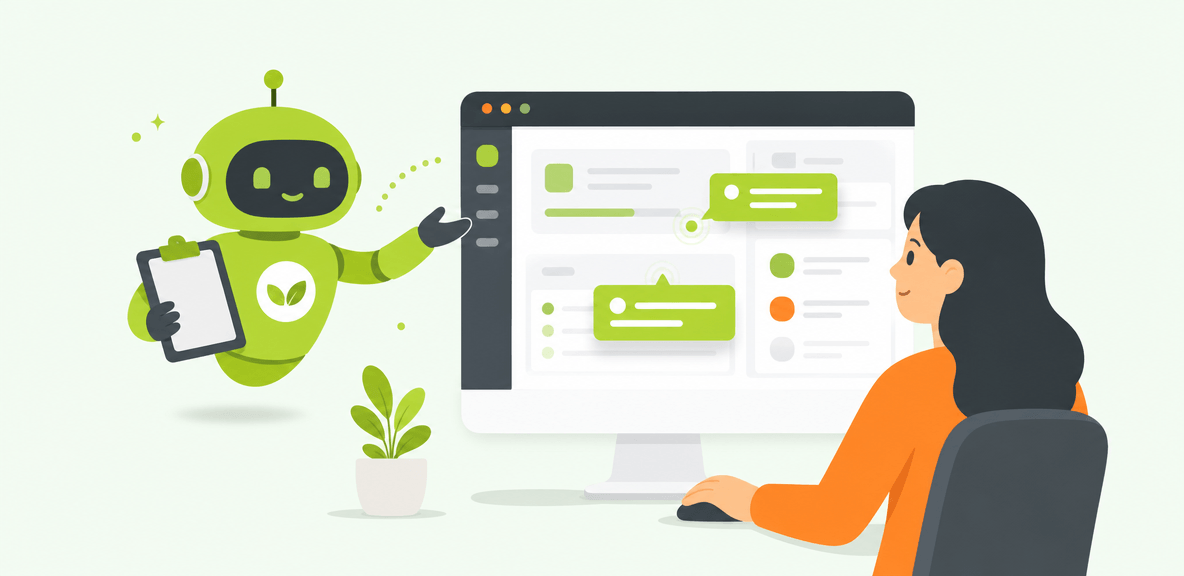
Employees retain more when guidance appears in the moment of use. That is especially true during new process rollouts or AI-enabled software adoption, where the gap between training and execution can be costly.
Traditional learning methods help build awareness. But when employees are trying to complete a live task, contextual support often matters more than what they learned weeks earlier. In practice, adoption improves when the organization reinforces training inside the application or workflow where the work happens.
How enterprises can reinforce AI training at scale
Enterprises can reinforce AI training through:
- contextual guidance inside applications
- embedded tips for approved AI usage
- just-in-time support during complex tasks
- analytics that show where users struggle after training ends
This is where digital adoption capabilities become relevant. For organizations rolling out AI-enabled software across large teams, in-app guidance can help translate training into consistent workflow execution. WalkMe, for example, supports in-app guidance, contextual help, and analytics that help teams understand where users need reinforcement inside enterprise applications.
How to measure ROI from AI training
AI training should be treated as a business investment, not a learning event. The return typically shows up in productivity, quality, adoption, risk reduction, and faster time-to-competency.
A practical measurement model starts by selecting a few workflows where AI should improve performance. Then define what success looks like, establish a baseline, and measure changes over time.
Useful metrics include:
- task completion time
- error or rework rates
- tool utilization
- support volume
- employee confidence
- manager-reported productivity changes
The strongest ROI usually comes when training is tied to defined workflows, clear success metrics, and ongoing reinforcement after the formal course ends.
Metrics that matter for enterprise teams
For enterprise leaders, the most useful measures often include:
- Time-to-productivity: how quickly employees become effective with AI-enabled tasks
- Reduction in repetitive work: time saved on recurring activities
- Fewer support tickets: less confusion after rollout
- Improved policy compliance: better adherence to approved usage standards
- Stronger adoption of AI-enabled software: increased utilization of licensed tools and features
Common mistakes in AI training measurement
The most common mistake is relying only on attendance, completion rates, or test scores. Those metrics show exposure, not behavior change.
A second mistake is measuring training in isolation from workflow performance. If output quality, cycle time, or support demand does not improve, the business impact is likely limited regardless of how many people completed the course.
Realistic expectations: what AI training can and cannot do
AI training can improve readiness, confidence, and execution. It cannot, by itself, fix broken processes, poor data quality, or weak governance.
That distinction is important. Some organizations assume training alone will solve adoption problems. In reality, employees also need clear policies, sensible workflows, approved tools, and practical reinforcement.
There are other limits as well:
- AI models and interfaces change quickly
- employee confidence varies widely
- learning needs differ by role
- certification does not guarantee strong real-world performance
Readers searching for ai training job opportunities should keep this in mind. General AI literacy programs can open the door, but many AI-related roles also require portfolio work, domain expertise, technical depth, or documented project experience.
Organizations should therefore treat AI training as an ongoing capability-building program, not a one-time event.
When AI training falls short
AI training tends to underdeliver when:
- policies are unclear
- workflows are not redesigned for AI use
- employees are expected to use tools without in-context support
- managers do not reinforce standards and use cases
In those conditions, training may raise awareness but fail to change behavior.
When to consider a digital adoption approach
If your organization is rolling out AI-enabled applications at scale, formal training may need to be supplemented with a digital adoption approach. In-app guidance and usage analytics can help reinforce training inside real workflows, especially when employees are learning new processes while also adopting new software features.
This approach is often worth evaluating when the challenge is not awareness alone, but consistent execution across large user groups.