FACT CHECKED
Innovations and bespoke solutions, including unique software, AI tools, and anything-as-a-service (XaaS), mean no two product offerings will be priced the same.
Pricing new and novel products for a range of customers and businesses, each with distinctive demands and preferences, can be highly complex.
CPQ (Configure, Price, Quote) software is designed to handle these pricing complexities, ensuring that, no matter how unique product solutions become, the final sticker price is reflected correctly.
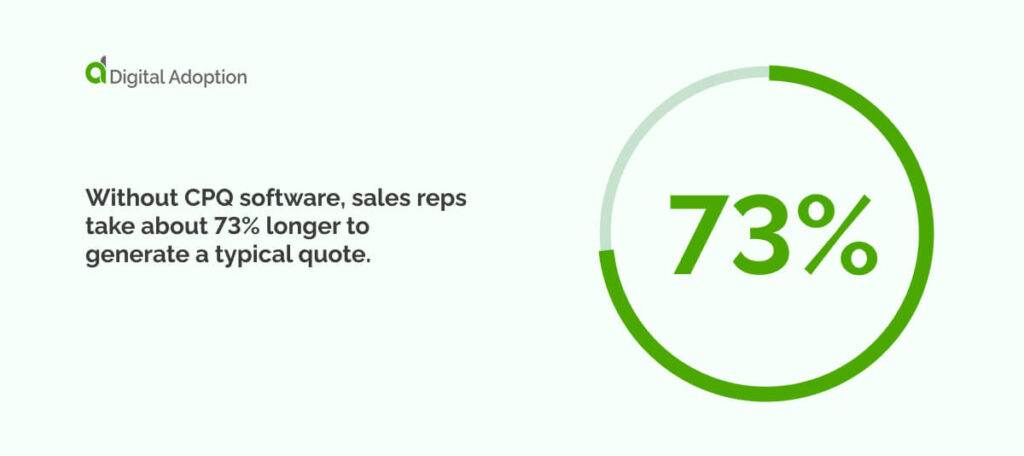
Without CPQ software, sales reps take about 73% longer to generate a typical quote. This shows how manual pricing directly slows the sales process.
This article explores CPQ software, including cost, must-have features, and how to evaluate the best platforms for the job.
What is Configure, Price, Quote (CPQ) software?
Configure, Price, Quote (CPQ) software is a key tool for setting product pricing and configurations and generating precise quotes. It’s a long-standing business process used primarily by sales operations for pricing and quoting custom products and services.
Pricing data from configured quotes informs quantitative forecasts of spend, revenue, and financial performance. It covers the end-to-end quote-to-cash process and governs each stage of the sales cycle, from ordering and customizations to quote calculations and final payment.
CPQ processes are already prevalent in business-to-consumer (B2C) environments, such as customizing your order at Starbucks or McDonald’s. It’s especially crucial, however, for pricing business-to-business (B2B) products such as software-as-a-service (SaaS).
The distinct objectives of a business mean subscription-based software can be configured and priced in nearly infinite ways.
This may require continually adjusting for business size, scaling users, increasing usage, adding features, or increasing data storage. For sales reps, using a static rule sheet to manually price solutions just won’t cut it.
CPQ platforms can automatically assess these dynamic variables and accurately calculate a fair, reflective final price.
Who uses CPQ software?
You might be surprised to learn that CPQ software isn’t just used by sales reps. While sales teams are the most visible users, CPQ supports anyone involved in pricing, configuration, and revenue decisions. Here are the most common users of CPQ software:
Sales teams
Sales reps are the most common CPQ users, relying on it to configure products correctly, apply approved pricing, and generate accurate quotes. CPQ removes the need to manually check price lists or discounts, reducing uncertainties during live customer conversations.
Sales operations/revenue operations
Sales and revenue operations teams use CPQ to enforce pricing, approval workflows, and discount thresholds. The system gives them visibility into quote activity and sales behavior, helping maintain control as volume grows.
Product and pricing managers
Product and pricing managers rely on CPQ to model pricing structures, bundles, and configurations without constant sales intervention. CPQ allows them to test changes safely, roll out updates consistently, and ensure new products are priced correctly from day one.
Customers
In self-service or assisted selling models, customers interact directly with CPQ through guided configuration and transparent pricing. This gives buyers clarity on options, costs, and constraints without waiting for manual quotes.
How does CPQ software work?
We’ve briefly discussed what CPQ software is and who uses it, but by taking a closer look at this three-part process, we can see exactly how each stage contributes to a complete and reliable sales process:
| Stage | Focus | What it controls | Why it matters |
| Configure | Product validity | What can and cannot be sold together | Prevents sales from offering options that cannot be delivered |
| Price | Commercial accuracy | How value converts into revenue | Protects margins while keeping pricing responsive |
| Quote | Commitment | What is formally offered to the customer | Turns internal decisions into a trusted external agreement |
Configure
Configuration is the stage at which customizations and unique specifications are applied to a product or service. Companies select the product components and features they want, along with available customization options.
CPQ applies predefined rules and constraints to prevent infeasible or incompatible functions, such as blocking overlaps or conflicting modules. The software ensures valid configurations while calculating complementary items and suitable add-ons.
Price
The pricing stage is where the total price for all configurations and customizations is calculated. This is the natural next step after configuration, but CPQ real-time calculations mean prices auto-shift when configurations are entered into the system.
The system will adjust pricing as long as baseline component costs are set. At this stage, pricing parameters can be adjusted to ensure that any discounts, markups, and promotions are reflected correctly.
Quote
Quotes bring configuration and pricing together into a customer-ready document. CPQ automatically generates a quote using approved templates, terms, and branding, removing the need for formatting or cross-checking.
Quotes reflect the latest pricing and contract conditions, ensuring accuracy before anything is sent to the customer. This step shortens turnaround time and builds confidence in the offer for both sales teams and buyers.
What are the most essential CPQ features?
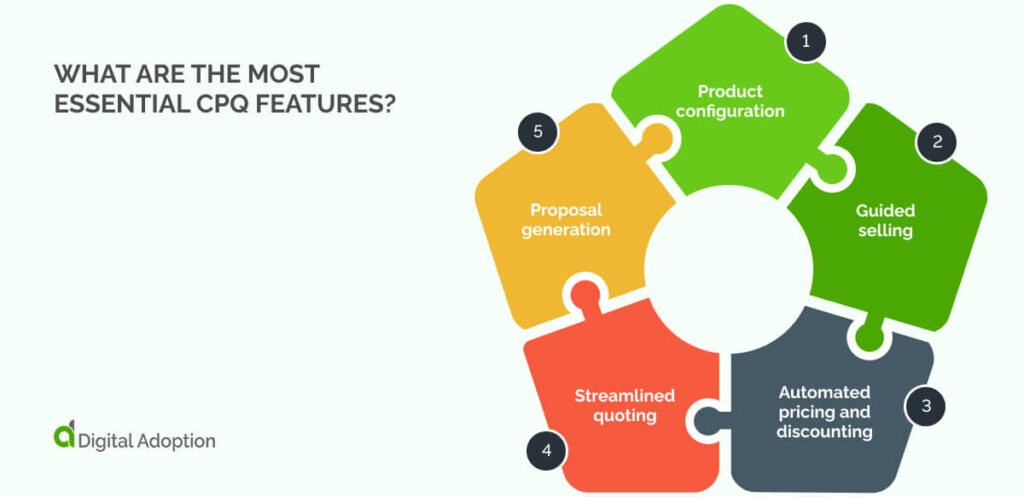
Understanding which CPQ features matter most is essential when pricing rules, products, and customer expectations all vary. The right capabilities determine whether CPQ supports selling or becomes another layer of complexity:
- Product configuration: CPQ limits choices to approved combinations, preventing teams from selecting options that conflict or cannot be delivered. This keeps complex products consistent and reduces confusion as offerings expand or change.
- Guided selling: Sales reps are guided through decisions in a clear, customer-needs-based order. The system helps surface the right options at the right moment, even when products, pricing, or rules vary.
- Automated pricing and discounting: Pricing adjusts as selections change, with discounts applied within agreed limits. It keeps quotes aligned with commercial rules while giving sales teams flexibility during conversations.
- Streamlined quoting: All quote details are consolidated in one place, using approved formats that shorten turnaround time and help teams respond with confidence.
- Proposal generation: Final offers are presented in consistent, professional layouts that reflect the agreed configuration and price. Customers then receive clear proposals that are easy to review and approve.
What are CPQ pricing models + examples?
So, how much does CPQ software cost? Below, we explore the most widely available pricing models set by CPQ vendors. As with all CPQ solutions, the final price will be highly configurable and dependent on your business’s unique objectives.
All figures are shown in USD; local-currency pricing may vary and should be verified to reflect regional differences.
| CPQ software | Core or entry pricing | Mid-market pricing | Enterprise pricing |
| Salesforce CPQ | CPQ – $75 per user per month | CPQ+ – $150 per user per month | Custom |
| Oracle CPQ | $240 per month | Not available | Custom |
| SAP CPQ | Standard – $99 per user per month | SAP Commerce add-on – $11,658 per month | Custom |
| DealHub CPQ | CPQ+ – Custom | CPQ + CLM – Custom | Quote-to-revenue – Custom |
| Conga CPQ | Salesforce AppExchange – $35 per user per month | $85 per user per month | Custom |
| PROS Smart CPQ | Essentials – $60 per user per month | Advantage – $75 per user per month | Not available |
| Zuora CPQ | $75,000 per year | $175,000 per year | $250,000+ per year |
| IBM Sterling CPQ | $703 per feature per year | Custom | Custom |
| ConnectWise CPQ | $89–99 per user per month | Custom | Custom |
These prices are based on 2025 market research and are subject to change at the vendor’s discretion. For accuracy, confirm current pricing directly with each provider and request a tailored quote.
Do you need a CPQ platform for your business?
Deciding whether your business needs a CPQ platform isn’t about technology for technology’s sake.
Most firms today operate with diverse product portfolios, complex pricing structures, and multiple customer segments. Sales processes work innately when quoting requires checks, approvals, and bespoke options.
Research shows that organizations that adopt CPQ report up to a 30 % reduction in pricing errors and faster quote turnaround times, improvements that directly protect revenue and strengthen digital trust.
CPQ also plays a strategic role beyond speed and performance. It provides a single reference point for product definitions, pricing strategies, and contract terms, reducing contention between sales, finance, and operations.
As customer expectations for tailored solutions grow, a CPQ platform helps ensure offers are both profitable and competitive.
Choosing the right system is therefore among the most critical decisions a business can make, as it affects efficiency, margins, and the consistency of every deal closed.
How to evaluate CPQ software solutions
The next step is to assess the CPQ platforms you have benchmarked, a process that becomes far more manageable when you evaluate each option against a clear, consistent set of criteria. Here is how to assess CPQ software solutions:
Scalability and performance
CPQ should develop in the background as your business expands. Scrutinize performance and consider peak usage, complex deal structures, and future product growth.
A platform that slows down under pressure will quickly become a blocker rather than a support. Strong performance means quotes load quickly, rules apply quickly, and you can work without interruption, even during busy sales cycles or rapid expansion.
Integration depth and data fidelity
CPQ software rarely works in siloed environments. It must exchange data cleanly with CRM, billing, finance, and product systems. The real test is not whether an integration exists, but whether information stays consistent as it moves between tools.
Poor data alignment leads to pricing mismatches and gaps in reporting. A well-integrated CPQ keeps product details, customer data, and revenue figures aligned across the business.
Rules governance and maintainability
Pricing and configuration rules change more often than most expect. The key here is to evaluate how easy it is to update logic without breaking existing deals or relying on technical specialists.
Strong governance means directions are transparent, traceable, and controlled, with visibility into who changed what and why. A maintainable system allows pricing teams to adapt quickly without introducing risk or confusion.
User experience and sales adoption
User experience (UX) is often overlooked in CPQ software. The experience should feel intuitive and easy to grasp rather than instructional.
Look for clean guidance, minimal clicks, and workflows that match how sales conversations unfold. When CPQ supports rather than interrupts selling, digital adoption becomes innate.
High usage is often the clearest signal that a platform aligns with the realities of sales work.
Pricing transparency and contract terms
Understanding what you are paying for matters just as much as the software itself. Review how CPQ pricing scales, what features are included, and where additional costs may appear.
Clear contract terms reduce surprises later, especially around renewals, support, and usage limits. A transparent pricing model makes it easier to forecast spend and ensures the platform remains viable as needs inevitably evolve.
Roadmap maturity and vendor stability
One of the most important takeaways here is that CPQ is not a short-term investment. Assess whether the vendor has a clear product direction and a track record of delivering meaningful updates.
A stable provider with a mature roadmap signals long-term support, regulatory readiness, and ongoing improvement. Choosing a vendor that continues to invest in its platform helps protect your implementation and keeps the solution relevant as your business evolves.
How to implement CPQ software
After evaluating CPQ solutions, the next step is implementation, where decisions move from planning into use. This stage demands care, as missteps here can undermine platform choice and limit long-term value. Here is how to implement CPQ software:
| Implementation stage | Primary owner | Readiness check |
| Map current workflows | Sales operations | Are all quote paths visible, including edge cases and handoffs? Has ownership been confirmed for each decision point? |
| Design the configuration model | Product and pricing | Do product choices reflect how customers evaluate options? Are dependencies obvious enough to navigate during live conversations? |
| Build pricing and rules | Finance | Can pricing outcomes be anticipated without explanation? Are boundaries clear enough to support confident deal progression? |
| Engineer integrations | IT and systems teams | Does information arrive where it is needed, when it is required, without re-entry or reconciliation? |
| Automate selling and approvals | Sales leadership | Do routine deals progress without delay while complex ones surface at the right moment? |
| Test and validate | Cross-functional team | Have uncommon or high-pressure deals been completed without confusion or rework? |
| Launch and govern | Business owner | Is a long-term owner accountable for accuracy? Are review moments defined to keep CPQ aligned as offerings evolve? |
Map current workflows
Begin by watching how quotes move through the business in practice, from first conversation to final sign-off. This reveals where decisions slow, where judgment is needed, and where momentum is lost, giving CPQ a clear role that reflects how teams operate rather than how processes were once imagined.
Design the configuration model
The configuration should mirror how customers think about the offer, not how systems prefer to structure it. When options are grouped logically and dependencies are clear, CPQ is easier to navigate. This is especially true during live conversations, which keep it flexible enough to accommodate variation without forcing sales teams to explain internal constraints.
Build pricing and rules
Pricing logic works best when it conveys commercial intent in a way that is predictable to users. Clear thresholds create confidence during deal creation, allowing sales teams to move forward knowing outcomes remain consistent even as deal structures grow more complex.
Engineer integrations
Integration decisions should align with the flow of information throughout the revenue lifecycle. When CPQ exchanges data with the right systems at the right moments, it supports continuity from early pricing through billing and fulfilment. This reduces disconnects that often appear after a deal has already been agreed.
Automate selling and approvals
Approval paths preserve sales momentum without removing oversight. This means straightforward deals progress naturally, while more complex scenarios receive attention only when needed. It creates a balance that supports pace while maintaining confidence in how offers are reviewed and approved.
Test and validate
Testing should reflect the reality of selling rather than ideal scenarios. Running complex and uncommon deals through CPQ exposes gaps that only surface under pressure, ensuring the system is clear and at pace when decisions matter most.
Launch and govern
Remember that implementation does not end at launch. Ongoing ownership ensures CPQ evolves alongside products and pricing. It does this by keeping the system aligned with business intent and preventing gradual drift that can undermine trust over time.
How the right CPQ software can impact the bottom line
Taking the complexity out of CPQ software isn’t as complicated as you might think. However,
the last thing you want to do is rush the implementation and risk ending up with an overpriced, underperforming platform.
As you know, CPQ software should work in tandem with sales processes and the wider revenue engine, reinforcing pricing discipline, shortening deal cycles, and protecting margins with every quote that reaches a customer.
The easiest way to ensure the CPQ software is working as intended is to anchor decisions to the evaluation criteria and implementation steps already outlined earlier in the article.
Become a subject matter expert and ask whether the platform mirrors commercial decision-making and supports future change without rework.
Doing so harmonizes the sales discovery process and genuinely earns trust at the point of pricing, where commercial integrity decides whether revenue is won or lost.
People Also Ask
-
Can CPQ integrate with existing CRM systems?Yes. Most CPQ platforms are designed to connect directly with popular CRM systems, keeping customer details, products, and quotes in sync. This keeps sales conversations grounded in current data, avoids re-entry, and ensures quotes reflect the same information seen across sales, finance, and leadership teams.
-
What compliance challenges exist for CPQ?CPQ must respect pricing traditions, discount limits, contract terms, and regional regulations. Challenges arise when rules are unclear or change frequently. A well-governed CPQ helps enforce approvals, document decisions, and maintain traceability, supporting audits and reducing exposure to pricing disputes or contractual risk.
-
How long does it take to implement CPQ software?Implementation time varies by product complexity, integrations, and readiness. Simpler setups may take a few months, while larger deployments can extend longer. Time is often spent aligning pricing logic, configurations, and workflows so the system reflects commercial decisions rather than forcing teams to adapt to it.