FACT CHECKED
Have you seen your organizational structure?
Most types of organizational structures look the same. Owners or the C-suite sit at the top, managers are in the middle, and employees on the bottom.

But why is this important?
Organizational structure can affect employees differently depending on their work style. In the US today, 41% of employees work alone, and 29% work with others in person. Different structures work better for various types of individuals and teams.
This article defines organizational structure types and ten types to help you understand your organization’s structure and use it to promote responsibility and efficiency.
What are organizational structure types?
Organizational structure types are how companies organize their teams to work efficiently. They are especially important when the hybrid workplace is the standard. Think of it like building a LEGO set. Each piece has a place, and together, they form something bigger. Different sets suit various purposes.
Some companies use a functional structure. Teams pair with departments like marketing or sales, each with tasks. Others might use a divisional structure. A company is divided based on products or regions. Each section runs like a separate, smaller company.
These structures guide digital transformation efforts, aligning your digital business strategy with operational capabilities and supporting your strategic aims. Each type of organizational structure has a unique purpose in helping enterprises in the ever-changing digital world.
Knowing different organizational structures helps companies organize jobs and improve organizational development and scalability. It also promotes clear communication, fast problem-solving, efficient work, and reaching goals.
10 different types of organizational structures
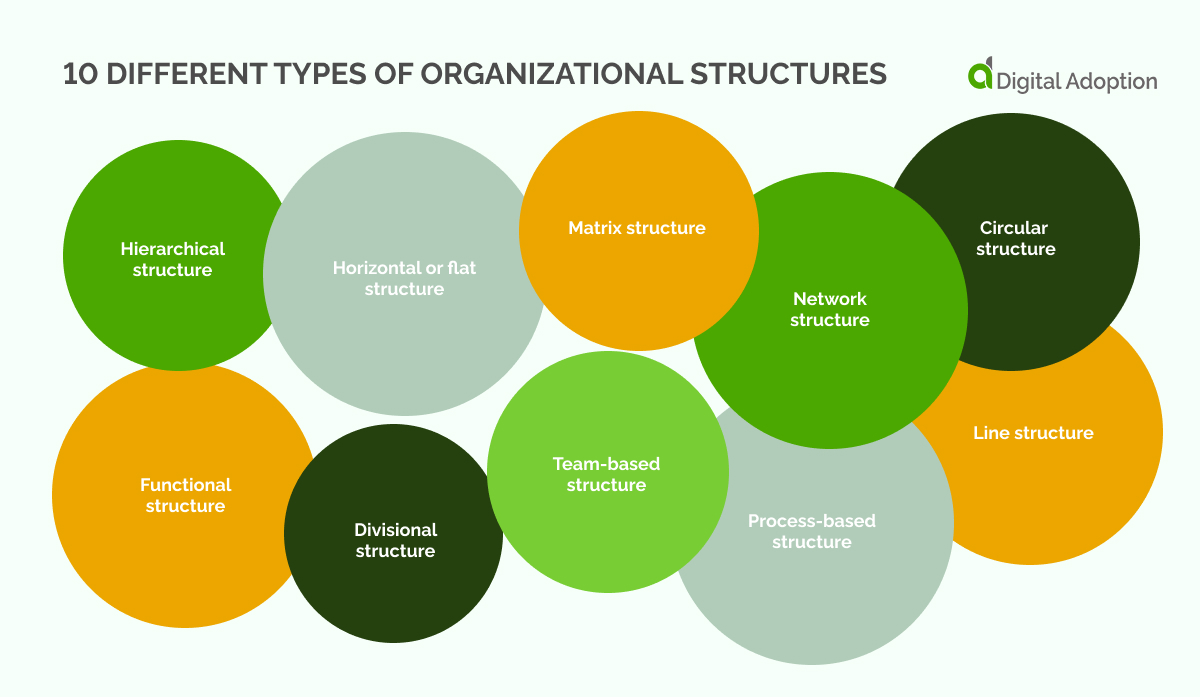
There are ten different types of organizational structures. They include functional, divisional, matrix, and others.
A functional structure groups people by their jobs, like all salespeople working together. A divisional structure divides the company by product or location.
Knowing your structure is vital so everyone understands their role. It makes work easier and helps the company succeed.
1. Hierarchical structure
A hierarchical structure organizes a company by levels of authority. The top level makes important decisions, while lower levels follow directions and report back. This structure creates a transparent chain of command. The command line focuses on defined roles and responsibilities for role-specific tasks to ensure efficiency.
Pros:
- Clear roles and responsibilities.
- Easy communication flows from top to bottom.
- Efficient decision-making at the top level.
- Defined career paths and promotions.
- Strong control over operations.
Cons:
- Slow decision-making from the bottom up.
- Limited collaboration between departments.
- Employees may feel less involved in decisions.
- High dependency on leaders.
- Can create a rigid work environment.
A hierarchical structure is typical in large organizations like banks. In a bank, top executives make major financial decisions, while branch managers and employees follow set rules to serve customers, ensuring smooth operations and consistency.
2. Functional structure
A functional structure organizes a company into departments based on specific jobs, such as marketing or finance. Each department has experts who focus on their tasks. This role-oriented structure groups employees by their specialized skills or roles to improve efficiency and expertise in each department.
Pros:
- Experts work together in the same department.
- Clear job roles and responsibilities.
- Employees develop specialized skills.
- Easier management of each department.
- Focused team goals.
Cons:
- Departments may not communicate well with each other.
- Decisions can take longer.
- Limited view of the company’s overall goals.
- Harder to coordinate between departments.
- Employees might feel isolated in their roles.
Hospitals use a functional structure. This structure allows doctors, nurses, and administrative staff to work in specific departments. Examples include surgery, emergency, or billing. This structure helps staff focus on their tasks and provide specialized patient care.
3. Horizontal or flat structure
A horizontal or flat structure has few or no management levels, so employees work more closely together, share responsibilities, and communicate more directly with leaders. This structure aims to increase teamwork and decision-making speed by reducing management levels and encouraging direct communication.
Pros:
- Faster decision-making.
- Employees have more responsibility.
- Closer communication with leaders.
- Encourages teamwork and collaboration.
- Reduces management costs.
Cons:
- Can be confusing without clear roles.
- Harder to manage larger teams.
- Fewer opportunities for promotion.
- May cause power struggles.
- Leaders might be overloaded with tasks.
Startups and tech companies, like software development firms, often use a horizontal structure. These companies benefit from quick decisions and close collaboration, which allows teams to innovate and adapt rapidly to market changes.
4. Divisional structure
A divisional structure organizes a company into separate units based on products, regions, or customers. Each division operates independently with its resources, like a mini-company. This approach helps each unit operate independently and adapt quickly to its market.
Pros:
- Focuses on specific products or markets.
- Quick decision-making within divisions.
- Each division can operate independently.
- Easier to track performance by division.
- Flexibility to adapt to market changes.
Cons:
- Duplicate resources across divisions.
- Limited communication between divisions.
- Can be costly to run multiple divisions.
- Competition may arise between divisions.
- Inconsistent company-wide policies.
Large companies, such as automobile manufacturers, often use a divisional structure. For example, a car company might have truck, SUV, and electric vehicle divisions. This structure might allow each division to focus on its specific market and product line, helping each division improve the quality of its market and product specialization.
5. Matrix structure
A Matrix Structure is like a big team where people report to two leaders. One is responsible for their special skills, and the other is responsible for their projects. This approach helps them work on different tasks together.
Pros:
- Helps team members work on multiple projects.
- Encourages sharing of skills and knowledge.
- Flexible and can adapt to changes quickly.
- Improves communication across the team.
- Makes it easier to solve complex problems.
Cons:
- Can be confusing who to listen to.
- Might cause conflicts between leaders.
- Requires lots of meetings and communication.
- Can make decision-making slower.
- Needs clear roles to avoid confusion.
A tech company might use the Matrix Structure to manage its software projects. This way, engineers can work with different teams and managers on various projects at the same time.
6. Team-based structure
A Team-Based Structure is when a company is organized into small groups working on projects. The aim is to make it easier for teams to share ideas and get things done faster. This structure helps them be more creative and efficient.
Pros:
- Teams can solve problems quickly.
- Team members can use their unique skills.
- Encourages teamwork and communication.
- Makes it easier to adjust to changes.
- Improves job satisfaction.
Cons:
- Can confuse who is in charge.
- Teams may not always agree.
- This structure can lead to conflicts between teams.
- Might be hard to keep everyone organized.
- Some people might work better alone.
A video game company might use a team-based structure. Different teams work on other parts of a game, such as designing, coding, and testing. This approach can help them create a better game faster. This approach applies to enterprise software development practices, like homegrown CRM development.
7. Network structure
A Network Structure is when a company connects with other companies or people to get work done. The aim is to use the best resources and skills available. This approach helps the company be more flexible and focus on what it does best.
Pros:
- Helps companies use outside experts.
- Allows for quick changes and updates.
- Makes it easier to work with different partners.
- Can reduce costs by outsourcing.
- Encourages digital innov++ation through various ideas.
Cons:
- It can be hard to manage many connections.
- This approach might lead to less control over work quality.
- It can confuse roles and responsibilities.
- It may create dependency on other companies.
- Communication issues can arise with many partners.
A fashion company might use a network structure to work with designers and manufacturers. This approach helps them quickly and efficiently create new clothing lines. The structure helps them use the best experts and resources available.
8. Process-based structure
A process-based structure organizes a company by different tasks or activities. Some examples are making a product or serving customers. The goal is to make each task work smoothly and efficiently. This structure helps the company get things done faster and better.
Pros:
- Makes tasks clear and easy to follow.
- Helps improve efficiency and speed.
- Allows workers to specialize in certain tasks.
- Improves quality by focusing on processes.
- Can make it easier to identify problems.
Cons:
- It can be rigid and hard to change.
- This approach might create gaps between different tasks.
- It can lead to a lot of paperwork.
- This structure may cause workers to focus only on their tasks.
- This approach could lead to less teamwork between departments.
Car manufacturing companies use the process-based structure to manage different steps. Examples of these steps are assembling, painting, and testing cars. This process helps them produce high-quality vehicles efficiently. The approach supports a focus on each process step.
9. Circular structure
A Circular Structure arranges a company so everyone is in a circle with leaders in the center. The goal is to make communication easy and make everyone feel involved. This structure helps people work together better and share ideas.
Pros:
- Encourages open communication.
- Helps everyone feel involved.
- Can lead to faster decision-making.
- Makes it easier for everyone to share ideas.
- Reduces the gap between leaders and workers.
Cons:
- Can be confusing who to report to.
- Might be hard to manage large teams.
- This structure could lead to unclear job roles.
- May create conflicts without clear leaders.
- Harder to track progress in large groups.
A tech startup uses a Circular Structure so team members can easily share ideas and work closely together. This helps them quickly develop new software by making communication and teamwork easier.
10. Line structure
A Line Structure organizes a company with a clear chain of command, where each person reports to one boss. The goal is to keep things simple and direct. Everyone knows who they need to follow and who is in charge.
Pros:
- Simple and easy to understand.
- Clear chain of command.
- Makes it easy to see who is in charge.
- Helps in quick decision-making.
- Reduces confusion about roles.
Cons:
- Can limit communication between departments.
- May not be flexible to changes.
- Can lead to too much control by bosses.
- Might not use workers’ skills fully.
- Harder to handle complex projects.
A small retail store organizes its staff using a line structure. Each employee reports to a manager, making it clear who to follow and ask for help. This approach helps keep the store running smoothly and efficiently.
There are so many types of organizational structures. Examining them becomes less overwhelming when considering your industry business type and size.
Each type of structure corresponds to an industry and fits a certain business size. Match your business to the right structure and enjoy efficiency and responsibility benefits at every level.
Organizational Structure Examples: Real Companies for Each Type
Understanding the ten types is more useful when each one is grounded in a real organization. The examples below are drawn from publicly available information about how major companies organize themselves.
Hierarchical Structure — General Motors
General Motors operates a clear hierarchical structure, with distinct reporting layers from C-suite executives down through regional presidents, divisional heads, and frontline managers. This structure supports consistent policy enforcement across a global workforce of more than 160,000 employees.
Functional Structure — Apple
Apple is organized by function rather than by product line. There is one head of hardware engineering, one head of software engineering, one head of marketing, and so on — regardless of which product they are supporting. This model keeps deep technical expertise centralized and prevents the fragmentation that product-based divisions can create.
Divisional Structure — Amazon
Amazon operates semi-autonomous business units — Amazon Web Services, Amazon Retail, Amazon Advertising, Alexa, and others — each with its own leadership, P&L, and strategic priorities. This divisional approach allows each unit to move independently without being constrained by the pace of the broader organization.
Matrix Structure — Google (Alphabet)
Google combines functional expertise (engineering, product, design, finance) with project-based teams that cut across those functions. Engineers may report to both a functional manager and a product team lead simultaneously, enabling cross-disciplinary collaboration on large-scale initiatives like AI research or hardware development.
Flat / Horizontal Structure — Valve Corporation
Valve, the video game company behind Steam, operates with no middle management and no formal hierarchy. Employees self-organize around projects they choose to join, and project leadership emerges organically. This works at Valve’s scale and in a creative industry — but it is rarely viable for organizations beyond a few hundred people.
Network Structure — Uber
Uber’s core organization coordinates a network of independent contractors (drivers), third-party logistics partners, and technology service providers rather than employing them directly. The central company owns the platform; the work is distributed across the network.
How to Choose the Right Organizational Structure
Choosing an organizational structure is not a one-time decision — it is a strategic choice that should evolve as your company grows, your market shifts, and your operational model matures. The following criteria provide a practical framework.
1. Company size
Small companies (under 50 people) typically benefit from flat or functional structures. There is not enough organizational complexity to justify multiple layers, and flat structures keep communication fast. As headcount grows past 150–200 people, some form of hierarchy or division becomes necessary to maintain accountability and reduce coordination overhead.
2. Industry and regulatory environment
Highly regulated industries — financial services, healthcare, defense — tend toward hierarchical or functional structures because clear reporting lines are required for compliance and audit purposes. Creative and knowledge-intensive industries (tech, advertising, consulting) often benefit from matrix or flat structures that encourage collaboration.
3. Growth stage
Early-stage startups benefit from flat structures that maximize speed and flexibility. Growth-stage companies often transition to functional structures to build depth of expertise. Mature enterprises operating across geographies or product lines typically adopt divisional or matrix structures to balance autonomy with coordination.
4. Geographic footprint
A company operating across multiple regions or countries will often need a divisional structure organized by geography to allow local leadership to respond to market conditions — pricing, regulation, culture — without requiring central approval for every decision.
5. Strategic priorities
If your strategy centers on deep product expertise, a functional structure concentrates that expertise. If it centers on customer-segment focus (enterprise vs. SMB, for example), a divisional structure organized by customer type may work better. If it centers on cross-functional innovation, a matrix structure — despite its coordination overhead — enables collaboration that neither functional nor divisional structures easily support.
When to Change Your Organizational Structure
Most organizations keep their structure in place far longer than is optimal. Reorganizations are disruptive, and the instinct is to delay them. But the cost of the wrong structure compounds over time — in slowed decisions, misaligned incentives, talent attrition, and missed market opportunities.
Signals that your structure needs to change:
Rapid headcount growth. When a team doubles in size, communication patterns that worked informally break down. If your organization has grown past 100 or 150 people and decisions are still being made by the same two or three people, the structure has not kept pace with the headcount.
New business lines or markets. If you have launched a new product category, entered a new geographic market, or acquired a company, your existing structure may not have the right ownership, accountability, or expertise to run the new business effectively. This is often when companies move from functional to divisional models.
Persistent decision-making bottlenecks. If the same decisions keep escalating to the same person, that is a structural problem, not a talent problem. The fix is usually to create a new role, layer, or division with delegated authority — not to tell the bottleneck person to work faster.
Strategic pivot. A company shifting from a services model to a product model, from a direct-sales model to a partner-led model, or from a single-product to a multi-product strategy will typically need to reorganize to reflect the new operating model. Structure follows strategy — when strategy changes, structure should follow.
Post-merger integration. Acquisitions create structural collisions — duplicate functions, competing hierarchies, incompatible reporting lines. A deliberate reorganization after an acquisition is not optional; it is the mechanism by which the acquired company’s capabilities are integrated into the parent organization.
Become more adaptable using types of organizational structure
You need to understand organizational structures as much as possible to advance in business.
They help your company organize teams and tasks to promote efficiency and flexibility. Different types, like the matrix, team-based, or circular structures, make it easier for companies to adapt to changes.
Let’s consider three effective organizational structures. The matrix structure facilitates cross-functional teamwork and adaptability across multiple projects.
Alternatively, a team-based structure promotes collaborative problem-solving and operational flexibility.
Lastly, the circular structure enables open communication and rapid decision-making, proving particularly valuable in dynamic environments requiring swift, well-informed changes.
Each type of structure helps a company manage its work and respond to new challenges.
The main benefit to businesses is that having the right structure makes them more adaptable, allowing them to stay successful even when things change. This flexibility promotes lasting innovation and higher revenue.
People Also Ask
-
What are the four main types of organizational structures?The four types of organizational structures are: 1. Line Structure: Everyone reports to one boss. 2. Matrix Structure: Teams report to a project leader and a skill leader. 3. Team-Based Structure: Small teams that work on different projects. 4. Circular Structure: Leaders in the center and everyone around them.
-
What are the four pillars of organizational theory?The four pillars of organizational theory are: 1. Structure: How leaders organize a company. 2. Culture: The values and beliefs shared by employees. 3. Processes: The methods and steps used to get work done. 4. People: The roles and interactions of employees in the company.
-
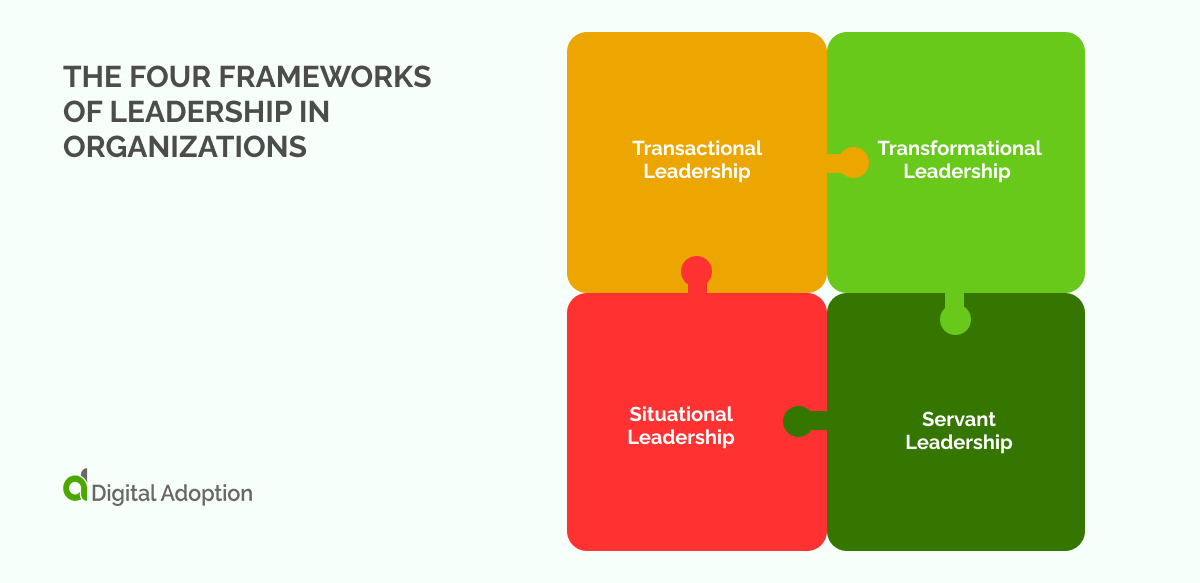
The four frameworks of leadership in organizations are:The four frameworks of leadership in organizations are: 1. Transactional Leadership: Rewards and punishments for employees. 2. Transformational Leadership: Inspires and motivates employees. 3. Servant Leadership: Help and support employees. 4. Situational Leadership: Adapts leadership style based on the situation and needs of the team.