FACT CHECKED
According to McKinsey, AI-enabled customer service is now the quickest and most effective route for institutions to deliver personalized, proactive experiences that drive customer engagement.

This race towards AI adoption can be seen in the rise of AI chatbots. These solutions are changing how businesses communicate with customers, quickly answering questions, solving problems, and helping customers around the clock.
Powered by AI, they understand what people ask and respond in a way that feels natural, like talking to a person. Because they work 24/7, businesses can save time and money while keeping customers happy. As AI chatbots keep getting smarter, they can offer each customer even better, more personal help.
This article highlights the five best AI chatbots for customer service, focusing on their features, benefits, and how they can enhance customer enablement.
What is an AI Chatbot for Customer Service?
An AI chatbot for customer service is a software application that uses artificial intelligence to understand customer messages and respond with relevant, contextually appropriate answers — without requiring a human agent for every interaction.
Modern customer service AI chatbots exist on a spectrum of sophistication. Understanding where a tool sits on that spectrum matters when evaluating options for your organization.
Rule-Based Chatbots
Rule-based chatbots follow predetermined decision trees: if the customer says X, respond with Y. They’re predictable, easy to configure, and reliable for handling narrow, well-defined use cases — order status lookups, store hours, basic FAQs. Their limitation is brittleness: a customer phrasing a question slightly differently than the bot expects will hit a dead end. Most legacy “chatbots” on websites are rule-based systems.
NLP-Powered Chatbots
Natural language processing (NLP) chatbots can understand variations in phrasing, context, and intent. They’re trained on historical customer conversations to recognize patterns and route correctly without requiring an exact match. Tools like Zendesk’s Answer Bot and Freshdesk Freddy use NLP to handle a broader range of customer queries, escalating to human agents when confidence is low.
Generative AI Customer Service Agents
The most recent generation — tools like Intercom Fin (built on GPT-4), Salesforce Agentforce, and Ada — can hold multi-turn conversations, reference customer account history, execute actions (issuing refunds, updating orders, resetting passwords), and generate responses in natural language rather than selecting from a pre-written answer library. These systems are more capable and more complex to deploy, but they represent where enterprise customer service AI is moving.
Why Organizations Deploy AI Chatbots
The business case for customer service AI rests on three pillars: deflection rate (the percentage of tickets resolved without human involvement), response time (customers expect answers in under 2 minutes; AI delivers in seconds), and agent capacity (AI handles routine queries so human agents focus on complex, high-value interactions). McKinsey research identifies AI-enabled customer service as the fastest route to personalized, proactive customer experiences at scale.
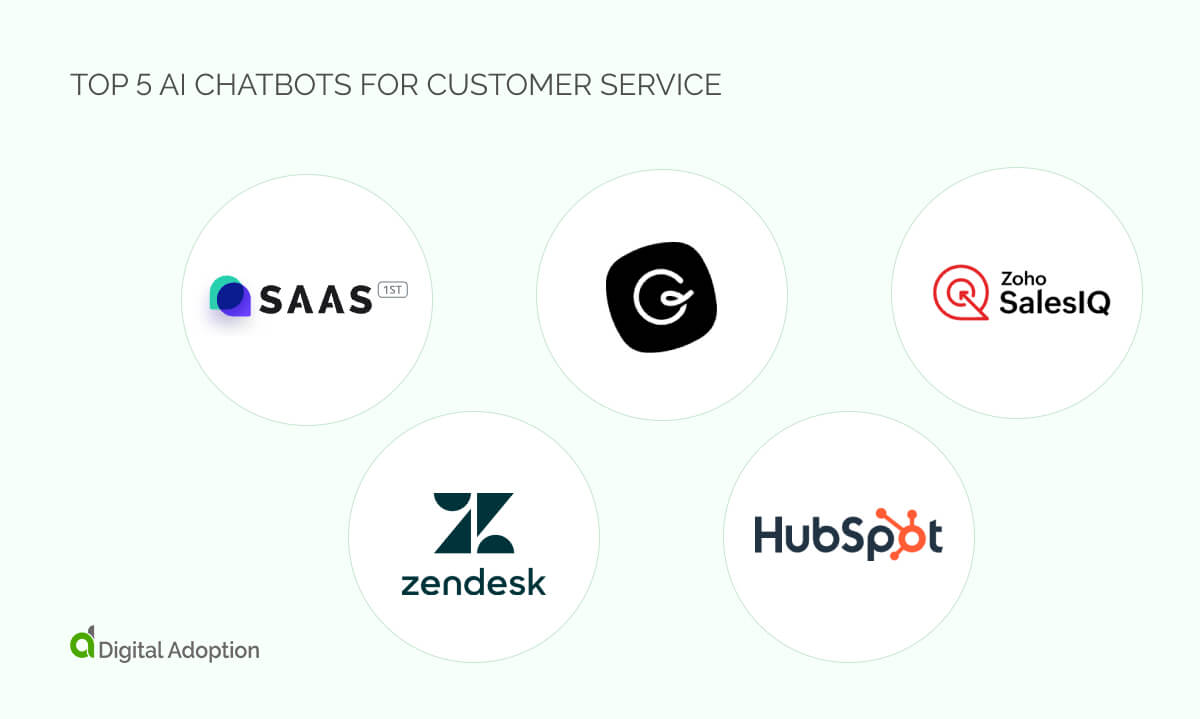
1. SAAS First
- G2 rating: 5/5
- Best for: 24/7 support
SAAS First is the first AI chatbot for customer service on our list. It leads an AI agent workforce guided by human expertise, combining automation with oversight. At its core is Milly, a dedicated chatbot designed to understand and respond to customer queries in real-time.
Support goes beyond simple responses. SAAS First includes a built-in CRM, task board, and automated ticketing, keeping every interaction organized. Custom integrations connect existing tools, creating a unified system that adapts to business needs. Customers receive 24/7 multilingual support, while teams gain 10x more insights into engagement patterns.
Real-time AI analytics add another layer of visibility. Customer discovery and experience leaders can track campaigns, monitor behavior, and refine interactions based on AI-derived insights. Every data point shapes a clearer picture of customer needs.
Engagement doesn’t stop at chat. SAAS First connects live chat, email, and social media into a single communication suite, ensuring every conversation stays connected across channels.
Key AI features
- AI data-backed analytics delivered in real-time: Instant insights on performance and customer sentiment.
- 24/7 customer engagement and multilingual support: Continuous support in multiple languages, day or night.
- Integrated with your firm’s internalized knowledge base: AI agents are trained on your content for accurate responses.
Integrations
- WhatsApp: Support customers via WhatsApp messaging.
- Facebook Page: Engage customers directly through your Facebook page.
- Twilio – SMS: Provide support via SMS messaging.
Pricing
| Plan | Price | Duration |
| Base Plan | $9/User (Free trial available) | Monthly |
| Add-On | $1.5/SAAS Credits | N/A |
2. Get Guru
- G2 rating: 4.7/5
- Best for: Advanced knowledge access
Get Guru is the ideal AI chatbot solution for customer service professionals seeking smarter knowledge management. It gathers content from enterprise chats, applications, and documents into one central hub. Teams can search this hub like a powerful search engine or receive personalized answers directly in their workflow. This design keeps teams focused without the need to switch between apps.
Guru also connects with CRM and HRIS systems. It learns from your existing data pools and adjusts to your organization’s current state. The platform’s AI refines responses using real-time insights drawn from your information. A dedicated customer success manager can guide your team throughout the setup process, providing practical assistance.
With Guru, your organization maintains a single source of truth. Everyone stays informed and connected while managing demanding workflows. The system scales with your business, making it suitable for enterprise-level operations. Each feature works together to simplify knowledge management and support customer service professionals in delivering accurate, actionable information.
Key AI features
- AI-powered enterprise search: Instant, accurate access to HR policies and benefits.
- Proactive knowledge base: Keeps information current and pushes verified knowledge where needed.
- AI-driven intranet: This centralizes key updates, ensuring teams stay aligned and informed.
Integrations
- Adobe Workfront: Integrates for seamless project management and task tracking.
- Slack: Connects with Slack for real-time collaboration and updates.
- Microsoft Teams: Syncs with Teams to improve communication and knowledge sharing.
Pricing
| Plan | Price | Duration |
| Free | Free | Monthly |
| All-in-one | $15/User | Monthly |
| Enterprise | Contact GetGuru | |
3. Zoho SalesIQ
- G2 rating: 4.4/5
- Best for: Automating customer support
The next entry on our list is Zoho SalesIQ. This leading customer engagement platform is ideal for businesses wanting to “communicate with every site visitor at every stage of the customer lifecycle.” It combines live chat, analytics, and automation to ensure the right conversations happen at the right time.
The platform removes language barriers with live chat translation, while automated chat triggers responses based on visitor actions. This ensures timely interactions that feel natural. Lead scoring then takes it further, helping teams identify the most valuable prospects and focus on high-priority conversations.
Zoho SalesIQ includes audio calls and screen sharing for deeper interactions, allowing support teams to guide customers in real-time. Answer bots handle quick, common inquiries, drawing from FAQs and knowledge bases. With chat preview, agents can review messages before sending them, ensuring accurate and helpful responses.
Zoho SalesIQ also manages content, filtering out profanity to keep chats professional. Its no-code and low-code tools make it simple to design chatbots and workflows using a visual interface. This ease of use makes scaling support fast and accessible and empowers teams to engage visitors meaningfully.
Key AI features
- Custom chatbots: Automate and personalize responses
- Chat translation: Real-time translation for seamless communication
- Lead and company scoring: Prioritize customers based on engagement
Integrations
- Zoho Analytics: Provides in-depth reporting and data analysis.
- Salesforce CRM: Enhances customer relationship management with seamless integration.
- Zoho CRM: Manages and tracks customer interactions efficiently.
Pricing
| Plan | Price | Duration |
| Free | £0 | |
| Basic | $10/Operator Licence | Monthly |
| Professional | $17/Operator Licence | Monthly |
| Enterprise | $25/Operator License | Monthly |
4. Zendesk
- G2 rating: 4.3/5
- Best for: Help desk management features
Built on billions of real service interactions, Zendesk AI is the penultimate entry on our list of AI chatbots for customer service.
This out-of-the-box solution offers enterprise service teams the latest bleeding-edge AI for fast-tracking operations at scale. With omnichannel support across social media, phone, and email, Zendesk lets service teams connect with customers on every platform, ensuring no questions go unanswered.
Its case management system tracks each customer issue while personalized conversations keep things relevant. AI workflows speed up responses and automate simple back-office actions. Agent tools and automation reduce time spent on mundane and routine work so teams can focus on more high-value issues. With over 1,000 apps, Zendesk easily integrates with existing systems.
Zendesk is easy to set up, requiring no in-house IT engineers, meaning teams with minimal technical knowledge can use it. Trusted by over 130,000 brands, Zendesk aims to improve the customer service experience with its AI agents, admins, and self-service solutions.
Key AI features
- Zendesk AI: Automates interactions, suggests answers, and supports agents.
- Zendesk advanced AI: Enhances workflows with intelligent triage, summaries, and replies.
- Advanced AI add-on: Adds generative AI for voice, content, and agent support.
Integrations
- Shopify: Connects with Shopify to manage customer inquiries about orders and products.
- Jira: It integrates with Jira to streamline issue tracking and resolution between support and development teams.
- Mailchimp: Syncs email marketing campaigns and customer interactions for cohesive marketing efforts.
Pricing
| Plan | Price | Duration |
| Suite Team | $25/User | Monthly |
| Suite Growth | $69/User | Monthly |
| Suite Professional | $149/User | Monthly |
| Suite Enterprise | Custom | Monthly |
| Suite Enterprise Plus | Custom | Monthly |
5. HubSpot
- G2 rating: 4.4/5
- Best for: Managing the entire customer lifecycle
HubSpot is the last entry on our list. Brought to you by HubSpot Marketing Hub, these conversational AI chatbots leverage ChatGPT to help customer service teams scale.
Breeze Customer Agent, still in Beta, allows teams to deploy on-brand AI agents using existing content in just minutes. It automates ticket resolution, helping teams handle large volumes of inquiries efficiently.
With Breeze, AI agents can engage with customers around the clock, providing personalized and reliable interactions. They can also easily answer complex customer queries, ensuring support is always available.
Teams can integrate content from blogs, articles, and URLs and help sites train these AI agents quickly. The agents will only use approved content and maintain your company’s tone, ensuring that accurate responses align with your brand.
Breeze AI also generates reports and insights, offering valuable analytics on resolution rates, handoff percentages, and customer sentiment. These insights help teams monitor performance and improve support.
Build AI chatbots for conversations that need the most attention easily using HubSpot’s intuitive platform.
Key AI features
- AI Agents: Automate lead qualification, meeting scheduling, and customer queries using GPT-based chatbots.
- Automated content generation: Easily customize chatbots with templates and an intuitive visual editor.
- 24/7 self-service: Manage lead generation, ticket triage, and conversations automatically.
Integrations
- Zendesk: Manage customer support tickets within HubSpot CRM.
- Shopify: Incorporate eCommerce data into marketing and sales workflows.
- WordPress: Use HubSpot for forms, leads, and campaign management.
Pricing
| Plan | Price | Duration |
| Marketing Hub Free | $0 | N/A |
| Marketing Hub Starter | $20/User | Monthly |
| Marketing Hub Professional | $890/User | Monthly |
| Marketing Hub Enterprise | $3,600/5 Users | Monthly |
6. Intercom Fin
Intercom Fin is an AI customer service agent built directly on top of large language models (GPT-4 and Claude). Unlike traditional chatbots that select from pre-written responses, Fin generates answers by reading your help documentation, support articles, and knowledge base in real time. It can resolve multi-step queries in a conversational format and hands off seamlessly to a human agent when it reaches the boundaries of its knowledge. Fin is part of the Intercom platform, making it the natural choice for companies already using Intercom for customer messaging. Reported deflection rates in enterprise deployments range from 40–70% of incoming volume.
7. Ada
Ada is a no-code AI chatbot platform built specifically for enterprise customer service at scale. It’s designed to integrate with backend systems — CRMs, order management platforms, billing systems — so that the chatbot can take action (look up an order, process a return, update account information) rather than just providing information. Ada’s approach is to build a persistent AI layer that improves with every conversation through automated training. It’s particularly strong in regulated industries (financial services, telecommunications) where the chatbot needs to operate within strict compliance constraints.
8. Tidio
Tidio is a customer service chatbot platform oriented toward e-commerce and small-to-mid-size businesses. It combines live chat, AI chatbot functionality, and email support in a single interface, with direct integrations into Shopify, WooCommerce, and Magento. Tidio’s AI product (called Lyro) uses NLP to answer customer questions from a configured knowledge base and can handle up to 70% of common customer queries automatically. Its pricing is significantly more accessible than enterprise platforms, making it a practical option for growing e-commerce teams.
9. Freshdesk Freddy AI
Freshdesk’s Freddy AI is embedded throughout the Freshdesk customer support suite, providing AI capabilities at three layers: self-service (Freddy Self Service handles customer-facing chatbot conversations), agent assistance (Freddy Copilot suggests responses and summaries to human agents), and analytics (Freddy Insights surfaces trends and anomalies in support data). For organizations already on the Freshdesk/Freshworks stack, Freddy AI is the path-of-least-resistance AI upgrade — no new vendor, no new integration, and progressive capability adoption.
10. Forethought
Forethought is an AI platform purpose-built for support ticket triage and resolution. Its Solve product handles customer-facing AI responses; its Triage product classifies incoming tickets and routes them to the right agent or team; its Assist product provides human agents with AI-generated suggested responses and relevant knowledge base articles. Forethought’s differentiation is in the triage and classification layer — for high-volume support organizations that struggle with routing accuracy and SLA adherence, Forethought’s AI classification can meaningfully reduce misrouting rates.
AI Chatbot vs. Live Chat vs. AI Agent: What’s the Difference?
These three terms describe different points on the customer service automation spectrum, and choosing the wrong one is one of the most common deployment mistakes.
Live Chat is human-to-human messaging delivered through a web or app interface. A customer types a message; a support agent reads it and responds in real time. Live chat is synchronous (both parties are present), immediate, and as capable as the human agent handling it. Its constraint is cost: live chat requires staffing, which means limited availability and scaling challenges during peak demand.
AI Chatbots are automated systems that handle customer conversations without human involvement. The spectrum ranges from simple rule-based bots that answer FAQs to sophisticated NLP systems that manage complex multi-step queries. Chatbots are available 24/7, respond instantly, and scale infinitely — but they have knowledge boundaries and struggle with novel or emotionally complex situations. The best implementations combine chatbot self-service with a seamless escalation path to a live agent when the bot reaches its limits.
AI Agents are the newest category — systems that don’t just answer questions but take actions on behalf of customers. An AI agent can look up an order, process a refund, change a shipping address, or reset a password without any human involvement. Tools like Intercom Fin, Ada, Salesforce Agentforce, and Anthropic’s Claude in enterprise configurations are moving in this direction. AI agents require deeper backend integration than chatbots (they need API access to your order management, billing, and CRM systems) but deliver significantly higher deflection rates.
Which Should You Deploy?
Most mature customer service operations use all three in sequence: the AI chatbot handles first contact and triage, AI agents handle routine transactional requests, and live chat handles complex, high-value, or sensitive conversations. The goal isn’t to eliminate human agents — it’s to ensure human agents spend their time on interactions where human judgment and empathy genuinely add value.
How to choose the right AI chatbot for your customer service needs
Choosing the right AI chatbot for your customer service involves more than just picking the most popular option.
It’s essential to assess your business needs, whether that’s 24/7 support, multilingual capabilities, or integration with existing tools.
Don’t forget about ease of use for your team and your customers. Testing different solutions and understanding their flexibility can help you find one that fits your goals.
Remember, the best chatbot is the one that works for your unique digital transformation journey, offering both efficiency and a personalized touch to ensure customer loyalty.
People Also Ask
-
What are AI chatbots for customer service?AI chatbots automate customer support and automate intelligent actions. They answer queries and remedy issues without human agents. They are available 24/7 for faster, more efficient service.
-
What are the different types of AI chatbots?There are rule-based chatbots, AI-powered chatbots, and hybrid chatbots. Rule-based bots follow preset instructions. AI bots use machine learning to improve over time. Hybrid bots combine both methods.
-
How can you measure the ROI of a customer service chatbot?You can measure ROI by tracking cost savings, response times, and customer satisfaction. Monitor the reduction in human workload and improvements in customer engagement and issue resolution.