FACT CHECKED
During the software tech buying process, value is often measured by the immediate benefits a solution offers. It includes overhauling workflows, automating capabilities, and accelerating digital transformation initiatives, to name a few.
However, the true value software delivers can only be measured when calculating all costs incurred throughout the entire lifecycle. This is known as the total cost of ownership (TCO).
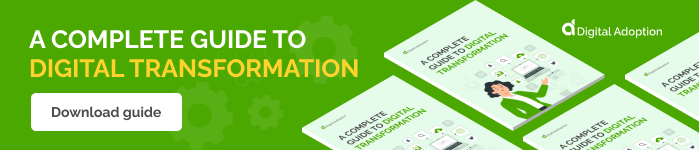
Research indicates that a company paying $60,000 for a 20-user perpetual ERP system can expect annual support and maintenance costs of about $15,000. This shows that the initial purchase is just part of the total cost a company will face over time.
Calculating TCO is key to enabling CIOs to forecast future software expenses and make sound IT cost-optimization decisions that align with budgets. This article explores everything TCO, analyzing the components that add to spend, how to calculate total costs, and trusted methods for lowering them.
What is the total cost of ownership (TCO)?
Total cost of ownership (TCO) is a financial assessment that calculates the end-to-end cost of an asset purchase across its lifecycle. It often includes calculating the initial acquisition cost, along with hidden and ongoing costs such as implementation, training, operations, maintenance, and decommissioning.
Calculating the TCO beyond a product’s immediate sticker price helps determine whether a solution’s long-term value justifies the costs incurred over its life.
This way, assessing the return on digital technology investments shifts from loose financial estimates to more accurate oversight of enterprise spend.
While the affordability of upfront purchase prices may appeal to those with tight budgets, solutions with a lower TCO often bear greater value over time.
Why is calculating the total cost of ownership (TCO) important?
Enterprise’s architecture is increasingly hybrid, with a mix of on-premises, private, and public solutions.
Shifting from one-time software costs to recurring subscription-based pricing means fluctuations occur over a longer period. This can make calculating their overall costs accurately quite complex.
Companies use over 100 SaaS apps and rely on SaaS for most of their software, and large businesses still waste around $21 million a year on unused licenses. This shows how failing to track TCO can drain millions, even when most software appears fully subscribed and in use.
TCO provides firms with a tangible process for identifying these costs, enabling more accurate financial forecasts and targeted budgeting decisions. It’s especially crucial in enterprise buying, where large investments span a complex suite of infrastructure and services.
Without measuring TCO, unforeseen expenses can rack up, diminishing investments intended to generate value.
What are the core components of the total cost of ownership?
To calculate the total cost of ownership, you must first examine every component that incurs costs across its lifecycle. Assessing these aspects provides a holistic view of spend, ensuring no corner is overlooked. The table below provides a brief TLDR overview of the core TCO components you need to pay attention to:
| Component | Included Costs |
| Up-front software fees | Licence fees, implementation, onboarding, add-ons, activation fees, premium modules, data migration, and scaling user seats. |
| Implementation and transition costs | Configuring and tailoring solutions, transitioning legacy systems, preparing and migrating company data, and project coordination. |
| Training costs | Training programmes, in-app guidance (DAPs), and vendor workshops to ensure effective user adoption. |
| Security and backup costs | Access permissions and controls, monitoring, audit capabilities, backup, or disaster recovery needs. |
| Support and maintenance | Ongoing vendor support (troubleshooting, bug fixes), routine technical checks, and ensuring reliable system uptime. |
| Upgrades and improvements | Version updates, added features, performance enhancements, and adjustments for system changes. |
| Disposal and end-of-life costs | Removing data, exporting information, shutting down environments, ending contracts, and preparing for new systems. |
Up-front software fees
Up-front software costs, also known as the sticker price, typically drive initial decisions. These costs are the most visible aspect of software spend and outline what you can expect to pay over the asset’s lifecycle.
They include licence fees to start using the service, plus implementation, employee onboarding, and add-ons for enterprise needs. These fees are included in your total cost, but buyers must watch for additional charges such as activation fees, premium modules, data lifecycle management fees, or scaling user seats.
Implementation and transition costs
The more complex the enterprise business architecture is, the higher the implementation costs are likely to be. This involves configuring and tailoring enterprise solutions, from legacy application modernization to migrating company data, and coordinating projects without interruption.
Overlooking implementation and transition requirements can silently increase the TCO through lengthy rollout delays and the costs of sourcing external support.
Training costs
The value of new software is realized only in how well users adapt to it. Without proper training, digital adoption lags and transitions weaken. TCO should include training costs to ensure employees have the skills to use new systems.
Account for costs needed for training programs, in-app guidance through digital adoption platforms (DAPs), and vendor workshops. TCO can be lowered when productivity gaps are closed, and users operate with minimal errors.
Security and backup costs
Enterprise software must include strong security measures and backup protocols to protect data and strengthen system defences.
TCO should account for costs tied to access permissions and controls, monitoring and audit capabilities, and backup or disaster recovery needs. Assess vendors’ out-of-the-box security and backup services and calculate any additional costs needed for protection and support down the line.
Support and maintenance
TCO includes support and maintenance costs that run right through to asset end-of-life. These costs are non-negotiable, as software systems are expected to be up to date and resilient to downtime.
Costs comprise ongoing IT vendor management for troubleshooting issues, fixing bugs, routine technical checks, and ensuring reliable system uptime. Different support levels incur other expenses, especially for near-instant response times or when dedicated help is needed.
Upgrades and improvements
Software systems rarely involve one-time static improvements; they require ongoing upgrades and improvements to ensure full capabilities.
TCO should include costs for upgrades and improved configurations, such as version updates, added features, performance enhancements, and adjustments needed when other systems change. Accounting for upgrade costs enables companies to anticipate upcoming improvements or disruptions that can undermine ROI.
Disposal and end-of-life costs
Accounting for software setup and implementation often overshadows the costs of decommissioning a software asset at the end of its useful life. Ambitious adoption efforts tend to front-load expectations and forget that disposal and end-of-life costs are part of TCO.
These include removing data, exporting required information, shutting down environments, ending contracts, and preparing for a new system. Planning ahead prevents vendor lock-in, mitigates last-minute stress, and ensures seamless solution transitions.
What other costs should be included when measuring TCO?
When measuring TCO, it is not enough to focus on direct, tangible expenses such as licences, infrastructure, or support fees. Intangible costs can influence the TCO and should be considered to provide a complete picture. Let’s explore some of these other TCO cost considerations below:
- Productivity loss: The cost of lost productivity and labor can increase overall costs if left unaddressed. Software adoption needs to be robust, ensuring solutions aren’t lagging, inconsistent, or hard to navigate. Employees spending extra time rectifying issues or waiting for approvals indirectly increase TCO.
- Compliance exposure: Compliance exposure is another hidden cost. Systems that fail to support regulatory or legal requirements can expose organizations to fines, penalties, or audits. Even the smallest oversights can result in financial or reputational harm.
- User frustration: Employee frustration can also impact TCO. Disengaged users are less likely to fully adopt the system, which can lower ROI, slow efficiency, and drive higher support needs.
- Decision-making delays: Decision-making delays should be accounted for as well. When teams can’t access critical data, or it’s delivered inconsistently, or with delay, misaligned or late decisions can occur, resulting in opportunity costs.
- Reduced service quality: Reduced service quality that exacerbates slower responses and process errors can affect customer discovery, client retention, or partner relationships. These outcomes may not appear directly in financial statements but have a real impact on long-term value.
How to calculate total cost of ownership (TCO)
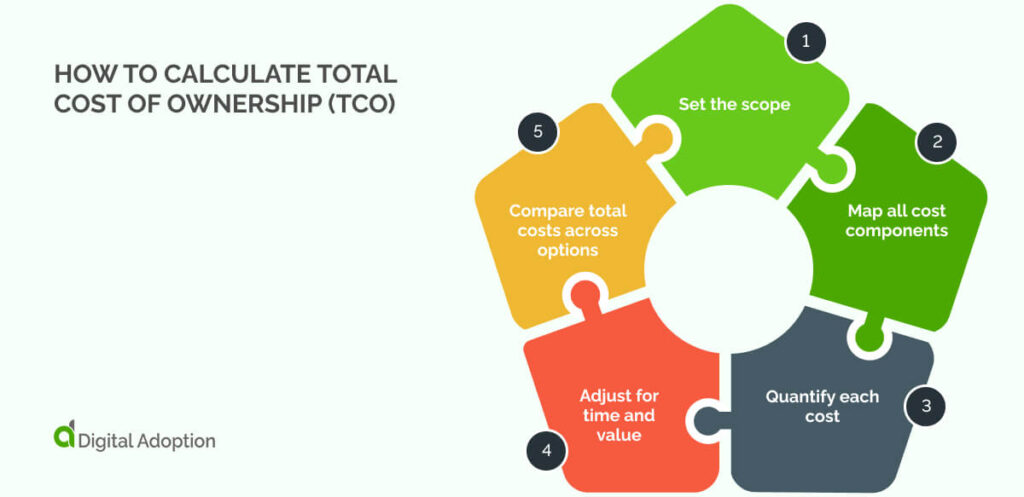
Now that we’ve looked at the components that make up the largest TCO costs, let’s explore quantitative methods for determining the TCO of software.
A simplified formula involves adding your initial costs to all the expenses you incur to run the software over its useful life. Then figure out what the system is still worth at the end of its lifecycle and subtract that amount from your total spend.
This gives you a truer picture of what the system actually costs you once you factor in the value you gauged from it. Let’s take a look at how to calculate TCO:
Set the scope
Calculating TCO begins with assessing the scope of software use across several variables. This includes defining software and determining its lifecycle duration. Is it a temporary one-year solution or a long-standing system that has been operating for multiple years?
To minimize inflated costs or overspending, specify the number of users or teams. It’s also key to identify cost dependencies, such as integrations or regulatory obligations, which add to the overall cost. Scoping performance levels, uptime, and adoption rates helps gauge financial thresholds by comparing them with success criteria.
Use a formal scope document that includes the asset name, start date, end date, and expected disruptions to provide a concrete framework for keeping the TCO model focused and defensible.
Map all cost components
As we know, without a holistic view of cost, TCO calculations will remain hidden.
Categorize each component, including upfront acquisition costs, operational and maintenance fees, and end-of-life costs. Beyond this, mapping sub-costs within these components will give a highly specific price breakdown.
Look at licence fee shifts, usage charges, support tiers, and any hidden or variable outlay. We’ll cover this more in the next section, but each item must connect back to the main cost drivers you set at the start.
Quantify each cost
Determining specific figures for each cost component will provide a material method for calculating TCO.
This includes assessing vendor quotes, gleaning the average price of past purchases, and using other quantifiable markers to provide an accurate forecast. It also involves looking at implementation and integration needs, shifting user seats, usage expectations, service support, and data costs, and assigning real price tags to each.
Workload expenses of both internal teams and external vendors should also be included in calculations. This helps capture the true cost of things like admin and maintenance over the software’s operational life.
Adjust for time and value
When you look at costs that you’ll pay down the line, you shouldn’t treat them the same as money you spend today. Money loses value over time. So, a cost you pay three years from now may actually be worth less than the same amount paid today.
To address this, use Net Present Value (NPV) or discounting to adjust future costs to their current value.
Depreciation is similar in that, instead of counting the full cost of something in one year, you spread it out over several years so it matches the length of time you use it.
Compare total costs across options
Conducting a TCO analysis doesn’t have to be done with a single solution. Compare total costs across multiple potential solutions for a more well-rounded analysis.
Make sure you’re comparing the same number of users, features, and support levels so that the total estimates are evenly matched. This helps you see which option costs less once all fees, future expenses, and hidden charges are included.
This way, you can see the full picture of each option’s costs and make a choice with confidence, avoiding unexpected fees or future surprises.
What methods exist to improve TCO?
Calculating TCO is only one half of a sound cost equation. Minimizing overall TCO also requires proactive measures that improve operational processes and prevent unnecessary spend throughout the lifecycle. Let’s explore some of these options below:
Automate manual processes
Employee workloads are not always factored into total costs, which can increase spend if not anticipated.
TCO can be reduced by automating manual data entry, approvals, reporting, and user administration. Over the software’s lifecycle, it can inform cost estimates that are more predictable and require fewer resources to maintain.
Simplify support and training needs
Heightening employee support and user training requirements can reduce TCO margins. Software that is easily navigable and clearly explained helps flatten learning curves, reducing the need for additional training and support tickets.
The cost of IT labour is reduced when not troubleshooting user roadblocks or providing lengthy walkthroughs on how to use systems. As a result, employee productivity can accelerate, reducing time-to-value for solutions as users adapt through proactive training and skills development.
Adopt solutions that scale efficiently
Assessing the scalability of solutions before locking into contracts helps keep costs balanced should your business need room to grow. Some vendors raise prices when usage, storage, or support needs increase.
Systems that handle more users, data, or features without expensive upgrades can minimize long-term spend, avoid disruptive migrations, and keep costs predictable during periods of growth.
Assess long-term value, not just upfront costs
The success of software depends on whether the end-to-end costs are lower than the value it generates over time.
This means examining renewals, support needs, integrations, adoption rates, and productivity gains. Comparing these variables against the cost of the initial purchase provides an accurate economic overview of the value generated. It also helps you opt for solutions that deliver value throughout their lifecycle.
Strengthen vendor management practices
Reliable vendor management practices ensure solutions deliver on expectations and that vendors fulfill their service-level agreements (SLAs).
Scrutinising usage, support, and pricing changes can uncover hidden costs and lower vendor management challenges. This can help reinforce TCO margins by stabilizing spend and safeguarding value. It also provides an unambiguous benchmark for software investments long into the future.
How TCO justifies solution value
As enterprise technology spend increases, the risks of misaligned software investments can be damaging if ignored.
Sporadic, disparate procurement strategies, in a rush to transform and adapt to evolving business demands, can eat away at finances rather than bolster them.
Risks to productivity, critical operations, and regulatory compliance breaches can also occur if investments aren’t guided by a thorough TCO framework.
In this way, TCO is a concrete solution for assessing the financial impacts of software adoption by accounting for holistic costs overlooked at the initial purchase.
Remember, software procurement choices are justified once the value of a solution outweighs total costs. Calculating TCO accurately helps determine software ROI by providing a clear view of the return relative to total spend.
People Also Ask
-
How do you deal with unpredictability in long-term costs?Look at past spending, upcoming upgrades, and vendor trends to predict future costs. After that, factor in price changes, inflation, and unexpected maintenance costs. Update your estimates regularly so they reflect reality, giving you a clear picture of what owning and running the system costs over time.
-
How do you account for opportunity costs and lost business when systems underperform?Think about what your business misses when systems are slow or unreliable—delayed projects, errors, or lost deals. Assign a value to these setbacks and include it in your TCO. This shows the true cost of software beyond licences, helping teams see the hidden impact on growth and efficiency.
-
How can you fairly compare cloud vs on-premises systems?Add up all costs for each option: licences, hardware, maintenance, upgrades, support, and downtime. Use the same number of users and timeframe, and assume similar performance. This creates a side-by-side view that highlights real differences, so decisions are based on total impact.