FACT CHECKED
For businesses currently on their digital transformation journeys, a strong alignment of people, technologies, and business process management (BPM) tools is non-negotiable for success.
When adopting AI tools and technologies to transform models and culture, business process performance can be overlooked, fueling a culture of quantity over quality if unchecked.

McKinsey says “almost all companies invest in AI, but just one percent believe they are at maturity.” These findings show that nearly every company invests in AI, yet only 1% feels mature in its AI strategy.
ISACA’s Capability Maturity Model Integration (CMMI) is designed to assist with exactly this through a well-defined framework that enables organizations to gauge their potential and performance.
This article delves into CMMI integration, exploring its origins, how it works, and key steps for success. We’ll also explore the top benefits and challenges, along with real-world examples of how the CMMI is fast-tracking process proficiency across sectors.
What Is CMMI?
The Capability Maturity Model Integration (CMMI) was created to enhance the U.S. Department of Defense’s process capabilities and performance.
Today, CMMI has transitioned into an industry-leading process and performance solution used by the global business sector.
The framework merges various disciplines and best practices into an integrated product suite. In essence, it helps organizations improve process iterations and set capability standards.
CMM focuses on software improvements, whereas CMMI extends the model scope to other areas. This includes refining product development, extending hardware and software life-cycles, and standardizing risk management.
CMMI is a strategic means for achieving operational resilience and improving business results through iterative improvement.
What is the CMMI model used for?
The purpose of the CMMI model is to measure and refine business processes through continuous improvement. It uses the most up-to-date understanding of an organization’s capability and performance levels, acting as a guide for steering better business outcomes.
CMMI closely aligns with business process management (BPM), another essential approach for sharpening performance, managing quality, and ensuring compliance. BPM tools formalize key processes across business units. They use methods such as process definition and design, automation, and monitoring, which are aligned with CMMI requirements.
The CMMI framework is divided into three segments called CMMI constellations. Each segment targets a key area of organizational development. These are:
- CMMI-DEV: The Development constellation helps refine how products and services are designed and built, improving efficiency, quality, and innovation at every stage.
- CMMI-SVC: The Services constellation ensures consistent, reliable delivery across areas like customer support, IT, maintenance, supply chains, and transport.
- CMMI-ACQ: The Acquisition constellation helps assess contractor software quality and performance, driving measurable improvements in production, supply chains, and procurement.
How has the CMMI model evolved?
ISACA’s CMMI has helped build high-performing organizations for over three decades.
CMMI brings together several earlier maturity models into one clear framework. It was first developed by Carnegie Mellon University’s Software Engineering Institute to help organizations improve how they work.
Then, in 2002, the first release, CMMI V1.0 (CMMI-SW), piggybacks on the earlier CMM software-specific model to become widely applicable for various processes.
ISACA’s first version clearly defined stages from the start. It set maturity levels and outlined ways to progress through them:
- Level 1: Processes are informal, unpredictable, and often inconsistent.
- CMMI Versions 1.1–1.3 (2006–2010): Added Agile and Lean Six Sigma approaches and introduced “constellations” to focus on improving specific areas of work.
- CMMI V2.0 (2018): Made processes more flexible and easier to improve, and combined process areas into practice areas. It also allowed organizations to plan actions in four segments: Doing, Managing, Enabling, and Improving.
Apart from merged practice areas, Version 2.0 introduced more streamlined appraisal methods and a stronger performance orientation. It also harmonized process improvement with business goals while adopting more agile approaches.
The latest version, CMMI V3.0, updated in April 2023, builds on Version 2.0 with enhanced features designed to accommodate the high-octane pace of business technology adoption. It stresses greater relevance and flexibility, ensuring the model remains adaptable to the realities of modern business.
Some practice areas have been merged into others, like Supplier Source Selection (SSS) becoming part of Supplier Agreement Management (SAM).
V3.0 added new areas, including:
- Development
- Safety
- Suppliers
- People
- Services
- Security
- Data Management
It also updated definitions and practices based on user and partner feedback to help reach Maturity Level 2.
Ultimately, the trajectory of CMMI evolution has seen greater integration across domains, easier deployment, and reduced implementation costs with each iteration.
What are the different CMMI Maturity levels?
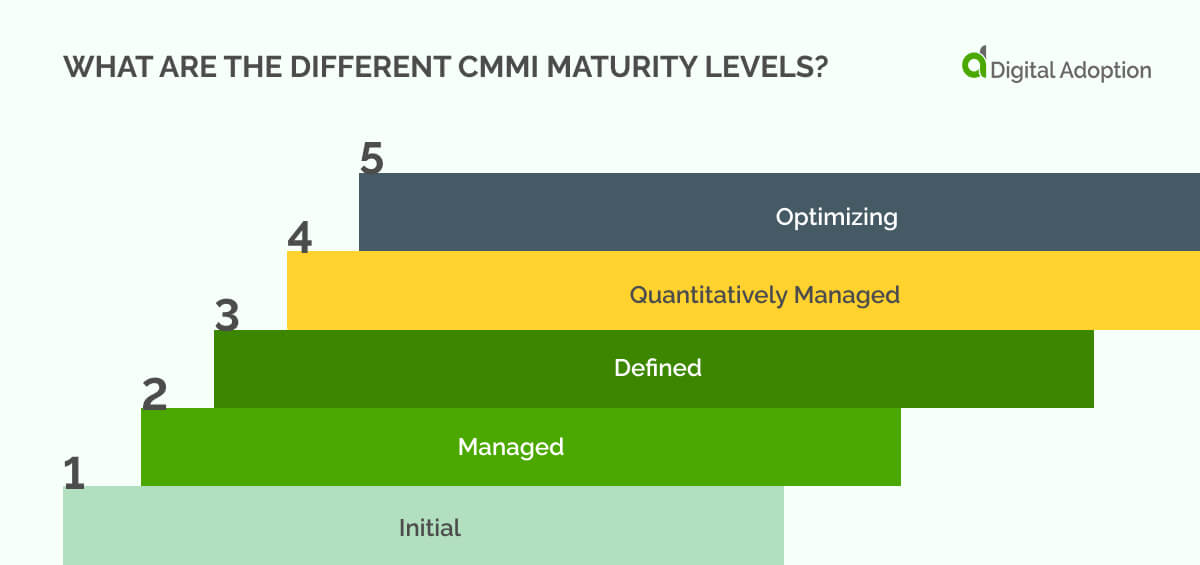
CMMI establishes 5 Maturity Levels to assess the proficiency of an organization.
Each level shows specific capabilities and organizational maturity, with companies expected to progress upward. Maturity Level 5 signifies the highest maturity benchmark an organization can reach.
Let’s break down each CMMI Maturity Level and explore the criteria for graduating each stage:
Initial
At the ‘Initial’ stage, processes are messy, reactive, and unpredictable. Work is unstructured and relies on individuals to make things happen.
Processes at this phase often rely on an ad-hoc, or impromptu approach to problem-solving, frequently lacking tangible process documentation. It’s common for deadlines to be missed, delays to occur, and expenses to rise before a project is finally complete. This stage carries the highest project risks and can lead to inconsistent results.
Managed
The bare-bones process standardization is established in the second stage, the ‘Managed’ phase. Here, the processes become more structured. A basic improvement cycle is followed, with the correct process documentation, costs, scheduling, and other prerequisites established.
There’s further stakeholder involvement at this stage, but the processes are more rigid and adhere to a distinct methodology. While process performance becomes more reliable, numerous variables and inefficiencies still exist.
Defined
The ‘Defined’ stage, or Maturity Level 3, marks the beginning of organizational process performance improvement and is further defined. When process standards are set, practices become repeatable and predictable. Organization procedures are clearer, and risk management is improved, making potential roadblocks easier to see.
Improvement goals are now clear across teams. Setting up a shared strategy of procedures, tools, and methods to inform processes has become the norm. At this stage, global standards and compliance are introduced, and process changes become proactive rather than reactive.
Quantitatively Managed
CMMI Maturity Level 4, or the ‘Quantitatively Managed,’ stage, is the penultimate stage before an organization reaches full maturity. This means a major shift towards fully optimized process norms, where statistical and quantitative analysis strengthen process outputs.
At this stage, processes are measured and controlled. Risks are preempted, and data-backed objectives ensure that process improvement is tangible and supports stakeholder confidence. Statistical models for forecasting performance are used, including AI tools and data to test sub-processes and create more predictable outcomes.
Optimizing
Congratulations. Once an organization has reached the ‘Optimizing’ level, or Maturity Level 5, it has achieved the industry-leading level of maturity. Data-driven objectives inform a process of continuous improvement that refines near-perfect process performance.
Process variables are well understood, and the goal shifts to maintaining and improving already efficient processes rather than reaching new levels. Organizations reaching Maturity Level 5 uphold full process optimization while mitigating as many process variables or bottlenecks as possible.
The goals are to enhance continuous performance capabilities and maintain flexibility in responding to sudden external or internal shifts. It also involves innovating processes through new adoptions. For example, better integration with BPM software which enables organizations to shift strategies and stay agile amid market volatility.
What is the CMMI implementation process?

Because reaching CMMI maturity is complex, it’s important to plan the implementation process carefully beforehand.
These steps outline the actions an organization must follow during integration. Here’s what to expect, step by step:
Initial Assessment
Before creating new processes, it’s important to understand how current methods are working. A CMMI-certified appraiser reviews your existing workflows against CMMI standards to spot gaps and weaknesses. Usually, this starts with Level 1 processes, giving a simple, realistic baseline for improvement. Once the gaps are clear, processes are written down in plain language, improvement areas are noted, creating a practical roadmap everyone can follow.
Process Definition
First and foremost, you need to know exactly what your processes are. This means writing them down in plain language, outlining who does what, and clarifying how tasks move from start to finish. Having a clear picture prevents confusion, mistakes, and wasted effort. Everyone in the team knows what’s expected, how to do it, and why it matters. A strong foundation here makes all the next steps smoother and more effective.
Process Implementation
Once processes are defined, they need to be implemented. Teams start following the documented steps in real projects to test whether they work in practice. In this step, plans turn into routines, responsibilities are assigned, and everyone knows their role. Implementation also highlights gaps and helps the organization understand how processes flow in reality.
Process Monitoring
After processes are running, businesses need to keep an eye on how well they perform. Monitoring helps track progress, spotting delays, and checking that work is done correctly. Don’t think of this step as micromanaging, but rather as understanding trends, bottlenecks, and risks. Regular check-ins and feedback loops also make sure the process is actually helping.
Process Improvement
Monitoring will reveal where things aren’t working as they should. Process improvement focuses on fixing these gaps and making workflows smoother. It could involve simplifying steps, reallocating resources, or adjusting responsibilities to ensure projects run more efficiently. This step encourages teams to speak up with ideas and create small, practical fixes that add real value.
Continuous Improvement
Even after improvements, there’s always room to get better. Continuous improvement embeds a culture of learning into everyday work, where teams regularly review processes, experiment, and adapt. Remember, small, ongoing tweaks build resilience, boost quality, and make teams smarter over time.
What CMMI tools are available for supporting implementation?
Various software tools can help with CMMI implementation and compliance. Some popular options include:
- Jama: Helps manage requirements and testing, keeping projects on track with process standards.
- Atlassian Jira: Tracks tasks, issues, and progress, simplifying process monitoring and reporting.
- Microsoft Azure DevOps: Unites planning, coding, testing, and tracking in one platform for structured workflows.
- IBM Engineering Workflow Management: Organizes teams, code, and tasks while supporting process compliance.
- Helix ALM (Perforce): Handles requirements, tests, and defects to meet quality and process goals.
What are the benefits of CMMI implementation?
Understanding CMMI’s benefits helps businesses see beyond compliance and recognize how structured processes make work smoother, and set the stage for more reliable results.
Here are the benefits of CMMI:
Better project control
CMMI helps teams know exactly what to do, when to do it, and who is responsible, so projects feel less chaotic. Providing a transparent framework makes spotting problems easier, meeting deadlines simpler, and making decisions faster. Work flows more predictably, giving teams confidence that they can reach their goals efficiently.
Consistent quality
With CMMI, teams follow clear standards that ensure work is done right the first time. Processes become repeatable, mistakes are reduced, and deliverables consistently meet expectations. Everyone understands what good work looks like, which builds trust with stakeholders. It also creates reliable outcomes that feel intentional, professional, and predictable across projects.
Continuous improvement
Through continuous improvements, CMMI encourages teams to examine how they work. Processes evolve gradually as lessons are learned, mistakes are caught earlier, and workflows become smoother. Over time, these improvements build stronger, more capable teams. It’s the best way to create a culture where learning, growth, and efficiency are part of everyday work.
What are the challenges of CMMI implementation?
As you’ve read, CMMI brings clear benefits, but implementing it isn’t always straightforward. Organizations often face hurdles that test resources, patience, and planning. Recognizing these challenges upfront helps teams avoid common pitfalls and make the process smoother.
Here are the challenges of CMMI implementation:
Complex implementation
CMMI involves detailed processes, multiple levels, and strict standards. For teams new to structured frameworks, this can feel overwhelming. Figuring out where to start, how to document processes, and how to align teams can slow progress. Without careful planning, complexity can lead to confusion and delays that frustrate staff.
Time and resource demands
Achieving CMMI maturity takes time, effort, and dedicated resources. Teams must document processes, train staff, and monitor improvements, often alongside regular work. Small or busy teams may struggle to balance priorities. This is why organizations need to budget time and people carefully to avoid burnout and ensure progress.
Cultural resistance
Introducing CMMI often changes how people work, which can create resistance. Staff may see structured processes as extra bureaucracy or unnecessary. Overcoming this requires clear communication, training, and leadership support. A culture that embraces gradual change and highlights benefits is key to keeping teams engaged and committed.
What are some real-world industry use cases for CMMI?
Real companies use CMMI to make work easier and more organized.
Here are examples of how different industries use it to solve problems and get better results:
IT & software development: Captia
Captia was juggling multiple software teams and struggling to get everyone on the same page. Deadlines slipped, and processes felt messy. Adopting CMMI Level 5 gave them clear steps, repeatable methods, and better communication. Teams now deliver faster, collaborate more smoothly, and innovate confidently. This is because they know the process supports their creativity instead of slowing it down.
Healthcare: Fisher & Paykel
Fisher & Paykel faced pressure to meet strict medical standards while developing new products. Using CMMI through the Voluntary Improvement Program helped them organize projects, track progress, and use data smartly. The team could better plan resources, spot issues early, and create safer products. Patients and healthcare providers benefited from more reliable and well-tested solutions.
Finance: Bank of Montreal (BMO)
BMO wanted software development to run like clockwork so customers get better service. CMMI Level 3 standardized team practices, clarified workflows, and reduced mistakes. Developers felt less stressed, managers had a clear view of progress, and projects finished more predictably. Customers experienced faster updates and more dependable digital banking services.
What are the future applications of CMMI?
Business processes are always changing, especially with new digital tools, remote work, and faster ways of doing things.
CMMI V2.0 helps companies keep their processes organized and consistent by giving clear steps and simple methods to follow. It works with agile process improvement methodologies, making it easier to adopt new tools and track progress without confusion.
Businesses can measure how well processes are working, identify problems early, and make sense of improvements.
With AI, cloud adoption, and hybrid work all on the horizon, CMMI helps teams stay in control. It also feeds into future of work strategies and helps get better results as workloads inevitably change.
People Also Ask
-
What is the difference between CMM and CMMI?CMM was made to improve software projects. CMMI takes it further and helps improve all types of business processes. It combines several models into one, giving a clear path to make work smoother, more predictable, and higher quality across the whole organization.
-
How does CMMI V1.3 differ from CMMI V2.0?V1.3 focused on software and fixed steps for improvement. V2.0 is easier to use and fits modern ways of working. It blends processes into practical steps, works with agile teams, and helps businesses track, improve, and adjust processes without confusion or heavy bureaucracy.
-
What is the SCAMPI Appraisal method?SCAMPI is a way to check how well a company follows CMMI. Experts look at current processes, point out gaps, and score maturity. It shows what’s working, what needs fixing, and gives a clear plan to improve so teams can get better results faster.
-
Why do companies use CMMI?Companies adopt CMMI to improve how they work and deliver projects. It gives clear steps, tracks progress, and fixes gaps in processes. Software teams, IT departments, and manufacturers all use it to reduce mistakes, increase quality, and make sure projects finish on time and meet standards.
-
What industries benefit most from CMMI?CMMI is most useful in software, healthcare, finance, and engineering. In software, it improves coding and testing. Healthcare uses it to standardize patient care processes. Finance applies it to audits and compliance. Engineering teams follow it to keep production consistent. CMMI helps these industries reduce errors and stay efficient.