 FACT CHECKED
Line of business (LOB) refers to a specific industry or product segment that a company operates in. It is a corporate subdivision focusing on a single product or family of products.
It is easy to overlook what a line of business is and what it is used for, as it is a fundamental business term.
However, knowing that a line of business (LOB) allows companies to separate their products into markets for customers to purchase them easily is an effective way to ensure you maintain focus when aiming for product-led growth.
Knowledge of a line of business is especially significant for the success of 33.2 million small businesses in the US, contributing to 99.9% of the business in the country.
We will help you understand what a line of business is with examples via the following topics:
- What is a line of business?
- Why is a line of business important?
- How do different departments use a line of business?
- Line of business examples
What is a line of business?
A line of business (LOB) is a product or service a company offers to serve a specific customer need. A bank, for example, provides LOBs to serve consumers’ financial needs, such as loans, overdrafts, and mortgages for companies of all sizes and individuals who require capital.
For businesses of any size, it’s helpful to consider LOBs for many reasons, which we will discuss next.
LOB Full Form: What Does “Line of Business” Stand For?
LOB is the standard abbreviation for “line of business” in corporate, financial, and technology contexts. The full form — line of business — refers to a specific product category, service offering, or market segment that a company operates in as a distinct revenue-generating unit.
The abbreviation appears across several professional domains with slightly different emphases:
LOB in corporate strategy: A line of business is a segment of the company’s operations that can be managed, measured, and evaluated independently. Large corporations (General Electric, Amazon, Berkshire Hathaway) organize themselves into multiple LOBs so that leadership can assess the performance, investment requirements, and strategic fit of each segment separately.
LOB in finance and banking: Financial institutions use “line of business” to define distinct service categories such as retail banking, investment banking, commercial lending, and wealth management. Regulatory reporting (particularly under Basel III and DFAST stress testing) requires banks to attribute revenues and risks to specific LOBs.
LOB in insurance: Insurance companies define lines of business as distinct coverage categories — property, casualty, life, health, commercial liability — each governed by separate actuarial models, regulatory requirements, and profitability metrics.
LOB in IT and software: In enterprise IT, “LOB application” refers to any software system that is specific to a particular business function — as opposed to infrastructure software used company-wide. Examples include a warehouse management system (WMS) for logistics, a clinical trial management system (CTMS) for pharma, or a loan origination system (LOS) for banking.
Why is a line of business important?
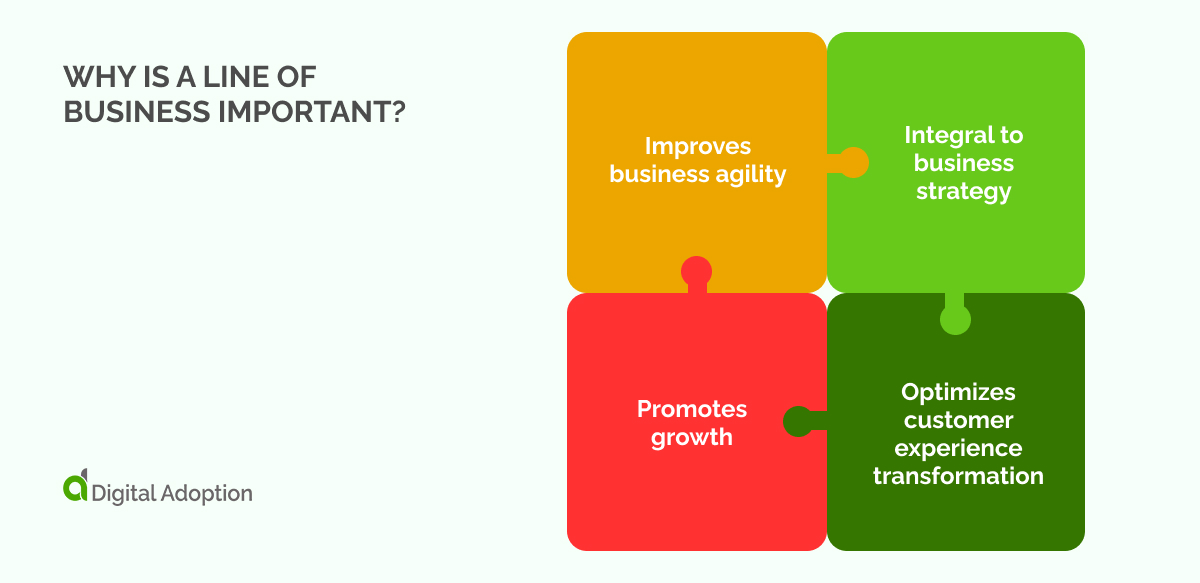
A business line is important to any business providing products or services to clients, mainly when a company has multiple LOBs providing many lines of similar products.
There are four main reasons that LOBs are helpful in business:
- Improves business agility.
- Integral to business strategy.
- Optimizes customer experience transformation.
- Promotes growth.
Through product or service life-cycle management, a line of business maintains the journey from start to finish for each item. LOBs allow you to oversee high-level collaborations that initiate processes where shared services take charge of more specific tasks.
As the product or service progresses through modifications and adaptations, life-cycle stages will be integral to these transformations to varying extents.
The value stream management of each Line Of Business (LOB) includes specific service units for its products or services.
At the uppermost level, these customized service units join up with others in a way that either directly or indirectly involves shared services to manage the thorough assignments.
LOBs are key to successful product and service development, whatever sector the product is developed for.
Various customers use the same LOB differently, meaning companies must develop different products within the same LOB.
For example, the insurance required by a large enterprise would be different from the needs of a small homeowner, though the products would be similar despite serving different needs.
Line of Business vs. Business Unit vs. Department: What’s the Difference?
These three terms are often used interchangeably inside organizations, but they describe different layers of corporate structure. Understanding the distinction helps clarify how LOBs are defined and where they sit in the organizational hierarchy.
Line of business (LOB) is defined by what the organization sells — the product or service category, and the customer segment it serves. LOBs are oriented around revenue: each LOB has its own market, its own competitive set, and often its own P&L. A company like Johnson & Johnson operates LOBs in pharmaceuticals, medical devices, and consumer health — three distinct markets with distinct strategies.
Business unit is often used synonymously with LOB, but technically refers to the organizational entity that manages a LOB. The business unit is the operational structure (the people, processes, and assets) while the LOB is the strategic scope (the market, product, and customer). In practice, most companies use the terms interchangeably.
Department is a functional unit that supports LOBs rather than defining them. Finance, HR, marketing, and IT are departments — they serve the LOBs but are not themselves lines of business. The same HR team might support three different LOBs simultaneously.
Why does the distinction matter? When organizations allocate resources, measure performance, or make acquisition decisions, they need to operate at the LOB level. Measuring the performance of the “HR department” tells you about operational efficiency. Measuring the performance of the “Commercial Insurance LOB” tells you whether the business is growing, where margins are, and whether the strategy is working.
How do different departments use a line of business?
Some large enterprises use ‘line of business’ (LOB) as a synonym for corporate division to decide how different departments meet customers’ needs.
Enterprises need to define the collaboration priorities and drivers for LOBs in each department to ensure they meet customer needs collaboratively and effectively.

- IT concentrates on achieving ROI and maintaining security and regulatory compliance by:
- Cutting application costs through the elimination of duplicate services in different LOBs.
- Ensuring a uniform user experience by providing employees with identical tools.
- Tackling the challenges of protecting privacy and data security.
LOBs prioritize departmental internal needs, often without IT input, neglecting overall organizational requirements.
Doing so involves:
- Addressing specific LOB requirements by selecting offerings tailored and optimized for particular needs, avoiding expensive IT customization.
- Supporting business objectives tied to individual team success metrics perpetuates the silo mentality that IT aims to overcome.
- Acquiring collaboration tools urgently without consulting IT or considering budget constraints.
Line of Business Examples
Lines of business exist across every industry. Here’s how different sectors define and organize their LOBs:
1. Banking and Financial Services
Major banks operate distinct LOBs including retail banking (checking, savings, personal loans), commercial banking (business lending, treasury services), investment banking (capital markets, M&A advisory), and wealth management (private banking, brokerage). Each LOB targets different customers and operates under different regulatory frameworks.
2. Insurance
Insurance carriers define LOBs by coverage type: property, casualty, life, health, commercial liability, and specialty lines (marine, aviation, cyber). Each LOB has its own underwriting teams, actuarial models, and loss ratios.
3. Healthcare
Hospital systems organize LOBs around service lines: cardiovascular, oncology, orthopedics, behavioral health, and primary care. Each service line manages its own capacity, staffing, equipment investment, and patient volumes.
4. Technology
Enterprise technology companies operate LOBs across hardware, software, cloud services, and professional services. Microsoft runs distinct LOBs in Productivity & Business Processes (Office 365, LinkedIn), Intelligent Cloud (Azure), and Personal Computing (Windows, Surface, Xbox).
5. Retail
Retail conglomerates define LOBs by format or category: e-commerce, brick-and-mortar, private label, wholesale. Amazon’s LOBs span online retail, third-party marketplace, AWS, advertising, and Prime subscription services.
6. Manufacturing
Industrial manufacturers divide LOBs by product category (automotive components, aerospace, industrial equipment) or customer segment (OEM, aftermarket, government contracts). Each LOB requires distinct supply chains, quality certifications, and sales processes.
7. Telecommunications
Telecom operators run consumer, enterprise/B2B, and wholesale LOBs — each with different pricing models, sales motions, and network infrastructure requirements.
8. Pharmaceuticals
Pharma companies organize LOBs around therapeutic areas: oncology, cardiovascular, immunology, rare diseases, generics. Each LOB manages its own R&D pipeline, regulatory strategy, and commercial infrastructure.
9. Hospitality
Hotel groups run LOBs across branded hotels, boutique properties, resorts, extended stay, and loyalty/rewards programs. Revenue management strategies differ significantly between LOBs.
10. Energy
Energy companies operate upstream (exploration, production), midstream (pipelines, storage), and downstream (refining, retail fuel) LOBs — each with distinct capital requirements and regulatory exposure.
11. Education
Universities define LOBs across undergraduate programs, graduate/professional schools, executive education, online learning, and research/grants. Each generates distinct revenue streams and serves distinct student populations.
12. Government/Public Sector
Government agencies define lines of business as distinct mission areas: tax administration, social benefits, defense procurement, infrastructure, public health. These LOBs determine budget allocation and interagency coordination.
Offer the right LOBs for your organization
Crafting the right LOBs for your organization requires a strategic blend of addressing specific departmental needs, aligning with overall organizational goals, and fostering collaboration.
Tailoring offerings to optimize functionality without excessive customization and promoting a unified approach can enhance efficiency and break down silos, propelling your organization forward.
People Also Ask
-
How can defining clear lines of business improve strategic resource allocation?Segmenting operations by distinct lines of business enables enterprises to allocate funding, talent, and technology more precisely—aligning investments with revenue-driving units and improving performance monitoring.
-
Why does separating corporate divisions into lines of business enhance customer focus?By grouping related products or services into dedicated lines, organizations can tailor strategies, offerings, and support more effectively to specific customer needs and market segments.
-
When should enterprises consider reorganizing functions into new lines of business?Reorganization is prudent during mergers, market expansion, or launch of new product families—when specialized structures can better support targeted growth and operational clarity.
-
What if IT systems are designed around generic tools—how do line-of-business apps add value?Line-of-business (LOB) applications, tailored to a unit’s operations, support mission-critical workflows more effectively than generic tools, improving efficiency and relevance.