FACT CHECKED
Why the agentic AI definition matters now

Enterprise AI spending is no longer experimental. Organizations have already committed major budgets to copilots, assistants, and workflow AI across productivity suites, ERP, CRM, ITSM, and HR systems. The problem is that many still cannot show workflow-level results or board-ready ROI.
That tension helps explain why interest in the phrase agentic AI definition is rising so quickly. Leaders are no longer asking only whether AI can write, summarize, or answer questions. They want to know whether AI can do work. Can it move a case forward, complete a handoff, fill the right fields, route an approval, or resolve a task across multiple systems?

According to a 2024 Gartner survey of more than 3,000 managers, only 8% of employees use AI in ways that meaningfully improve their work. Gartner research also finds 95% of CIOs expect significant AI value from their investments. That gap is not just about model quality. It is about whether AI can operate reliably inside the workflows where enterprise value is actually created.
What does agentic mean in AI?
In plain language, agentic means acting with agency toward a goal.
In AI, that usually refers to a system’s ability to pursue an objective, make decisions within defined boundaries, take actions, and adjust based on feedback. Instead of stopping at a recommendation, an agentic system can move toward execution.
A concise agentic AI definition
Agentic AI is artificial intelligence designed to perceive context, reason about goals, take actions across tools or workflows, and adjust based on results with varying levels of human oversight.
That is the search-friendly definition. In enterprise terms, the important distinction is simple: agentic AI aims to turn AI output into workflow execution.
What is agentic artificial intelligence and how does it work?
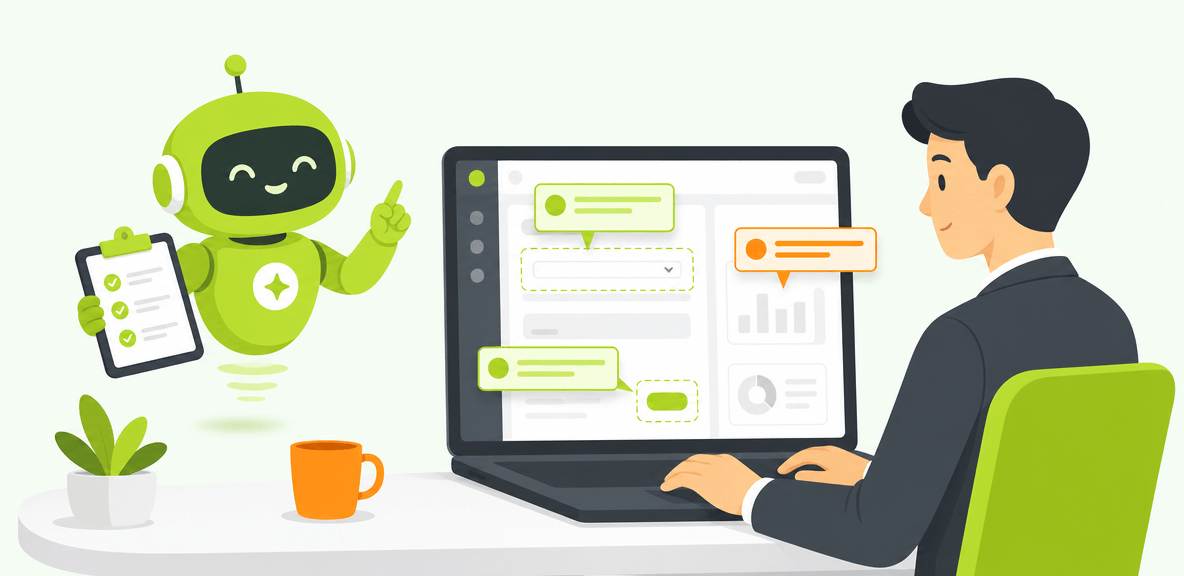
At a technical level, agentic AI combines several capabilities that work together: perception, reasoning, planning, execution, and learning. Not every system includes all five at the same depth, but the more agentic the design, the more the system can move from suggestion to action.
It also helps to clarify what agentic AI is not. It is not one fixed product category. It is better understood as a design pattern for AI systems that can interpret goals, use available tools, and act in sequence.
That matters because simple automation has existed for years. A rule-based workflow that sends an email after form submission is not usually considered agentic. An AI-driven system that interprets the situation, chooses the next best action, and completes a task with oversight is closer to the mark.
The five core capabilities behind agentic systems
Most agentic systems rely on five core capabilities:
- Perception: taking in signals such as user input, application state, documents, messages, or screen-level context.
- Reasoning: evaluating options, constraints, and likely outcomes.
- Goal interpretation or planning: deciding what steps are needed to achieve the objective.
- Execution: taking actions through software tools, interfaces, or workflows.
- Feedback and adjustment: checking results, identifying failures, and rerouting or escalating when needed.
This is why enterprise architecture matters so much. If the system cannot perceive the right context or act across the right systems, its reasoning quality alone will not produce business value.
Agentic AI vs AI agents: what is the difference?
An AI agent is usually a specific software entity that performs tasks on behalf of a user or system. Think of it as the operational unit.
Agentic AI is the broader capability or architectural pattern that makes that kind of autonomous or semi-autonomous action possible. In practice, an organization may deploy many AI agents, but the underlying design principles that allow them to reason and act are what make the environment agentic.
Agentic AI vs generative AI
Generative AI and agentic AI are related, but they are not the same.
Generative AI produces outputs such as text, images, code, summaries, or recommendations. Agentic AI can use those outputs as part of a larger decision and execution flow. The difference is the move from content generation to work completion.
The two are complementary. Many agentic systems depend on generative models for language understanding or reasoning. But they add planning, tools, policy controls, and execution layers on top.
Where agentic AI creates value in the enterprise
Agentic AI becomes relevant when work spans multiple systems, approvals, dependencies, and repetitive but variable tasks. That is why the idea is resonating so strongly with enterprise leaders. Real work rarely stays inside a single application.
A demo may show an AI assistant performing one isolated action well. Enterprise reality looks different. Workflows cross SAP, Salesforce, ServiceNow, Outlook, Slack, and custom or legacy applications. Each boundary creates friction. Each missing handoff reduces AI adoption and makes ROI harder to prove.
This is the core reframe. The challenge is not only whether the model is capable. It is whether the system has the context, execution reach, and accountability required to operate inside live enterprise workflows.
Agentic AI examples by business function
Here are common enterprise use cases where agentic AI can create value:
- IT service resolution: classify incoming tickets, pull context from the request, recommend or trigger next steps, and advance the case through the right systems.
- HR onboarding tasks: coordinate documents, provisioning, policy acknowledgments, and follow-up actions across HR and IT tools.
- Sales follow-up workflows: summarize meetings, create CRM updates, draft outreach, and trigger next actions based on deal stage.
- Procurement steps: route requests, check fields, flag missing data, and move approvals forward.
- Finance exception handling: identify anomalies, surface required evidence, and guide resolution workflows.
- Customer support case progression: summarize interactions, recommend actions, update systems, and route escalations.
Why copilots alone often stop short
Copilots can be highly effective at summarizing, drafting, or recommending inside one environment. But enterprise work often breaks at cross-application boundaries.
Even if your copilot works perfectly, it still needs context it cannot get on its own. It may not see the form your employee is viewing, the state of the workflow in another application, or the next step required outside its own ecosystem. It also may not have the execution reach to complete the task where work actually happens.
That is why WalkMe frames itself as complementary to copilots. WalkMe completes them. It does not compete with them.
What agentic AI needs to work in practice
To work in enterprise conditions, agentic AI needs more than a capable model. It needs:
- Screen-level context so the system understands what the employee is seeing in real time
- Cross-application unification so context can carry across systems
- Workflow execution where APIs do not exist or do not cover the full task
- Adoption analytics so leaders can prove whether AI is being used and producing outcomes
This is where WalkMe’s point of view becomes practical. The action bar sits where employees actually work. It can surface the next best action, connect context across applications, and support execution and accountability where enterprise workflows are most likely to stall.
The risks, limits, and governance requirements leaders should understand
Agentic AI is promising, but it is not a shortcut around broken processes, poor source data, or weak operating models. If the workflow itself is flawed, adding autonomy will expose the flaw faster. It will not correct it.
Enterprise leaders are right to focus on privacy, compliance, model errors, uncontrolled actions, unclear accountability, and employee trust. Many AI projects fail not because autonomy is impossible, but because execution is blind, ungoverned, or disconnected from live workflows.
Common limitations of agentic AI today
Common failure modes include:
- incomplete or missing context
- limited tool access
- brittle integrations
- hallucinated reasoning or flawed decision paths
- edge cases the system cannot resolve
- escalation loops when the agent gets stuck between systems or policies
These are not minor issues. They directly affect AI adoption because employees stop trusting systems that fail at the moment of execution.
Why enterprise governance cannot be an afterthought
Governance needs to be built into the architecture from the start. In regulated or high-risk environments, that means deterministic execution paths, human oversight, approval thresholds, audit trails, and policy controls.
The goal is not unconstrained autonomy. It is governed autonomous execution. Enterprise leaders need to know what the system can do, when it can do it, what data it used, and how to intervene when needed.
Computer use agents and the architecture question
Computer use agents are a real and important category. They point toward AI systems that can interact with interfaces and complete tasks in the UI layer.
The enterprise question is not whether that direction matters. It is whether the architecture is ready for enterprise requirements. Some computer use agents rely on screenshots sent to cloud servers. That raises serious questions about privacy, compliance, and consent in regulated environments.
WalkMe’s approach is different. WalkMe acts locally through direct UI interaction with no screenshots and no screen capture in transit. That distinction matters for security teams evaluating whether AI execution can be approved at scale.
How to evaluate agentic AI tools and prove business value
A useful evaluation starts with the workflow, not the demo. What problem is the agent solving? Where does it act? What systems does it cross? What happens when the workflow changes or fails?
This is also where AI accountability matters. Active licenses and polished demonstrations are not enough. Organizations need evidence that AI use is translating into completed workflows, time saved, lower error rates, and measurable business outcomes.
S&P Global research finds that 42% of companies abandoned the majority of their AI initiatives in 2025. That is a reminder that capability alone does not create value. Measurable performance does.
Questions to ask when comparing agentic AI tools
When evaluating tools, ask:
- How does the system access context?
- Can it work across applications, or only within one vendor ecosystem?
- How does it execute workflows when APIs are incomplete?
- What governance model is built in?
- What analytics does it provide beyond activation data?
- What implementation effort is required?
- How well does it work with existing copilots and enterprise software?
What to measure beyond activation
Leaders should measure more than whether a license was turned on. Focus on:
- AI adoption rate by workflow
- task completion rate
- abandonment points
- time savings at the task level
- exception or error rates
- business outcome reporting for CIO and CFO audiences
This is how AI moves from promise to performance. It also gives you the board-ready answer to the question many leaders still cannot answer: is our AI investment working?
Where WalkMe fits in the agentic AI stack
WalkMe fits as the execution and accountability layer that helps complete copilots through the action bar.
Its framework is straightforward:
- SEE: screen-level context in real time
- UNIFY: cross-application unification across enterprise software
- ACT: UI-native execution where APIs do not exist
- PROVE: adoption analytics and workflow-level evidence
That combination matters because enterprise AI performance depends on more than model output. It depends on whether AI can see, act, and be measured where work happens.
The future of agentic AI in the enterprise
The market is moving from AI that answers to AI that executes. But enterprise success will depend less on bold autonomy claims and more on governed AI adoption.
That is why the long-term direction is so important. In many enterprises, critical workflows still live in interfaces with incomplete API coverage. The UI remains the place where work gets done. The UI is the ultimate API.
From assistive AI to governed autonomous execution
The likely maturity path is clear:
- AI recommendations and summaries
- guided actions inside workflows
- deterministic workflow execution
- broader governed autonomous execution over time
Organizations that build this path carefully will be in a stronger position than those chasing autonomy without controls.
What leaders should do next
Start with high-friction workflows. Measure outcomes early. Keep humans in control where needed. Prioritize platforms that can prove AI adoption and performance, not just generate output.
The companies that define how agentic systems act safely across real workflows will be better positioned to convert AI potential into AI performance. If proving AI ROI is the next conversation you are having with your board, the WalkMe action bar is where that proof starts.
People Also Ask
-
What is the simplest agentic AI definition?Agentic AI is AI designed to understand context, pursue a goal, take actions, and adjust based on results, often with human oversight.
-
What does agentic mean in artificial intelligence?In artificial intelligence, agentic means the system has agency. It can make decisions within boundaries and act toward an objective instead of only generating a response.
-
What is the difference between agentic AI and generative AI?Generative AI creates outputs such as text, code, or summaries. Agentic AI uses AI outputs as part of a broader system that can plan, decide, and execute tasks.
-
What are real-world agentic AI examples in the enterprise?Examples include IT service resolution, HR onboarding coordination, sales follow-up workflows, procurement approvals, finance exception handling, and customer support case progression.
-
How do you evaluate agentic AI tools for security and ROI?Evaluate how the tool accesses context, where it can act, how it handles governance, what systems it crosses, and what analytics it provides. For ROI, measure workflow completion, time saved, error reduction, abandonment points, and business outcomes.
-
Can agentic AI act across multiple enterprise applications?Yes, but only if the architecture supports cross-application unification and workflow execution across those systems. That is where many tools fall short, especially when work moves beyond a single application or vendor ecosystem.