 FACT CHECKED
Higher education is undergoing a major digital transformation.
Universities are strategically investing in technologies that enhance teaching and learning. This promotes innovative delivery methods, making education more accessible and engaging for students.

Technology is fundamentally reshaping the educational experience. Institutions offer a range of tools, from online courses to digital learning platforms. These advancements extend even further, including AI-powered tutoring and virtual reality simulations.
Institutions embracing digital transformation are well-positioned to attract more students and deliver better education.
Universities are digitally revamping themselves for more than one reason. This transformation isn’t just about tech. It’s about making core education better for all students. Cost savings and smoother operations are perks, but the real win is boosting learning for everyone.
This article will explore the role of digital transformation in higher education. First, we’ll start with a definition and then cover the impact, objectives, and examples of modern digital transformation in higher education.
What is digital transformation in higher education?
Digital transformation in higher education refers to a university, research, or educational institution’s adoption of technology.
This includes leveraging digital solutions to heighten teaching standards and undertake innovative research.
To avoid confusion, let’s define ‘higher education.’
Higher education offers a path for both professional development and personal enrichment. Companies often encourage employees to pursue further education to enhance their skill sets.
Learning institutions are embracing digital transformation by integrating technology into their teaching methods. This creates a more engaging and flexible learning experience for students.
For students, purposeful technology adoption lowers the barrier to learning through digital solutions. Today’s students can fast-track learning while accessing a wealth of educational resources anywhere in the world.
Students can also communicate and collaborate with peers and teachers in real-time. This encourages new and innovative ways to learn together. Universities and colleges may also deploy digital strategies to enhance lesson design, teach classes remotely, and improve faculty skills.
The full impact of technology on education remains to be seen. However, digital advancements in teaching and learning methodologies show significant promise.
According to World Metrics, higher education’s digital virtual learning market is poised for significant growth. Projections are set to reach $12.86 billion by 2025. This trend suggests a growing appetite for online learning options within higher education institutions.
What is the impact of digital transformation in higher education?
Historically, universities, colleges, and educational institutions have been core information and knowledge centers. Learners have long been limited to the physical proximity of these educational environments. This is often the only source of access to higher learning.
Tech developments have made higher education more instant and accessible. Students can utilize various digital tools and resources to enhance their learning across multiple subjects.
Take established Learning Management Systems (LMS) platforms like Canvas and Blackboard. These platforms underpin higher learning capabilities. They offer intuitive interfaces and mobile compatibility for on-the-go learning.
Cloud adoption is empowering both e-learning platforms and research with readily accessible data. This focus on accessibility extends to the learning experience itself.
VR creates immersive learning environments. And social media bridges the gap between students and institutions.
Webinars connect learners with global experts, and blockchain technology offers secure record-keeping for the future. Even AI-powered chatbots are on the horizon, providing personalized learning support.
All this progress is backed by the reliable storage of research data in the cloud.
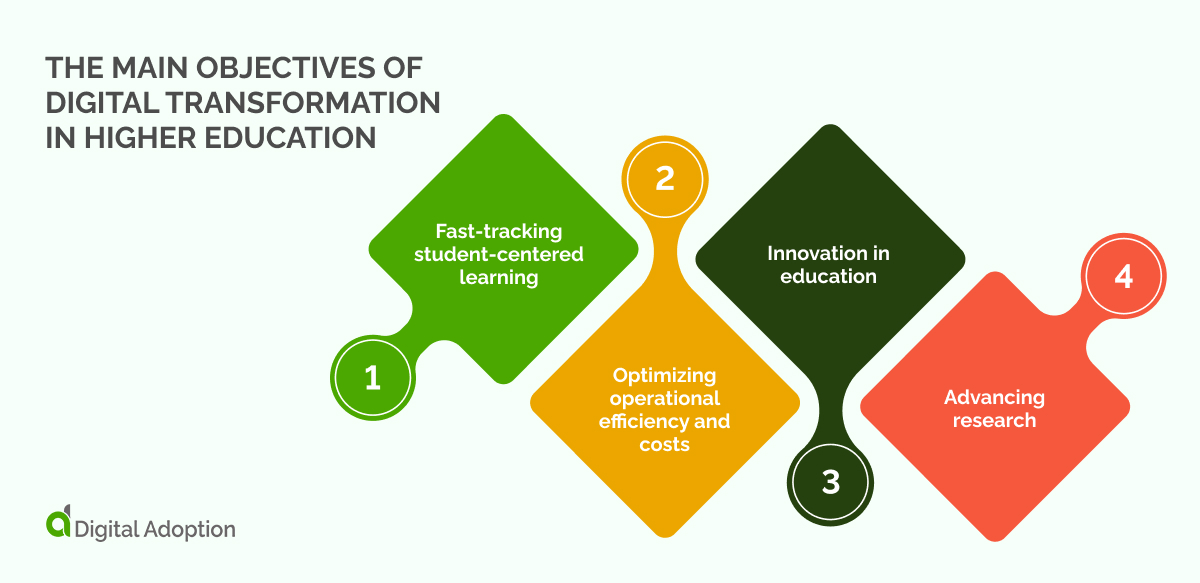
What are the main objectives of digital transformation in higher education?
Higher education boasts untapped potential for digital transformation. However, leaders must prioritize strategic investments over impulsive tech spending.
A strategic approach is crucial. You should consider factors like alignment with learning goals and cost-effectiveness.
This ensures long-term value from these investments in digital transformation.
As universities embrace the digital age, what goals drive transformation in teaching, learning, and research?
Fast-tracking student-centered learning
Indiscriminate blanket learning models are out. Enter a new era of personalized education.
AI tutors tailor lessons to individual needs, while adaptive platforms adjust difficulty on the fly. Mind-blowing VR experiences bring complex concepts to life in a way traditional lectures simply can’t.
This student-centric approach keeps learners engaged and empowers them to learn at their own pace. Flexible online courses, mobile apps, and free learning materials also break down barriers. This makes quality education accessible to everyone, regardless of background or location.
Optimizing operational efficiency and costs
University administration is getting a digital makeover. Gone are the days of endless paperwork. Automation, cloud systems, and data transformation streamline tasks like registration and financial aid. This allows faculty and staff to focus on what matters most: teaching, researching, and supporting students.
Additionally, online collaboration tools connect everyone across departments and even continents. This helps promote a more dynamic and efficient learning ecosystem.
Importantly, these digital solutions also contribute to cost optimization. Streamlined operations mean less administrative bloat. This frees resources for cutting-edge learning experiences and student support.
Innovation in education
Digital transformation isn’t just about efficiency. It’s about pushing the boundaries of education.
VR, AR, and other immersive technologies breathe life into complex concepts. Data analytics are helping educators refine their programs for even better results.
Universities are becoming innovation hubs. They are exploring new ways to make learning more engaging and effective. This ensures they remain at the forefront of knowledge creation and dissemination in the digital age.
AI in Higher Education: How Universities Are Using AI in 2026
Artificial intelligence has moved from a curiosity to a core component of university operations. By 2026, institutions that once piloted AI in a single department are deploying it institution-wide — changing how students learn, how faculty teach, and how administrators manage everything from enrollment to campus safety.
AI-Powered Personalized Learning
Adaptive learning platforms now use AI to analyze how individual students engage with course material — identifying when a student is struggling before they fall behind. Tools like Coursera’s AI tutor, Carnegie Learning’s MATHia, and Arizona State University’s internally built adaptive systems can adjust the pace, format, and difficulty of content in real time. Early adopters report 15–25% improvements in course completion rates for at-risk student populations.
AI in Student Support and Early Intervention
One of the highest-impact applications of AI in higher education is early warning systems. By analyzing patterns in LMS logins, assignment submission times, grade trajectories, and even campus dining card usage, universities can flag students at risk of dropping out weeks before the student themselves recognizes the problem. Georgia State University’s Advising Early Alert system, powered by predictive analytics, helped the university eliminate its graduation rate gap between Pell Grant and non-Pell students — a result that took five years but is now being replicated at institutions nationwide.
Generative AI for Teaching and Administration
Faculty are using generative AI tools to build course materials, draft assessments, and create accessible content alternatives (audio descriptions, translated readings, simplified summaries) at a fraction of the previous cost. On the administrative side, AI chatbots handle high-volume student inquiries — financial aid questions, registration help, housing applications — freeing staff for complex cases. Institutions like MIT and UC San Diego have deployed AI assistants that handle tens of thousands of student interactions per semester.
The Governance Challenge
Alongside opportunity comes complexity. Universities are investing heavily in AI governance frameworks: academic integrity policies, faculty training programs, and ethical AI committees. The institutions making the most progress are those treating AI not as an IT project but as a campus-wide academic initiative with clear ownership at the provost or deputy vice-chancellor level.
Advancing research
Transformation efforts leverage data as a resource. This makes information accessible to all students across various disciplines.
Digital libraries can channel an innumerable amount of information. This can include dissertations, publications, abstracts, and studies. It creates a more open and collaborative research environment where students can access information pools instantly.
High-performing computing, cloud storage, and big data analytics fuel this evolution.
Secure digital platforms enabled by these advancements are accelerating scientific progress. Researchers can now seamlessly share data and collaborate. This leads to a previously unimaginable pace of knowledge discovery.
What are some examples of digital transformation in higher education?
We’ve identified the following examples to help you better understand the impact of digital transformation in higher education.
Online learning platforms (OLPs)
These virtual classrooms offer courses and programs accessible worldwide. Students can learn asynchronously, at their own pace.
This makes education more flexible for working professionals or those facing geographical limitations. OLPs expand educational reach. They allow universities to cater to a wider audience and cater to diverse learning styles. They often feature interactive elements and multimedia resources.
They do this to create a dynamic learning environment. However, some challenges remain. These include ensuring student engagement and replicating the richness of face-to-face interaction.
Learning management systems (LMS)
LMS streamlines course management. It allows instructors to upload materials and communicate with students through forums.
This facilitates easy interaction, fosters collaboration, and provides valuable data on student performance. Instructors can analyze this data to identify areas for improvement and adapt their teaching strategies.
LMS can also integrate with other digital tools. For example, plagiarism checkers and online grading systems. This further enhances the efficiency and effectiveness of online learning.
Big data and analytics
Universities are using data to personalize learning and improve student success. Educators can identify students struggling in specific areas. They offer targeted support by analyzing vast amounts of information.
This includes quiz results, online forum participation, and learning material access patterns. This data-driven approach allows for early intervention, personalized learning plans, and catering to individual student needs and learning styles.
Big data can also assess the effectiveness of teaching methods and curriculum design, leading to continuous improvement in pedagogy. However, ethical data privacy and security considerations need to be addressed when collecting and using student data.
Virtual reality (VR) and augmented reality (AR)
These immersive technologies are revolutionizing education. VR throws open the doors to realistic simulations.
Students can travel back in time and experience historical events firsthand. VR also allows for safe virtual labs and low-risk practice of medical procedures. Imagine experiencing the fall of the Roman Empire or dissecting a virtual frog—that’s the power of VR.
Students can even view 3D models of human anatomy through their phones and explore historical landmarks with virtual overlays. This enriches and enhances their understanding of the physical world. However, the cost of VR and AR equipment and the need for robust technological infrastructure are potential challenges to widespread adoption.
Artificial intelligence (AI) tutors and personalized learning
Imagine having a tireless, 24/7 study buddy who tailors their approach just for you. AI tutors are making this a reality.
These intelligent programs can answer your questions, clarify confusing concepts, and offer personalized practice exercises. They analyze your learning patterns and adjust their approach based on your strengths and weaknesses.
This customized learning experience allows you to progress at your own pace. It also maximizes your learning potential. While AI tutors can’t replicate the human touch of a professor, they can be a valuable supplementary resource, providing on-demand support whenever you need it.
Collaboration tools and online communities
Gone are the days of learning in isolation. Digital platforms transform learning into a collaborative experience. Online forums, discussions, and real-time tools connect students and faculty, fostering knowledge sharing.
Brainstorm research with classmates worldwide or join a live Q&A with an expert. These are just a few possibilities unlocked by digital learning and online communities. This collaborative approach enhances your understanding and develops valuable communication and teamwork skills.
Gamification and interactive learning
Gamification injects a dose of fun and competition into learning—no more passive lectures. Dive into interactive quizzes that transform learning into a race for the top spot on the leaderboard.
Educational games test your historical knowledge by placing you in historical scenarios. In simulations that let you apply scientific principles, you can build your own virtual bridge.
Gamification transforms dry lectures into interactive experiences. For example, you can dissect a virtual frog with exploding views and interactive labels, earning points for correctly identifying organs. This engaging approach boosts motivation and solidifies your grasp of complex concepts.
Open educational resources (OERs) and accessibility
Quality education shouldn’t come with a hefty price tag. Open Educational Resources (OERs) are a game-changer for students facing financial limitations.
These freely available online resources include textbooks, video lectures, and course modules curated by educators worldwide. You can access a vast library of top-notch learning materials at your fingertips.
OERs democratize access to high-quality education, promoting inclusivity and empowering students to take charge of their learning journey.
Cloud-based learning management systems (LMS) and mobile learning
Cloud-based LMS platforms offer unparalleled flexibility for busy students. Did you miss a lecture? Stream the recording on your phone during your commute.
Review study guides while waiting in line. Participate in online discussions with classmates from the comfort of your couch. These platforms offer a significant advantage. They store all your course materials, assignments, and discussions online.
This translates into unparalleled accessibility. You can access them anytime, anywhere, from any device.
Mobile learning empowers students by allowing them to take control of their learning journey. They can adapt to their busy schedules and learn at their own pace, and the traditional classroom transforms into a portable learning environment.
University Digital Transformation Examples: Real-World Case Studies
Abstract discussions of digital transformation become concrete when you look at what leading universities have actually built. These case studies illustrate the range of approaches — from AI-first strategies to total campus infrastructure overhauls.
Massachusetts Institute of Technology (MIT) — Digitizing the Research Enterprise
MIT’s digital transformation extends well beyond its classrooms. The university has integrated cloud-based research data platforms that allow cross-departmental and cross-institutional collaboration on large datasets in real time. Its MIT OpenCourseWare initiative — now supplemented by AI-generated study aids and interactive problem sets — has become a global benchmark for open educational resources. Internally, MIT has automated much of its grant administration workflow, reducing processing time for research funding applications by over 30%.
Arizona State University (ASU) — Scaling Access Through Technology
ASU has become the most-cited example of digital transformation at scale in U.S. higher education. The university enrolled over 140,000 online students in 2025, supported by a digital infrastructure that includes AI-driven advising, an adaptive learning platform deployed across 100+ courses, and a custom analytics dashboard that gives academic leaders real-time visibility into student outcomes across every program. ASU’s approach is explicitly mission-driven: technology investments are evaluated against their impact on first-generation and low-income student graduation rates.
Georgia Institute of Technology — AI Teaching Assistants and Cost Reduction
Georgia Tech’s experiment with Jill Watson — an AI teaching assistant built on IBM Watson, later rebuilt on large language model architecture — demonstrated that AI could handle 40% of student questions in a graduate-level online course without students noticing the difference. The university has since expanded AI-assisted instruction across multiple programs, and its online Master of Science in Computer Science program uses digital delivery to serve over 12,000 students at a fraction of traditional tuition costs.
The University of Edinburgh — Digital Campus Infrastructure
The University of Edinburgh’s transformation program focused on unifying its campus technology stack: consolidating 27 separate HR and finance systems into a single cloud ERP, deploying smart building sensors to reduce energy costs by 18%, and building a centralized data warehouse that connects student records, learning analytics, and research outputs for the first time. The program took four years and required a dedicated change management function to manage faculty and staff resistance.
Digital Transformation Tools for Universities
Successful higher education digital transformation depends on selecting the right platforms — and integrating them. Below are the key technology categories and leading tools universities are deploying in 2026.
Learning Management Systems (LMS)
The LMS is the digital backbone of instruction. Canvas (Instructure) and Blackboard Ultra dominate the U.S. market, while Moodle remains the most widely used open-source option globally. Modern LMS platforms do more than host content — they integrate with AI tutoring tools, proctoring systems, accessibility checkers, and third-party publishers to create a unified learning environment. When evaluating an LMS, institutions should prioritize API flexibility, mobile experience quality, and analytics depth.
Student Success Platforms
Tools like EAB Navigate, Civitas Learning, and Salesforce for Education connect academic records, advising notes, and engagement data to give advisors a 360-degree view of each student. These platforms are increasingly AI-powered, flagging students for outreach before they miss the point of intervention.
Analytics and Business Intelligence
Institutional research teams are moving from static reporting to real-time analytics dashboards. Tableau, Power BI, and purpose-built higher education platforms like Civitas and Qualtrics XM for Education give academic leaders the data they need to make enrollment, retention, and resource allocation decisions quickly.
Cloud Infrastructure and Collaboration
Microsoft 365 for Education and Google Workspace for Education have replaced on-premise infrastructure at most institutions. Beyond email and document sharing, these platforms provide video conferencing (Teams, Meet), collaborative authoring, and cloud storage with built-in compliance tools for FERPA and GDPR requirements.
Digital Adoption Platforms (DAPs)
As universities deploy more software, training becomes a bottleneck. Digital adoption platforms — including WalkMe, Whatfix, and Pendo — overlay in-app guidance on top of existing software, reducing IT support tickets and accelerating staff and student onboarding to new tools. University IT teams are increasingly using DAPs to manage the change management dimension of technology rollouts.
What are the benefits of digital transformation for higher education institutions?
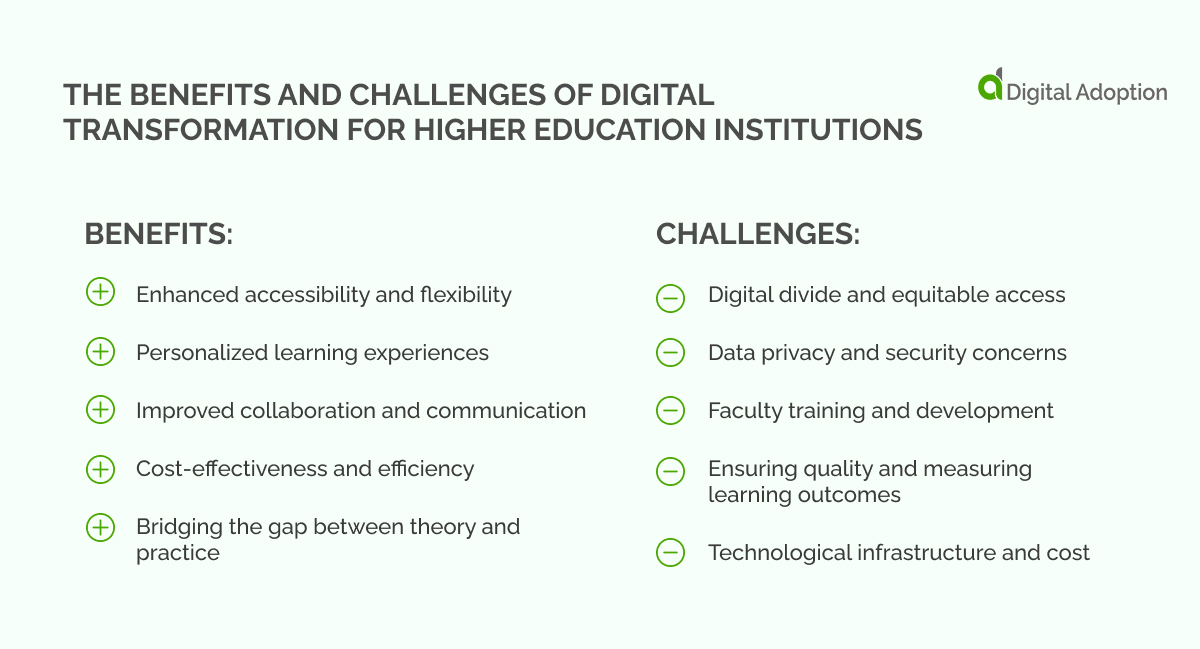
It’s important to understand the benefits of digital transformation in higher education to make informed decisions about the future of teaching and learning.
Let’s dive in.
Enhanced accessibility and flexibility
Online learning platforms, Open Educational Resources (OERs), and mobile learning are revolutionizing education. Students can now learn anytime, anywhere, regardless of their learning style, schedule, or location. This increased accessibility opens doors for everyone to pursue educational goals.
Personalized learning experiences
Big data and analytics empower educators to personalize learning. They can tailor the experience to individual student needs, ensuring a better fit for each learner. This personalization goes even further with AI tutors, gamification, and interactive learning tools. These engaging tools encourage deeper engagement and maximize student potential. It does this by catering to individual learning styles.
Improved collaboration and communication
Collaboration tools and online communities connect students and faculty across borders. This promotes teamwork, knowledge sharing, and diverse perspectives. This collaborative learning environment simulates real-world scenarios. It also hones communication skills vital for professional success.
Cost-effectiveness and efficiency
Digital tools like online courses and cloud-based LMS reduce operational costs for universities. Personalized learning pathways and efficient communication channels can minimize wasted time and resources for students and faculty.
Bridging the gap between theory and practice
VR, AR, and simulations create immersive learning environments. These environments allow students to apply theoretical knowledge in practical settings. This promotes critical thinking and prepares students for careers in an increasingly technology-driven world.
What are the challenges of digital transformation for higher education institutions?
Now that you understand the benefits of digital transformation in higher education, we will explore the challenges of effectively implementing these new technologies in the classroom.
Digital divide and equitable access
Ensuring all students have the necessary devices and internet access is crucial for equitable participation. Initiatives like loaner programs or subsidized internet plans can address this. However, varying levels of technical literacy can disadvantage some students. Institutions can bridge this gap by offering training workshops.
Data privacy and security concerns
The collection and analysis of student data raises concerns about breaches, misuse, or non-compliance with data privacy regulations. Robust cybersecurity measures, clear data governance policies, and student transparency regarding data usage are all essential steps to ensure data protection.
Faculty training and development
The transition to digital learning requires professors to adapt their teaching methods and embrace new technologies. This necessitates training on integrating technology for active learning, developing technical skills, and managing the additional workload. Universities can support faculty through workshops, ongoing technical support, and incentive programs that encourage innovation with new technologies.
Ensuring quality and measuring learning outcomes
Evaluating the effectiveness of these digital tools is another challenge. Institutions must ensure online learning initiatives meet objectives and maintain accreditation standards. This necessitates developing clear learning goals, utilizing diverse assessment methods, and analyzing student data on engagement, performance, and satisfaction to identify areas for improvement.
Technological infrastructure and cost
The financial investment required for digital transformation can significantly strain universities. Upfront costs for hardware, software, and learning platforms, along with ongoing maintenance and scalability considerations, must all be factored in. Institutions can explore options like grant funding, strategic resource allocation, open-source software, and partnerships to manage these financial burdens.
Striking a balance: Digital transformation in education
Digital transformation is reshaping higher education, offering a treasure trove of possibilities.
Online learning platforms offer a gateway to accessible education, allowing students to learn anytime, anywhere. The future goes beyond accessibility. Immersive VR experiences personalize learning, creating a more engaging journey for each student.
These advancements unlock a fate where education is flexible, personalized, and truly captivating.
However, navigating the new normal requires a balanced approach.
While AI tutors can provide on-demand support, they can’t replace the depth of human interaction with professors. Cost-effective online courses are fantastic, but ensuring equitable access for all students remains challenging.
Strategic use is crucial. We need to leverage the strengths of digital tools while acknowledging their limitations.
Striking this balance is the key to a healthy digital transformation. It can revolutionize education, empowering students and propelling them towards a brighter future.
But finding this balance is crucial.
When educators embrace digital tools while safeguarding the value of human interaction, they create a rich and dynamic learning environment that equips students for the future.