FACT CHECKED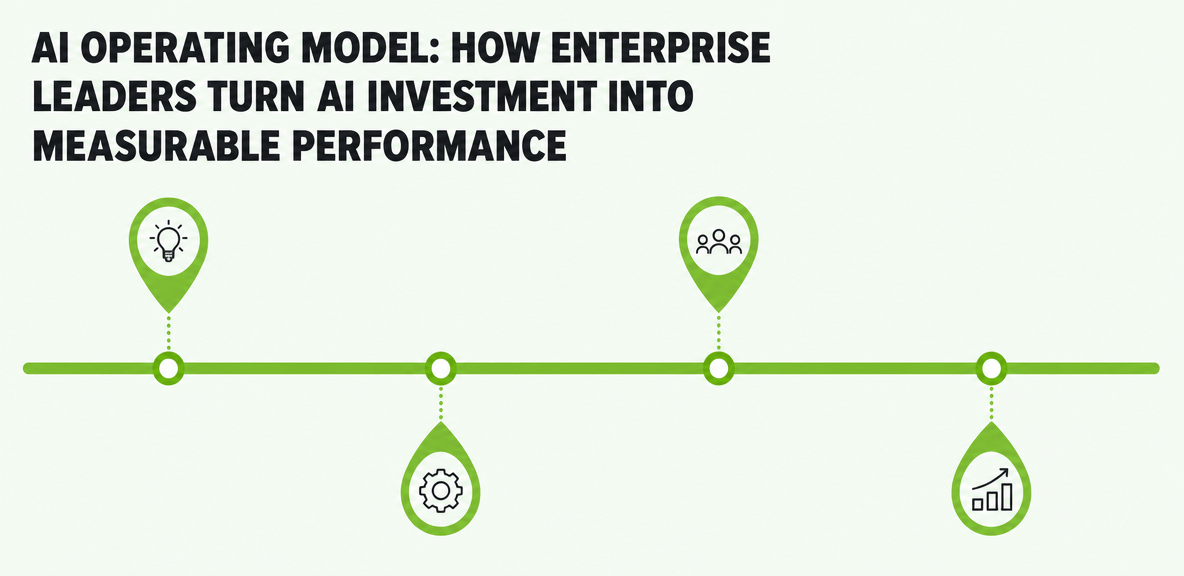
What is an AI operating model, and why does it matter now?

An ai operating model is the way an enterprise organizes decision rights, workflows, governance, technology, and measurement to turn AI use cases into repeatable business outcomes.
That definition matters because many organizations still confuse an operating model with planning documents. An AI strategy explains where you want to go. A technical architecture explains how systems connect. An org chart shows who reports to whom. An AI operating model explains how work actually gets done once AI enters live workflows.

That distinction has become urgent. Many enterprises have already licensed copilots, assistants, and automation tools across Microsoft 365, SAP, Salesforce, ServiceNow, and other environments. But licensing AI is not the same as operationalizing it. Leaders are still being asked basic questions they cannot answer with confidence: Who owns adoption? Which workflows improved? Where did employees stop using the tool? What business result changed?
According to a 2024 Gartner survey of more than 3,000 managers, only 8% of employees use AI frequently in ways that meaningfully improve their work. Gartner research also finds 95% of CIOs expect significant AI value from their investments. That gap is why the AI operating model conversation has moved from innovation teams to the boardroom.
AI operating model vs organizational structure
Organizational structure defines reporting lines. It tells you who sits in a central AI team, who belongs to a business unit, and where responsibility lives on paper.
An operating model goes further. It defines how AI decisions are made, how use cases are approved, how workflows are redesigned, how risk is managed, and how results are measured across teams. Two companies can have the same org chart and very different operating models. One may have clear approval paths, workflow metrics, and accountability for adoption. The other may have committee ownership but no reliable way to move from pilot to production.
Why AI pilots fail without an operating model
Most failed AI pilots do not fail because the underlying model is unusable. They fail because the enterprise never built the conditions for repeatable execution.
S&P Global research finds that 42% of companies abandoned the majority of their AI initiatives in 2025. In many cases, the pattern is familiar: unclear ownership, weak process integration, limited training, and no accountability after launch. A pilot may demonstrate capability in isolation. It does not prove that employees can apply AI consistently inside the workflows that matter.
Without an operating model, AI remains a series of disconnected experiments. With one, it becomes a managed system for business performance.
What are the core components of an enterprise AI operating model?

A strong enterprise AI operating model connects six components: business priorities, governance, data and technology, workflow design, talent and change management, and performance measurement.
These are not abstract maturity categories. They only matter if they work together in live workflows. If your governance model is strong but your employees cannot apply AI in the systems they use every day, value stalls. If your use cases are promising but nobody measures adoption or completion, ROI becomes guesswork.
The strongest models are built around execution in the applications where work already happens. That is where digital adoption becomes central. AI value is not created when a tool generates a response. It is created when that response leads to a completed task, a faster process, or a measurable business outcome.
Business value and use case prioritization
Use case selection should start with business value, not novelty.
Prioritize AI opportunities based on four factors: workflow frequency, measurable business impact, risk level, and ease of proving results. A use case that touches a high-volume process in finance, HR, IT, or operations will usually create more measurable value than a low-frequency experiment with broad theoretical appeal.
This also keeps the operating model grounded. Instead of asking, “Where can we use AI?” ask, “Which workflows create enough friction, volume, and measurable cost to justify intervention?”
Governance, risk, and decision rights
Governance should define who owns policy, what requires approval, and where human oversight remains mandatory.
In practice, that means setting approval thresholds for high-impact workflows, defining model usage controls, documenting exception handling, and ensuring that actions can be audited. This matters most in regulated environments, but it also matters in ordinary enterprise operations where AI-generated errors can create finance, compliance, or customer risk.
A useful AI operating model does not treat governance as a separate workstream. It embeds it into workflow design and decision rights from the start.
Data, technology, and workflow execution
This is where many AI programs lose credibility. The model may generate a useful answer, summary, or recommendation. But enterprise value depends on whether employees can apply that output across applications and complete the actual workflow.
In most large organizations, work crosses systems. An employee might summarize an email in Outlook, update a case in ServiceNow, complete a transaction in SAP, and check a customer record in Salesforce. AI capability inside one application does not solve the full task.
That is why workflow execution matters as much as model quality. The operating model should account for how AI outputs move into action across the enterprise application environment, including workflows where API coverage is limited.
Talent, training, and change management
Training remains necessary, but it is not sufficient.
A 2024 Gartner survey identifies the top barriers to AI adoption as lack of training at 30%, change resistance at 30%, poor AI quality at 29%, and no process integration at 26%. That mix is revealing. The barriers are not only technical. They are behavioral and operational.
One-time education rarely creates sustained AI use. Employees need reinforcement in the flow of work, especially when they are expected to adopt new tools and new ways of thinking at the same time. This is where digital adoption practices matter. Guidance has to show up when the employee is doing the task, not weeks earlier in a training session.
Measurement and AI accountability
An AI operating model needs clear definitions of success before rollout begins.
Measure adoption by workflow, workflow completion rates, time saved, friction points, exception rates, and business outcomes tied to the process itself. Those metrics give leaders a defensible way to discuss performance. They also help isolate whether the issue is tool quality, process design, employee behavior, or governance friction.
For a CIO or CFO, AI accountability means being able to answer a simple question with evidence: is this investment changing how work gets done?
Which AI operating model structure fits your enterprise?

Enterprises usually evaluate four structures: centralized, federated, hub-and-spoke, and embedded.
No single model is universally best. The right choice depends on your risk profile, data maturity, business unit autonomy, application sprawl, and how quickly you need to prove value.
Centralized model
A centralized model places standards, governance, use case selection, and often delivery within one core team.
This approach works well for early-stage AI programs, especially where governance requirements are high or the organization needs common standards before scaling. It reduces fragmentation and helps establish policy discipline.
The tradeoff is speed. If every use case must wait on a central team, delivery becomes a bottleneck. Business units may then create side paths outside the model, which weakens control and measurement.
Federated or hub-and-spoke model
A federated or hub-and-spoke model balances central standards with domain-level execution.
The central team sets governance, tooling standards, and measurement rules. Business functions such as IT, HR, finance, and operations then apply those standards to their own workflows. Many enterprises prefer this model because it preserves control while keeping workflow expertise close to the teams doing the work.
It also tends to support stronger ROI measurement. Central leadership can compare results across domains, while each function stays accountable for adoption in its own environment.
Embedded model
An embedded model places AI capability directly inside business units.
This can work when those units already have strong technical capacity, clear ownership, and the need to move quickly. It is often attractive in organizations with high product or operational autonomy.
The risk is inconsistency. Different teams may adopt different tools, metrics, controls, and definitions of success. That makes governance harder and weakens the enterprise view of ROI.
How to choose based on maturity and risk
A simple decision framework helps.
If your AI program is early, your compliance burden is high, or your leadership team needs tight control, start more centralized. If your enterprise is large, your workflows differ by function, and you need both governance and speed, a federated or hub-and-spoke model is usually more durable. If your business units already operate with high autonomy and mature controls, an embedded model may be workable.
Also consider application sprawl. The more work crosses systems, the more your operating model must address cross-application execution and common measurement. That is often where generic structure debates become too shallow. Structure only works if it supports governance and ROI measurement in the real workflow environment.
How do you make an AI operating model work in real enterprise workflows?
This is where many operating model discussions become too theoretical.
In practice, AI efforts break down when employees move across multiple applications, copilots lack the screen-level context to understand the task at hand, and workflows stall at the moment of action. An employee may get a strong recommendation from a copilot, then lose momentum when the next step requires data entry, navigation, or a handoff in another system.
That is why many enterprises need an execution and accountability layer, not just an AI toolset. The purpose of that layer is to help apply AI in the flow of work and measure whether it is producing real outcomes.
WalkMe fits into this model as a complementary layer to copilots. It does not replace them. It completes AI investments by providing screen-level context, cross-application unification, workflow execution, and adoption analytics across environments such as SAP, Salesforce, ServiceNow, and Microsoft 365.
Why copilots alone do not create an operating model
Copilots can generate, summarize, and recommend. Those are useful capabilities. But they do not, by themselves, resolve cross-application boundaries, workflow completion gaps, or AI ROI measurement.
Even if a copilot works perfectly inside its own ecosystem, enterprise work rarely stays there. The operating model still needs a way to carry context across applications, help employees act on AI output, and measure whether the workflow actually completed.
That is not a copilot failure. It is a structural gap.
What an execution and accountability layer adds
An execution and accountability layer addresses that gap directly.
For example, the action bar can provide proactive assistance across applications, read screen-level context in real time, and surface the next best action without requiring the employee to reconstruct context manually. It can also support workflow execution at the UI level, which matters when the process crosses systems or lacks full API coverage.
Just as important, it can generate board-ready evidence. Leaders can see where AI is being used, where workflows succeed or stall, and where friction remains. That moves the operating model from policy to performance.
Where this approach fits, and where it does not
An execution layer has real value, but it has limits.
It cannot fix a broken process, poor source data, or an incapable model. If the underlying workflow is flawed, software will expose that flaw faster. If the AI output is unreliable, execution support will not make it trustworthy.
What this approach can do is reduce the friction between AI capability and employee action. For many enterprises, that is the missing link between deployment and measurable performance.
How should leaders implement and measure an AI operating model over the first 12 months?
The first year should focus on controlled execution, not broad declarations.
Many leaders review external frameworks from firms such as Bain and Company when shaping their AI plans. Those can be useful for strategy and transformation design. But the operating model still has to answer a practical question: how will AI improve workflow performance, and how will we prove it?
A practical 90-180-365 day roadmap
First 90 days: assess the current state. Establish ownership, map active AI tools and workflows, define governance boundaries, and capture baseline metrics for adoption, completion, time spent, and exceptions.
By 180 days: select a small number of high-impact workflows and launch in controlled scope. Focus on workflows with clear business value, measurable friction, and manageable risk. Validate whether employees are actually using AI and whether workflows are completing more effectively.
By 365 days: scale deliberately. Expand proven governance practices, metrics, and digital adoption support across additional teams and workflows. Standardize what worked. Retire what did not.
Metrics that prove AI is working
Different audiences need different views of the same program.
A CIO needs adoption by workflow, completion rates, friction points, and cross-application visibility. A CFO needs time saved, utilization trends, and business impact tied to process goals. A CISO needs policy adherence, exception patterns, oversight controls, and auditability. Business unit leaders need team-level completion, productivity, and issue resolution data.
Across all audiences, the core measures remain consistent: active AI use by workflow, task completion rates, exception rates, employee time saved, help desk trends, and business outcomes linked to the process.
Common limitations and failure patterns
Several patterns show up repeatedly.
Over-centralization slows delivery. Tool sprawl weakens control. Training without in-workflow reinforcement produces weak adoption. Vague ROI assumptions create reporting problems later. And governed autonomous execution should not be expanded until controls, approval paths, and auditability are ready.
Strong operating models improve adoption and accountability. They do not guarantee immediate enterprise-wide transformation. The goal in year one is to create repeatable proof, not to claim universal success too early.
As a next step, compare your current AI program against three questions: which workflows matter most, who owns adoption after launch, and what evidence would satisfy your board or executive team that AI is working. Those answers usually reveal whether you need a new structure, better measurement, or a stronger execution layer.
People Also Ask
-
What is an AI operating model?An AI operating model is the framework an enterprise uses to turn AI initiatives into repeatable business outcomes. It defines decision rights, governance, workflow design, technology use, change management, and performance measurement.
-
What is the difference between an AI operating model and organizational structure?Organizational structure defines reporting relationships and team placement. An AI operating model defines how AI work gets done, how decisions are made, how workflows are executed, and how outcomes are measured across teams.
-
Which AI operating model is best for a large enterprise?There is no single best model for every large enterprise. Many organizations prefer a federated or hub-and-spoke model because it balances central governance with domain-level execution. The right choice depends on compliance needs, data maturity, business unit autonomy, and application complexity.
-
How do you measure ROI in an AI operating model?Measure ROI through workflow-level evidence: adoption rates, completion rates, time saved, exception rates, friction points, help desk trends, and business outcomes tied to process goals. The strongest models measure actual workflow performance, not just license activation or employee sentiment.
-
Do copilots replace the need for an AI operating model?No. Copilots add AI capability, but they do not replace governance, workflow design, change management, or ROI measurement. Enterprises still need an operating model to define how AI is applied and how outcomes will be measured.
-
How long does it take to implement an AI operating model?Most enterprises can establish the foundations within 90 days, prove value in selected workflows within 180 days, and scale more deliberately over 12 months. The timeline depends on governance requirements, application sprawl, and the number of workflows in scope.