FACT CHECKED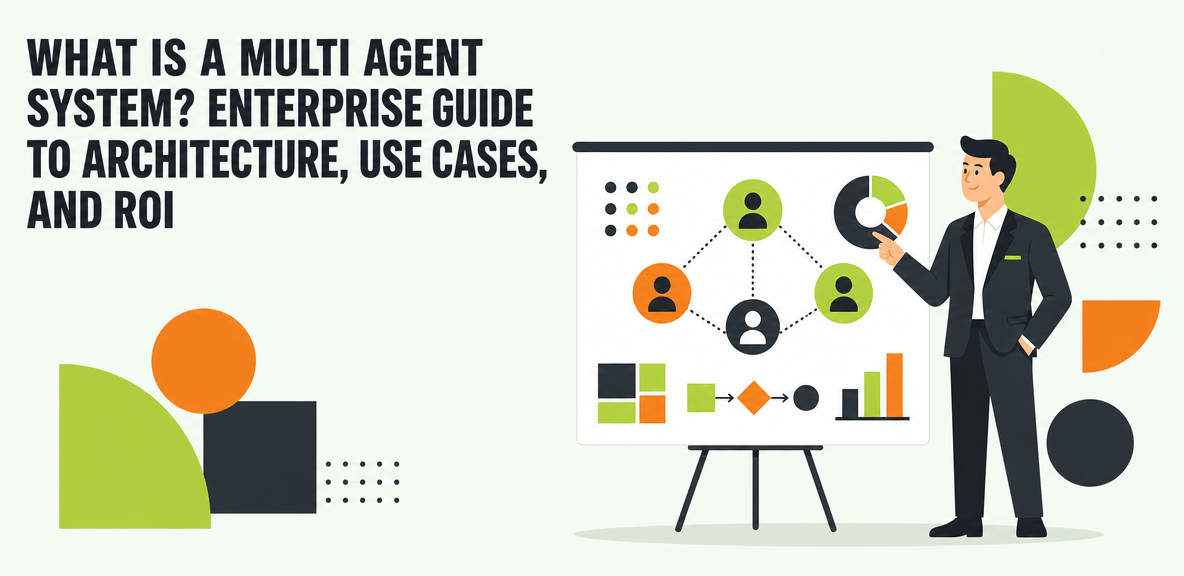
What is a multi agent system and why does it matter now?
A multi agent system is an AI setup in which multiple specialized agents work together to complete a task, make decisions, or manage a workflow. Each agent handles part of the work. One may plan, another may retrieve information, a third may validate policy, and another may execute the next step.
That model matters now because enterprise AI is moving beyond chat-based assistance. Leaders are asking AI to handle cross-functional work that spans research, approvals, handoffs, and action across several applications. A single general-purpose agent often performs well in a demo, then struggles in production when the task requires more context, more control, and more reliable execution.

This is the enterprise tension behind growing interest in the multi agent system model. According to a 2024 Gartner survey of more than 3,000 managers, only 8% of employees use AI in ways that meaningfully improve their work, even as Gartner research finds 95% of CIOs expect significant AI value. The gap is not only model quality. It is also workflow design, execution reach, and the ability to prove outcomes.
Academic definitions of multi agent systems usually focus on autonomous entities interacting in a shared environment. That is useful background. But enterprise deployment is more practical. You need to know whether the system can handle real business rules, cross-application work, exceptions, auditability, and measurable results.
Multi agent system definition in plain language
A multi agent system is a group of AI agents with different roles that coordinate to achieve a shared goal within a defined environment and set of rules.
In plain terms, five elements matter:
- Agents: the individual workers in the system
- Goals: the outcome they are trying to achieve
- Environment: the systems, data, and workflow conditions around them
- Rules: the permissions, policies, and constraints they must follow
- Coordination: the way they share context, divide work, and resolve conflicts
That is the simple definition enterprise readers can use. The harder question is whether those agents can complete work in the software environments where employees actually operate.
Single-agent vs. multi agent system
A single agent is simpler. It has one reasoning loop, one prompt strategy, and fewer coordination issues. For bounded tasks, that is often the right choice.
A multi agent system introduces specialization. That can improve quality and speed, especially when work can be broken into parallel or distinct steps. But it also creates new coordination requirements.
Here is the practical comparison:
- Specialization: single agents are broad; multi agent systems can assign narrow roles
- Speed: single agents are faster for simple tasks; multi agent systems can speed up complex work through parallelism
- Coordination needs: low for single agents; high for multi agent systems
- Observability: easier in a single flow; harder when many agents interact
- Control: simpler in one-agent designs; more policy design required across multiple agents
More agents do not automatically mean better outcomes. They usually mean more design work.
Why enterprises are revisiting multi agent system AI now
Three market shifts are driving interest.
First, copilots have familiarized enterprises with AI assistance, but also exposed the limits of single-assistant models. Second, agentic AI has expanded expectations from answering questions to taking action. Third, enterprise workflows remain fragmented across ERP, CRM, ITSM, HCM, collaboration tools, and legacy systems.
A multi agent system promises to divide work, share context, and manage handoffs across that fragmented environment. That promise is attractive because enterprise work rarely happens in one application or one reasoning step.
How a multi agent system works: core architecture, components, and types

At a high level, a multi agent system works by decomposing a goal into smaller tasks, assigning those tasks to specialized agents, coordinating outputs, and checking whether the final result meets the objective.
The architecture matters more than the headline concept. Many weak systems fail not because the agents are unintelligent, but because memory is scoped poorly, tool access is too broad, or coordination rules are vague.
Core components of a multi agent system
Most enterprise designs include these components:
- Agent specialization: each agent has a defined role such as planner, researcher, validator, approver, or executor
- Task decomposition: a supervisor or planner breaks a workflow into smaller actions
- Memory scope: agents need the right amount of context, not unlimited history
- Tool access: each agent gets access only to the systems or functions needed for its role
- Environment awareness: agents need awareness of workflow state, business rules, and application conditions
In practice, the best designs constrain agents tightly. A finance policy agent should not also be a workflow executor. An execution agent should not have unrestricted access across systems. Role clarity improves reliability.
Types of multi agent systems
Enterprises will usually encounter six common structures:
- Centralized: one controller assigns work to subordinate agents. Best for high-control environments.
- Decentralized: agents coordinate as peers. Useful where resilience matters, but harder to govern.
- Hierarchical: agents operate in tiers, often with planners above specialists. Common in enterprise workflow design.
- Team-based: a fixed group of agents collaborates repeatedly on similar tasks.
- Coalition-based: agents form temporary groups for specific problems, then disband.
- Holonic: each unit acts as both a whole and a part of a larger system. Useful for nested business structures, though more complex to implement.
For most enterprises, centralized and hierarchical models are easier to test, govern, and audit.
Communication and coordination patterns
Agents coordinate in several ways:
- Agent-to-agent messaging for direct handoffs
- Shared state where all agents read and update a common task record
- Event-driven workflows that trigger the next agent when a condition is met
- Voting or negotiation when there are multiple candidate actions
- Conflict resolution rules when outputs disagree
- Escalation paths for exceptions or low-confidence decisions
- Human-in-the-loop checkpoints for approvals, edge cases, or regulated tasks
The pattern you choose affects both performance and trust. In enterprise settings, explicit handoffs and visible checkpoints usually matter more than theoretical autonomy.
Where multi agent systems create enterprise value

A multi agent system creates the most value when work is complex, multi-step, exception-heavy, or spread across multiple domains. That is where one agent often becomes overloaded.
The value is not abstract intelligence. It shows up in task completion, cycle time, quality, and operational consistency.
Multi agent systems examples in enterprise operations
Some realistic examples include:
- IT ticket triage and resolution: one agent classifies the request, another checks knowledge sources, another validates access policy, and another initiates the approved action
- Employee onboarding: one agent collects required information, another routes approvals, another provisions systems, and another tracks completion across HR and IT workflows
- Procurement routing: one agent validates request details, another checks budget policy, another routes approvals, and another submits the transaction into the purchasing system
- Claims review: one agent gathers documents, another checks policy terms, another flags anomalies, and another prepares the reviewer packet
- Customer service escalation: one agent summarizes the case, another verifies entitlement, another recommends next steps, and another coordinates the handoff
- Sales-to-ERP handoffs: one agent reviews CRM opportunity details, another validates order requirements, and another prepares downstream ERP workflow execution
These are useful multi agent systems examples because they reflect how real enterprise work moves through departments and systems.
When a multi agent system is a better fit than a single agent
Use a multi agent system when the work includes:
- Many sub-tasks
- Multiple tools or systems
- Different reasoning styles
- High context load
- Parallel workstreams
- Distinct approval stages
If the task is simple, repetitive, and contained within one system, a single agent may be the better design. Complexity should earn its keep.
How to think about ROI for a multi agent system
ROI should be measured at the workflow level, not by counting agent interactions.
Useful metrics include:
- Reduced manual handoffs
- Faster workflow completion
- Fewer errors or rework loops
- Better adherence to policy
- Improved visibility into process bottlenecks
This is where digital adoption becomes important. Even a well-designed multi agent system fails if employees cannot use it easily or if the workflow breaks at the point of execution. Measured value comes from completed work, not theoretical capability.
What most multi agent system content misses: execution, observability, and cross-application reality
This is where many enterprise AI discussions lose contact with production reality.
A multi agent system can reason well and still fail to complete work. The usual reason is simple: enterprise processes span too many applications, too many interfaces, and too many exceptions. Intelligence alone does not solve that.
Why many multi agent system AI deployments stall after the prototype
Common failure modes include:
- Incomplete context
- Brittle integrations
- Siloed agents
- Weak exception handling
- Lack of auditability
- Inability to execute in UI-based workflows
S&P Global research finds that 42% of companies abandoned the majority of their AI initiatives in 2025. That should temper expectations. The issue is often not whether the agent can generate an answer. It is whether the system can finish the workflow under real conditions.
The enterprise software problem agents still have to solve
Many enterprise processes still live in user interfaces without full API coverage. ERP, HR, procurement, and service workflows often depend on screens, form states, legacy logic, and application-specific navigation.
That creates a structural limitation for agents. If they cannot access the right screen-level context or act reliably in the interface, they stop where the workflow becomes real.
This is why execution still matters. The UI remains where much enterprise work happens.
What an enterprise-ready execution and accountability layer adds
An enterprise-ready execution and accountability layer closes that gap.
In practice, an action bar and UI-native execution layer can:
- Provide real-time screen-level context
- Unify workflows across applications
- Support governed action at the point of work
- Prove whether AI-assisted workflows are actually completing
This layer matters because it turns agent design into business performance. It gives the system eyes into the workflow, reach across application boundaries, and evidence for adoption and ROI.
For enterprise teams, that bridge is often the difference between an impressive prototype and a deployable operating model.
Challenges, limitations, and how to implement a multi agent system responsibly
A multi agent system is not automatically smarter, cheaper, or easier to manage than a single-agent design. In many cases, it is the opposite.
Limitations of multi agent systems
The main limitations include:
- Coordination overhead
- Failure propagation across agents
- Prompt and rule complexity
- Debugging difficulty
- Latency and cost sprawl
- Diminishing returns from unnecessary specialization
There are also governance risks. Agents can drift from policy, hallucinate actions, or behave inconsistently when environment conditions change. Security teams also need clear answers on permissions, audit trails, and data exposure.
Implementation checklist for enterprise teams
A practical rollout usually starts with a bounded workflow and disciplined governance.
Use this checklist:
- Define the workflow boundary and what success looks like
- Assign agent roles with clear responsibilities
- Limit tool access by role and policy
- Create escalation rules for exceptions and low-confidence states
- Instrument task-level analytics so you can measure completion, friction, and abandonment
- Validate outcomes in production conditions across real systems and edge cases
- Add human checkpoints where approvals or risk controls require them
- Support digital adoption so employees know when to trust, review, or intervene
A multi agent system should earn expansion through measured results, not architectural ambition.
Further reading and learning resources
If you want deeper theoretical grounding, a multi agent systems book or scholarly research can help with formal coordination models and distributed intelligence concepts.
If you are evaluating enterprise deployment, prioritize different questions:
- Can the system complete the workflow?
- Can it operate across real applications?
- Can you govern and observe it?
- Can you measure outcomes clearly?
Those questions matter more than whether the design sounds advanced.
Before you expand beyond the first use case, compare three architectures for your target workflow: a single agent, a hierarchical multi agent system, and a multi agent design with a dedicated execution and accountability layer. That comparison will usually clarify whether your challenge is reasoning, coordination, or workflow completion.
People Also Ask
-
What is a multi agent system in AI?A multi agent system in AI is a setup where multiple specialized agents coordinate to achieve a shared goal. Each agent handles part of the work, such as planning, retrieval, validation, or execution.
-
What is the difference between a single-agent and a multi agent system?A single-agent system relies on one model or agent to manage the task. A multi agent system divides work across specialized agents. Single-agent designs are simpler. Multi agent systems can handle more complex workflows, but they require stronger coordination and governance.
-
What are some real-world multi agent systems examples?Examples include IT ticket triage and resolution, employee onboarding, procurement routing, claims review, customer service escalation, and sales-to-ERP handoffs. These use cases involve multiple decisions, systems, and approvals.
-
What are the main types of multi agent systems?The main types are centralized, decentralized, hierarchical, team-based, coalition-based, and holonic systems. Enterprises most often evaluate centralized or hierarchical models because they are easier to govern and audit.
-
When should an enterprise use a multi agent system instead of one AI agent?Use a multi agent system when the workflow has many sub-tasks, multiple tools, different reasoning needs, high context load, parallel work, or several approval stages. If the task is simple and contained, a single agent is often the better choice.
-
What are the biggest challenges in implementing a multi agent system?The biggest challenges are coordination overhead, brittle integrations, weak observability, debugging difficulty, policy drift, security concerns, and failure at the execution layer when workflows depend on user interfaces rather than clean APIs.