FACT CHECKED
Why agentic AI frameworks matter now
Enterprise teams are under pressure to show that AI spending is producing results. The contracts for copilots, assistants, and workflow AI are signed. The licenses are active. But the board is not asking whether AI sounds impressive in a demo. It is asking whether AI is improving work at the workflow level.
That is where many organizations hit a wall. According to a 2024 Gartner survey of more than 3,000 managers, only 8% of employees use AI frequently in ways that meaningfully improve their work. Gartner research also finds 95% of CIOs expect significant AI value from their investments. The gap between those numbers is why interest in agentic AI frameworks is accelerating.

In plain language, agentic AI frameworks are the software foundations used to build AI agents that can plan, use tools, manage memory, and complete tasks across steps. They move AI from answering a question to pursuing an outcome.
But the real enterprise challenge is not model capability alone. It is execution reality. Work breaks across applications, approval chains, legacy systems, and UI-heavy workflows that were built for humans, not for AI. An agent may reason well and still fail when the next step requires context from another application or action in a system with weak API coverage.
What is an agentic AI framework?
An agentic AI framework is a software framework for building AI agents that can make decisions across multiple steps, call tools, track state, use memory, and work toward a defined goal. It is different from a standalone model, which generates outputs, a copilot, which assists within a specific product boundary, or a simple automation, which follows fixed rules without adaptive reasoning.
Why interest in agentic AI frameworks is rising
Interest is rising because enterprise buyers are moving past experimentation. They want AI accountability. They want workflow automation that works across real systems. And they want measurable returns, not usage claims based on license activation alone.
S&P Global research finds that 42% of companies abandoned the majority of their AI initiatives in 2025. That is not happening because organizations lack access to capable models. It is happening because building AI into enterprise work requires planning, controls, execution reach, and adoption measurement.
What separates useful agentic AI frameworks from impressive demos
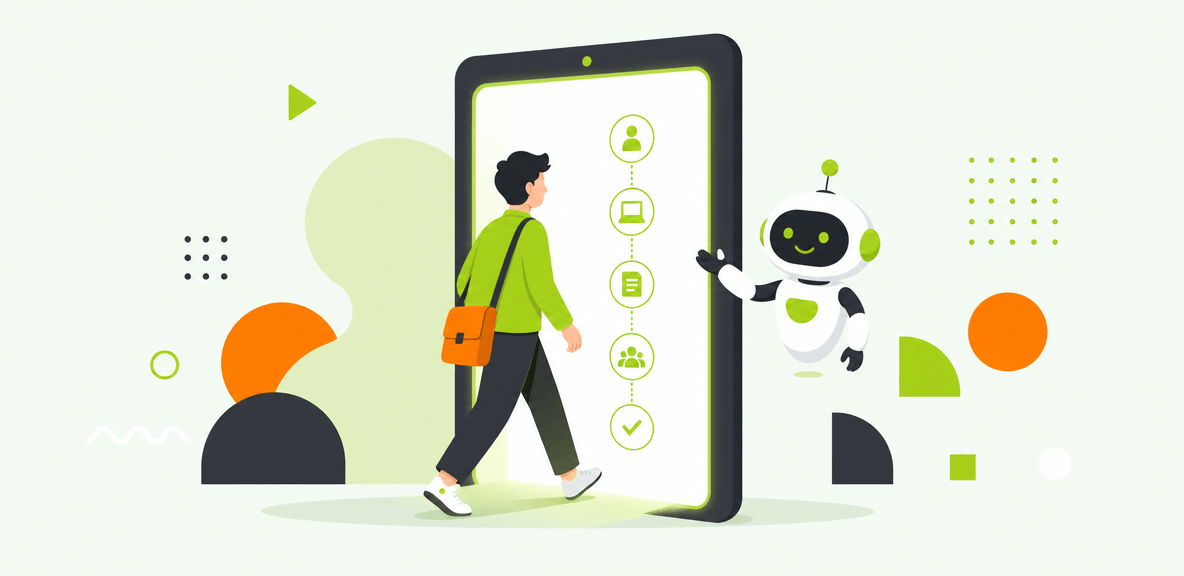
Many agentic AI frameworks look compelling in controlled environments. They can plan tasks, call tools, and coordinate multiple agents in a notebook or developer sandbox. Enterprise buyers should look deeper.
What matters in production is whether the framework can support reliable execution under security, compliance, and operational constraints. That means evaluating planning, tool use, memory, state management, multi-agent coordination, observability, and human oversight as a system, not as isolated features.
It also means addressing a major gap in many framework discussions: execution often stops at APIs. In real enterprises, that is not enough. Core processes still depend on form-based systems, legacy interfaces, partial integrations, and application switching. If your AI cannot operate where work actually happens, the framework alone will not close the performance gap.
Governance needs to enter the conversation early. High-risk workflows require controlled permissions, audit trails, fallback logic, and deterministic paths. The question is not just whether an agent can act. It is whether you can govern how it acts.
Core components every enterprise buyer should understand
Planning and reasoning
This is how the agent breaks a goal into steps. In business terms, it is the difference between an AI that answers a question and one that can work through a process.
Tool calling
Agents need to use enterprise systems, data sources, search tools, and services. Buyers should look at how frameworks define tool permissions, error handling, and retries.
Memory
Memory helps agents retain context across interactions. That can mean short-term task context, longer-term preferences, or workflow history. Without it, agents restart from scratch too often.
Workflow control and state management
Enterprise workflows are rarely linear. Tasks pause for approvals, fail on exceptions, and branch based on conditions. Strong frameworks manage these states explicitly.
Monitoring and observability
You need visibility into what the agent attempted, which tools it used, where it failed, and why. Without observability, debugging and governance become guesswork.
Escalation to humans
Not every path should be autonomous. Mature designs route exceptions, ambiguity, and high-risk decisions to a person with context intact.
The hidden enterprise challenge: context and execution gaps
Many agents still lack the context and execution reach required for enterprise work.
They cannot see real-time screen-level context. They cannot carry context across application boundaries. And they cannot complete tasks in systems where API coverage is incomplete or unavailable.
That matters more than many framework comparisons suggest. An agent that can plan perfectly but cannot see the order screen, detect the field state, or complete the next UI action will stall at the exact point where business value is supposed to appear.
Agentic AI frameworks list: top options and where they fit
When buyers search for an agentic AI frameworks list, they usually want a practical map of the market. The right way to read the landscape is by architecture style and use case fit, not by popularity alone.
Frameworks commonly discussed in 2026 include LangChain, LangGraph, AutoGen, CrewAI, LlamaIndex, Semantic Kernel, and Haystack. Some are open-source first. Others are backed by large commercial ecosystems. Some focus on agent coordination. Others are stronger in retrieval or application development patterns.
Top agentic AI frameworks by architecture style
Graph-based frameworks
Frameworks such as LangGraph fit workflows that need durable state, branching logic, and explicit control over multi-step execution. They are often useful for complex enterprise processes where task state matters as much as model output.
Chain-based frameworks
LangChain remains a common entry point for agentic AI frameworks. It is flexible and widely adopted, which is why searches for agentic AI frameworks LangChain remain high. It often fits teams building structured tool-calling and prompt pipelines, especially in early production work.
Multi-agent frameworks
AutoGen and CrewAI are often evaluated for scenarios where specialized agents need to collaborate. These designs can help when tasks benefit from role separation, but they also increase governance and debugging complexity.
Retrieval-centric frameworks
LlamaIndex and Haystack are often strong fits for retrieval-heavy use cases, knowledge workflows, and applications where grounding model output in enterprise content is critical.
Enterprise application development patterns
Semantic Kernel is frequently considered by teams that want tighter alignment with enterprise application development, especially where existing engineering standards and commercial ecosystem support matter.
How to read any top agentic AI frameworks comparison
Do not choose a framework based only on GitHub activity, community enthusiasm, or demo simplicity.
A useful comparison should tell you:
- how the framework handles workflow complexity
- what observability it provides
- how it manages permissions and controls
- whether it supports your deployment model
- how it behaves when tools fail or context is incomplete
- what it will cost to operate and maintain
This is especially important when evaluating agentic AI frameworks open-source. Open-source options can provide flexibility and control, but the governance, support, and operating burden do not disappear. They shift to your team.
How to choose agentic AI frameworks for enterprise use
The best evaluation process starts with the workflow, not the framework.
CIOs, enterprise architects, and AI teams should ask whether the framework fits the use case, the risk level, the operating environment, and the execution reality of the business process. A simple internal knowledge assistant has different needs than a cross-application procurement workflow with approvals and compliance requirements.
A 2024 Gartner survey identifies the top barriers to AI adoption as lack of training (30%), change resistance (30%), poor AI quality (29%), and no process integration (26%). That last point matters. Even capable AI fails when it is disconnected from how work actually gets done.
A practical enterprise evaluation checklist
Use these criteria when evaluating agentic AI frameworks for enterprise use:
- Security and privacy: How does the framework handle sensitive data, credentials, and tool permissions?
- Observability: Can you inspect task history, failures, tool calls, and state transitions?
- Human-in-the-loop controls: Can you route exceptions and approvals to people cleanly?
- Reliability under exception paths: What happens when a tool fails, data is missing, or policy blocks an action?
- Latency and cost control: Can you manage response times and model usage costs at scale?
- Extensibility: Will the framework support your systems, tools, and future architecture choices?
- Regulated environment support: Can it meet audit, policy, and residency requirements?
- Cross-application unification: Can the agent maintain context across the actual applications your employees use?
- Execution reach: Can it act where APIs are weak, or does it stop short of the workflow?
Where WalkMe fits alongside agentic AI frameworks
This is where many enterprise AI programs need more than a framework.
WalkMe is complementary to agentic systems and copilots. It is the execution and accountability layer that connects AI to real employee workflows through the action bar.
The action bar gives AI screen-level context in real time. It provides cross-application unification across the enterprise stack. It supports workflow execution at the UI level, where many enterprise processes still live. And it proves what is happening through adoption analytics that track usage, friction, and completion.
That matters because even a well-designed agent often lacks direct access to what the employee sees on screen or what changed in the workflow between applications. WalkMe closes that gap today. It helps AI systems act with better context and helps enterprise leaders prove whether those systems are working.
Why AI adoption fails even with the right framework
Framework choice is important. It is not sufficient.
AI adoption still fails when employees do not know when to use the system, do not trust the output, or abandon the workflow when the process crosses tools and systems. Training gaps, change resistance, AI quality issues, and weak process integration all contribute to that failure.
That is why enterprise teams need to measure actual workflow completion, not just model performance or license consumption. If your agent cannot be adopted consistently in live work, the framework did not solve the business problem.
Limitations, risks, and what enterprise teams should expect next
Agentic AI frameworks do not fix broken processes, weak governance, poor source data, or low employee trust on their own. They are foundations, not outcomes.
Common risks include agent sprawl, uncontrolled permissions, brittle tool chains, and architectures that depend on screenshots being sent to cloud services. In regulated environments, that last issue raises immediate privacy and compliance concerns. Enterprise teams should treat architecture choices as governance choices.
The larger opportunity is real. Governed autonomous execution becomes more practical when AI operates with real context, enterprise controls, and measurable outcomes. That future will not be defined by the number of agents deployed. It will be defined by whether those agents can perform reliably across the workflows that matter most.
What agentic AI frameworks cannot do by themselves
By themselves, frameworks cannot:
- redesign a broken business process
- carry context across every enterprise system automatically
- complete UI-heavy workflows where APIs are limited
- drive employee behavior change at scale
- provide board-ready ROI measurement tied to workflow outcomes
Those gaps are why many organizations need more than agent logic. They need an execution and accountability layer.
The path from frameworks to governed autonomous execution
Today, the strongest enterprise approach is to pair capable agentic AI frameworks with the infrastructure required for real execution.
That means screen-level context, controlled workflow execution, auditability, and cross-application unification. Over time, this becomes the path to governed autonomous execution. The UI is the ultimate API for the large share of enterprise work that still happens beyond formal integrations.
The teams that make smart framework decisions now, and connect them to real workflow execution, will be in a stronger position to scale AI with confidence.
If proving AI ROI is the next conversation you are having with your board, the WalkMe action bar is where that proof starts.
People Also Ask
-
What are agentic AI frameworks?Agentic AI frameworks are software frameworks used to build AI agents that can plan multi-step tasks, call tools, manage memory, track state, and pursue goals. They differ from standalone models, copilots, and fixed-rule automations because they support more adaptive task execution.
-
What are the top agentic AI frameworks in 2026?Commonly evaluated options include LangChain, LangGraph, AutoGen, CrewAI, LlamaIndex, Semantic Kernel, and Haystack. The right choice depends on architecture style, workflow complexity, retrieval needs, governance requirements, and enterprise development preferences.
-
How do I choose the right agentic AI framework for enterprise use?Start with the workflow and risk level. Then evaluate security, privacy, observability, human oversight, reliability, deployment fit, total operating cost, and execution reach. Also assess whether you need an execution and accountability layer to connect the framework to real employee workflows.
-
Is LangChain one of the best agentic AI frameworks for production?LangChain is one of the most widely discussed agentic AI frameworks and can be a strong option for structured tool-calling and application development. But production fit depends on your workflow requirements, control needs, and operating environment. Popularity alone is not a reliable selection criterion.
-
Which agentic AI frameworks are open-source?Several widely discussed agentic AI frameworks have open-source roots or open-source components, including LangChain, LangGraph, AutoGen, CrewAI, LlamaIndex, and Haystack. Open-source flexibility can be valuable, but enterprise teams still need to account for support, governance, and maintenance responsibilities.
-
How are agentic AI frameworks different from copilots and RPA?Agentic AI frameworks help developers build agents that reason across steps and use tools dynamically. Copilots are typically product-specific AI assistants that support users within a defined environment. RPA follows explicit rules and predefined scripts. Agentic systems sit between those worlds, but in enterprise settings they still need context, governance, and workflow execution support to perform reliably.