FACT CHECKED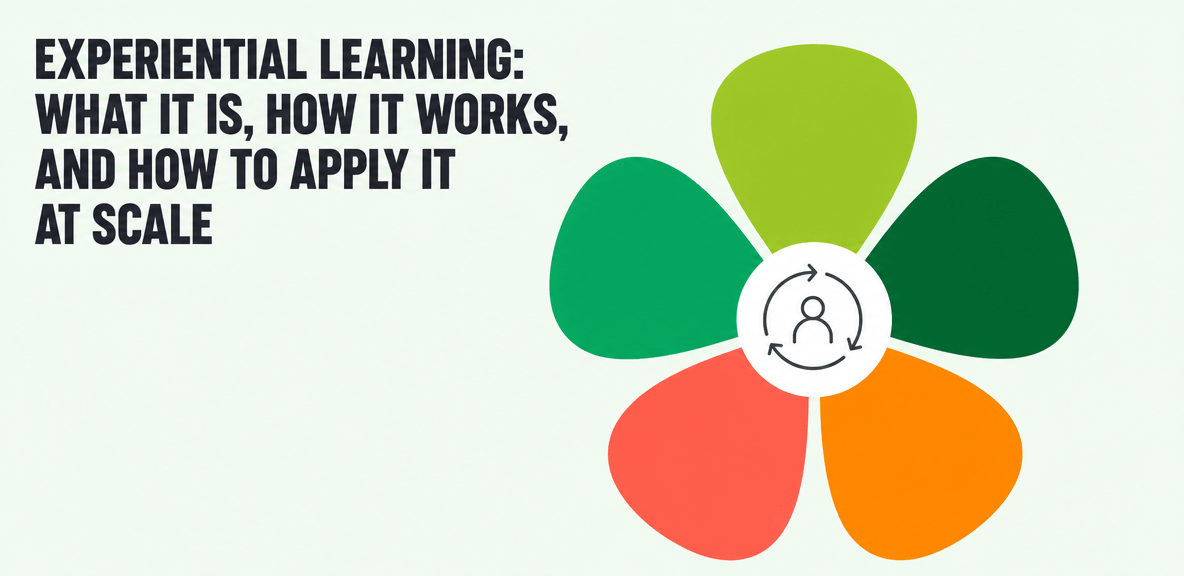
What Is Experiential Learning?

Experiential learning is a method of learning through direct experience, reflection, and application. Instead of relying on passive instruction alone, it asks people to do the work, examine what happened, and improve their approach the next time.
In practical terms, experiential learning moves beyond knowing about a task to becoming capable of performing it. That distinction matters in any environment where employees need to use judgment, complete workflows correctly, or adapt to changing tools and processes.

It is also worth separating experiential learning from a few related concepts:
- Lectures and one-time training focus mainly on information transfer
- Simple trial-and-error involves doing, but not necessarily reflecting or improving in a structured way
- Hands-on learning or learning by doing are close experiential learning synonyms, but they are not always identical because experiential learning usually includes structured reflection and intentional behavior change
That broader definition is why the concept matters far beyond academic settings. In the workplace, experiential learning supports employee onboarding, software adoption, leadership development, customer service training, and process execution. Wherever performance depends on applying knowledge in context, experiential learning becomes relevant.
Experiential Learning vs Traditional Learning
Traditional learning often emphasizes content delivery. The goal is to transfer knowledge efficiently through classes, slide decks, e-learning modules, or documentation.
Experiential learning emphasizes capability building. The goal is to help people perform successfully in real situations.
That difference shows up quickly in enterprise environments. An employee may complete formal training on a new CRM or HCM platform and still struggle during their first live transaction. Real performance usually improves when people can practice in context, receive support near the moment of action, and apply lessons across repeated attempts.
What Does Experiential Learning Theory Say?

When people search for experiential learning theory, they are often looking for Kolb’s model. David Kolb’s framework is one of the most widely cited ways to explain how experience becomes learning.
At a high level, experiential learning theory says that effective learning happens through a cycle. People have an experience, reflect on it, form conclusions, and test those conclusions in future action.
This matters because the model connects practice to retention, judgment, and repeatable performance. It helps organizations design learning that improves how work gets done, not just how much content employees consume.
At the same time, it is a framework, not a guarantee. Better outcomes depend on design quality, relevance to the job, and reinforcement over time.
The Experiential Learning Cycle Explained
Kolb’s experiential learning cycle is typically described in four stages:
- **Concrete experience** The learner performs a task or participates in an activity. In the workplace, that could mean completing an expense report in Workday, handling a customer escalation, or leading a team meeting.
- **Reflective observation** The learner reviews what happened. What went well? Where did confusion appear? What caused the mistake or delay? This step turns activity into insight.
- **Abstract conceptualization** The learner forms a principle or takeaway. For example, a manager may realize that a difficult conversation goes better when expectations are stated earlier. A system user may recognize that a specific workflow always fails when fields are completed out of sequence.
- **Active experimentation** The learner applies that insight the next time. This is where improvement becomes visible in practice.
In a software rollout, the cycle may look like this: an employee completes a transaction, reflects on where they got stuck, understands the logic of the process, and then performs the next transaction more accurately. In manager training, it may involve a role-play, debrief, coaching takeaway, and another attempt. In customer service, it could be a live scenario followed by review and refinement.
Why Reflection Is the Step Most Programs Miss
Experience alone does not create learning. Repetition without interpretation can simply reinforce poor habits.
This is where many workplace programs fall short. They provide exposure, but not reflection. Employees are told to practice, but they are not guided to examine what happened or connect it to the next task.
Reflection does not need to be overly academic. It can be a manager debrief, a peer discussion, a post-task prompt, or workflow analytics that show where friction occurred. The point is to help employees translate activity into better decisions and more consistent execution.
What Are the Benefits of Experiential Learning in the Workplace?

The main benefit of experiential learning is faster movement from awareness to competent performance. In enterprise settings, that often translates into better onboarding outcomes, stronger retention, and more reliable task execution.
Experiential learning is especially effective for complex workflows where employees need judgment, not just recall. Think ERP transactions, compliance documentation, service processes, or people-manager conversations. These tasks involve timing, sequence, context, and tradeoffs. They are difficult to master through passive instruction alone.
Experiential learning also supports change management. It reduces the gap between training completion and real-world performance by placing practice and reinforcement closer to the work itself.
For enterprise teams, the value should be measured operationally. Relevant metrics often include:
- Time-to-productivity
- Error rates or rework
- Support ticket volume
- Training completion versus actual task success
- Software utilization and feature adoption
How Experiential Learning Improves Adoption and Performance
The mechanism is straightforward. People learn faster when guidance appears close to the moment of action and can be practiced repeatedly in real workflows.
That is why in-workflow support matters. Instead of expecting employees to remember a training session from two weeks earlier, organizations can reinforce the task while it is being performed. In many software environments, that means employees do not need to leave the application, search documentation, or open a separate training system to move forward.
For large enterprises, this matters because training decay is common after system go-live. Formal instruction builds awareness. Repeated guided use builds capability.
Where It Delivers the Most Value
Experiential learning tends to create the most value in high-friction environments, including:
- ERP systems with complex multi-step transactions
- HCM platforms used for onboarding, benefits, and HR workflows
- CRM systems where adoption depends on daily usage habits
- Compliance processes that require both accuracy and judgment
- Frontline operations where mistakes disrupt service or productivity
- Cross-functional onboarding where employees need to learn systems, processes, and team norms together
Experiential Learning Examples Across Education and Enterprise
Experiential learning examples vary by setting, but the underlying principle stays the same: people learn by doing, reflecting, and applying.
In education, common examples include:
- Labs
- Simulations
- Internships
- Clinical practice
- Fieldwork
- Group projects
In professional development and enterprise settings, the same approach appears in different forms:
- Role-play for managers or sales teams
- Job shadowing
- Scenario-based onboarding
- Guided software tasks
- Peer practice and feedback
- Stretch assignments tied to real business goals
Some university programs package applied learning under branded models, including searches such as experiential learning UCF. Those examples reflect how institutions organize hands-on learning, but the principle is equally useful in enterprise environments.
Digital experiential learning is especially relevant today. Employees increasingly learn inside the tools they use, not just in separate classrooms or portals.
Examples for Employee Training and Digital Adoption
For employee training and digital adoption, experiential learning can include:
- In-app walkthroughs that guide users through a live workflow
- Sandbox exercises that let employees practice before performing the task in production
- Guided process completion during onboarding or role transitions
- Manager coaching after first attempts at key tasks
- Peer practice for recurring scenarios
- Post-training reinforcement through prompts, checklists, or contextual help
This is also where digital adoption platforms can support experiential learning at scale. For complex software deployments, they can provide in-app guidance, automation, and analytics that help employees learn while completing real work. For organizations rolling out systems like SAP, Salesforce, or Workday across large user groups, that model is often worth evaluating.
Examples for Leadership and Soft Skills Development
Experiential learning for leadership and soft skills development often includes:
- Role-play for feedback, coaching, or conflict resolution
- Stretch assignments that require cross-functional coordination
- Cohort projects tied to live business problems
- After-action reviews following major initiatives
- Live problem-solving exercises with manager feedback
These methods work well because soft skills improve through practice, reflection, and adjustment, not just through conceptual instruction.
How to Design Experiential Learning Programs That Actually Work
The most effective programs start with business-critical tasks, not generic content plans. Enterprise teams should begin by identifying where performance gaps affect productivity, quality, or adoption.
From there, the goal is to design the experience, add reflection, reinforce learning in workflow, and measure outcomes. That design needs to account for real operational constraints such as software complexity, employee time limits, and manager capacity.
Experiential learning should also complement, not replace, formal instruction. Documentation, LMS content, and foundational training still matter. The strongest programs combine structured education with in-the-flow support.
A Five-Step Framework for Enterprise Teams
- **Identify critical tasks** Focus on workflows where errors, delays, or low adoption create measurable business impact.
- **Design realistic practice** Create exercises, simulations, or guided live tasks that reflect how work actually happens.
- **Build in reflection** Add debriefs, coaching, prompts, or reviews so employees interpret what happened and adjust.
- **Reinforce in workflow** Use job aids, manager follow-up, contextual guidance, or peer support to help learning persist.
- **Measure operational outcomes** Track onboarding speed, task completion rates, error reduction, support demand, and utilization.
How Technology Can Support Experiential Learning at Scale
Technology becomes especially useful when the learning challenge is tied to complex software and large user populations.
In-app guidance and workflow analytics are often worth evaluating when traditional training decays quickly after go-live. For example, during large enterprise software deployments, employees may understand the basics in training but still struggle during first use. In those cases, digital adoption platforms can help reinforce learning directly in the application and surface where users continue to get stuck.
That does not make technology the whole answer. It is one option that fits particularly well when the organization needs to scale experiential learning across many workflows, teams, and systems.
Limits, Risks, and Realistic Expectations
Experiential learning is not automatically more effective, cheaper, or easier to scale than conventional training. It requires thoughtful design and ongoing reinforcement.
Common limitations include:
- Inconsistent facilitation
- Weak or missing reflection
- Poorly designed practice environments
- Lack of measurement
- Broken processes underneath the learning experience
It is also important to know where experiential learning is strongest. It works best when employees must apply judgment, navigate complexity, or perform tasks in context. Other methods still matter for foundational concepts, compliance basics, and standardized policy training where consistency of information is the primary need.
Organizations should evaluate results through role-specific outcomes. A method that improves onboarding for customer support may not create the same gains for finance, HR, or field operations without adaptation.
What Experiential Learning Does Not Solve on Its Own
Experiential learning cannot replace process redesign, executive sponsorship, or clear system configuration during major transformation efforts.
If the workflow itself is broken, practice will expose the problem faster but will not resolve it. If managers are not aligned, reinforcement will be uneven. If the software experience is confusing at a structural level, training alone will not fix adoption.
That is why experiential learning works best as part of a broader operational strategy, not as a standalone remedy.
People Also Ask
-
What is experiential learning in simple terms?Experiential learning is learning by doing, reflecting on the experience, and applying what was learned to improve future performance.
-
What is Kolb’s experiential learning theory?Kolb’s experiential learning theory describes learning as a four-stage cycle: concrete experience, reflective observation, abstract conceptualization, and active experimentation.
-
What are some common experiential learning examples in the workplace?Common examples include role-play, job shadowing, scenario-based onboarding, sandbox practice, in-app walkthroughs, guided task completion, coaching, and after-action reviews.
-
How is experiential learning different from traditional learning?Traditional learning focuses more on knowledge transfer through instruction. Experiential learning focuses more on capability building through practice, reflection, and application in real situations.
-
What are the main benefits of experiential learning for employee training?Key benefits include faster time-to-productivity, stronger retention, better decision-making, more consistent task execution, and improved adoption of tools and processes.
-
Can experiential learning be delivered through digital tools?Yes. Digital tools can support experiential learning through simulations, guided workflows, contextual in-app help, reinforcement prompts, and analytics that show where employees need additional support.