FACT CHECKED
Enterprises don’t always operate efficiently because the people within them are not completing tasks in the most structured, logical ways.
Process mapping tools are productivity software that helps organizations disassemble, examine, and recombine processes in new ways to improve efficiency.
This process creates more efficient workflows and productive employees. Staff can then quickly complete their tasks using process improvement methodologies within software tools to improve digital adoption and promote fast software ROI.
Many external agencies and software vendors exist in the Business Process as a Service (BPaaS) market, currently worth USD 68.8 billion. But are you spending wisely if you choose process mapping tools that don’t fit your needs, budget, or employee learning needs?
This article seeks to answer this question. After explaining process mapping tools, it lists the 13 best and how to choose the right one.
What are process mapping tools?
Process mapping tools are software that creates visual process maps detailing workflows, events, and steps as part of business process mapping. These maps help teams understand and improve processes, which is essential for operations.
Popular tools include digital whiteboards, mind-mapping software, and visualization apps, chosen based on organizational needs and ease of use for creating, sharing, and editing maps.
Types of Process Maps: Choosing the Right Format
Before selecting a process mapping tool, you need to know which type of process map you are building. Each format serves a different purpose — and using the wrong type for the job creates confusion rather than clarity.
Flowchart
The most common and widely recognized format. Flowcharts use standardized shapes (rectangles for steps, diamonds for decisions, ovals for start/end points) connected by arrows to show the sequence of a process. Best for: documenting simple, linear processes for training, onboarding, or procedure documentation. Suitable for any audience — no process modeling background required.
Swimlane Diagram (Cross-Functional Flowchart)
A flowchart organized into horizontal or vertical “lanes,” each representing a team, department, or role. Swimlane diagrams make handoffs visible — you can see exactly where a process crosses from one owner to another, which is typically where delays and errors occur. Best for: cross-functional processes like procurement, customer onboarding, or IT service management.
BPMN (Business Process Model and Notation)
The international standard for process modeling, BPMN uses a precise notation system to document complex processes with events, gateways, and message flows. BPMN diagrams are machine-readable — they can be imported into process automation platforms (Camunda, Bizagi) and executed as workflows. Best for: technical process documentation, process automation projects, and any organization that needs their process models to drive software behavior.
Value Stream Map (VSM)
A lean management tool that maps both the material and information flows required to deliver a product or service to a customer. VSMs include time data at each step (process time, wait time, lead time) so waste is quantified, not just identified. Best for: manufacturing operations, supply chain optimization, and any organization applying Lean or Six Sigma methodologies.
Mind Map / Concept Map
A radial, non-linear diagram that shows relationships between ideas rather than the sequence of steps. Less formal than the above formats but useful in early-stage process discovery — when you are brainstorming what a process involves before committing to a structured map. Best for: initial scoping, stakeholder workshops, and process discovery sessions.
Choosing the right map type is a prerequisite for choosing the right tool. A team building BPMN diagrams for process automation needs different software than a team creating swimlane diagrams for an employee handbook.
The 13 best tools for process mapping
Process mapping tools are one of your organization’s most significant investments.
They reconfigure how your employees approach tasks from the inside out to make operations smooth, helping users through business processes and your organization generate revenue quickly and consistently.
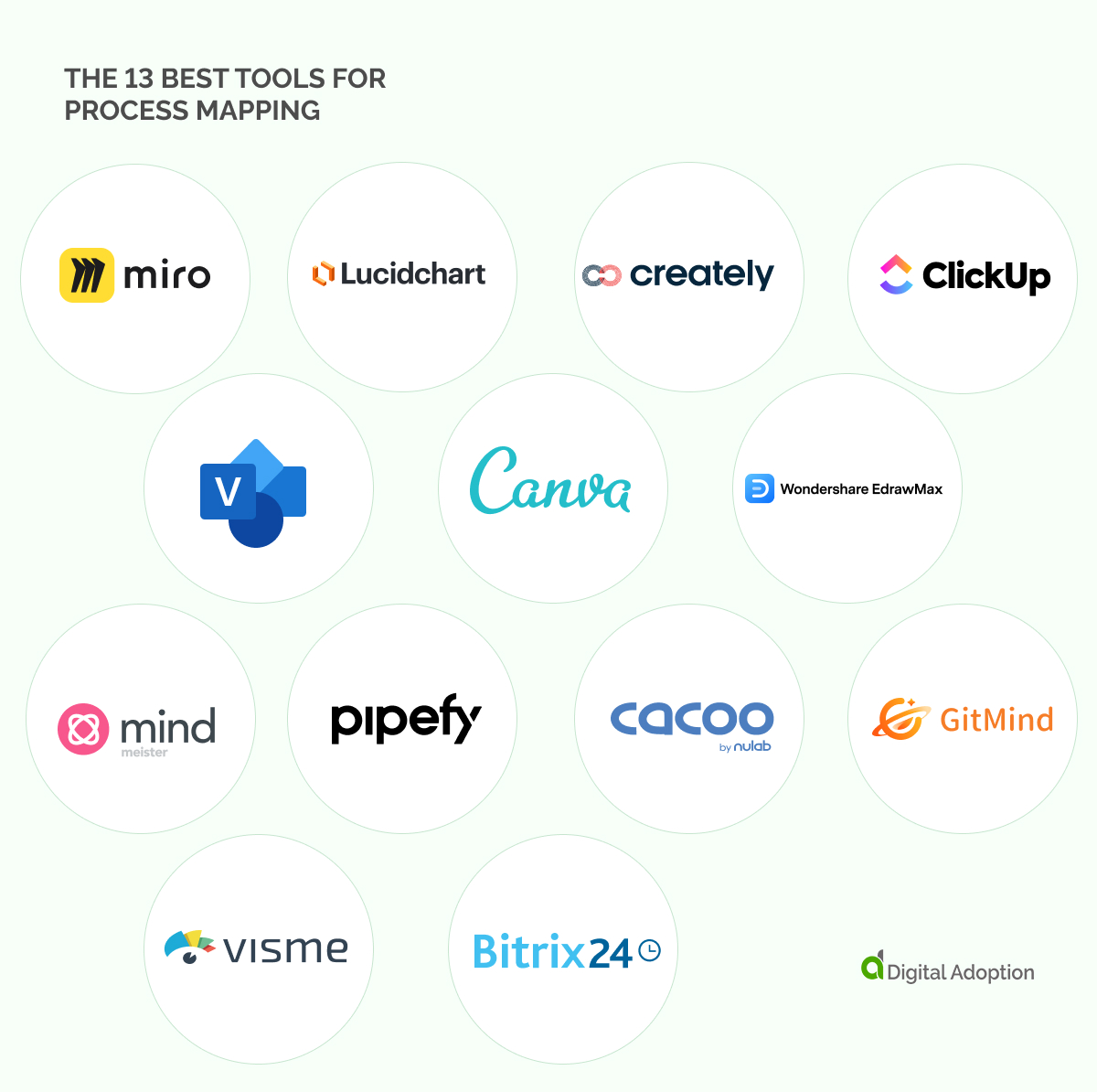
It’s essential to consider the best tool for the job before investing. So, let’s examine the best 13 tools to help you map key processes.
We built this list using the software review website G2 grading. G2 is impartial and the largest and most established site for enterprise software reviews, so it is the best choice for grading process mapping tools.
You may see some higher ratings lower down the list because we combine the number of user reviews with review scores to give a fair representation for each software.
- Creately
Creately offers diagramming and collaboration tools with real-time editing, a vast template library, and integration with popular apps. It’s known for its ease of use and robust collaborative features. This tool enables seamless team collaboration but has limited advanced features compared to some competitors.
- Lucidchart
Lucidchart provides intuitive diagramming, real-time collaboration, extensive templates, and integration with Google Workspace and Microsoft Office. Many organizations value its user-friendly interface and collaboration tools. It facilitates easy integration with other software, but one disadvantage is that the free version offers limited functionality.
- ClickUp
ClickUp combines project management, task tracking, and process mapping with customizable views and templates and is popular for its versatility and all-in-one approach. It centralizes various project management needs, but this strength can also become a weakness, as the extensive features can overwhelm inexperienced users.
- MindMeister
- Review Rating: 4.2/5
- Ease of Use: Excellent
- Effectiveness: Good
- Pricing: $8.50 per user, monthly
MindMeister specializes in mind mapping with real-time collaboration, presentation mode, and task management integration, which make it popular for organizations that brainstorm and organize ideas visually during process mapping. Despite being excellent for visual brainstorming, it contains limited diagram types beyond mind maps.
- Miro
Miro provides an online collaborative whiteboard with templates, real-time editing, and integration with popular tools. Many enterprises value Miro for its intuitive interface and strong collaborative features. It is excellent for remote team collaboration and brainstorming, but the free version has limited features and functionality.
- Pipefy
Pipefy offers workflow automation, process tracking, customizable templates, and integration with various tools. Known by enterprises for its process automation capabilities, Pipefy streamlines workflow automation, but it’s essential to know that initial set-up can be challenging and time-consuming.
- EdrawMax
- Review Rating: 4.3/5
- Ease of Use: Good
- Effectiveness: Excellent
- Pricing: $245 lifetime plan (one-time payment)
EdrawMax offers various diagramming tools and templates and is compatible with Visio (.vsdx) files, which Microsoft and LucidChart use for process mapping diagrams. This tool is famous for its comprehensive diagramming capabilities and supports various diagram types. However, the interface can feel complex and overwhelming for new users.
- Microsoft Visio
- Review Rating: 4.2/5
- Ease of Use: Excellent
- Effectiveness: Excellent
- Pricing: See the website for payment plans
Microsoft Visio provides professional diagramming tools, templates, and integration with Microsoft Office Suite. Enterprises use it widely for its comprehensive features and compatibility with Microsoft products. However, this process mapping tool has a high price tag compared to other tools with similar functionality.
- Canva
Canva provides graphic design tools, templates, and a user-friendly interface for creating various visual content. It is attractive for process mapping due to its ease of use and extensive template library. However, while being user-friendly and versatile, it is better for the early stages of brainstorming rather than the detailed later stages of process mapping, making it a weak all-in-one option. It is best to use Canva alongside more comprehensive process mapping tools.
- Cacoo
Cacoo offers collaborative diagramming with real-time editing, templates, and integration with various tools and has become well-known for its real-time collaboration and ease of use. Its main advantage is that it promotes excellent team collaboration, but a drawback is its limited advanced diagramming features.
- Visme
Visme provides tools for creating infographics, presentations, and visual content with templates and collaboration features. Enterprises favor it for creating engaging visual content, making it great for creating visually appealing presentations. However, like Canva, it is less focused on detailed process mapping.
- Bitrix24
- Review Rating: 4.1/5
- Ease of Use: Poor
- Effectiveness: Excellent
- Pricing: $399 per month, 250 users
Bitrix24 offers project management, CRM, team collaboration, document sharing, and process automation. This tool is popular for its comprehensive suite of business tools in one platform, which helps enterprises integrate multiple business functions, enhancing overall efficiency. However, the Bitrix24 interface can be cluttered and complex for new users, meaning a steep learning curve.
- GitMind
GitMind focuses on AI-enabled mind mapping with real-time collaboration, templates, and export options. Enterprises value its simplicity and effectiveness in mind mapping, making it easy to use and collaborate. However, it is limited to mind mapping and lacks broader diagramming features.
Review the list above and decide which tool best fits your organization’s needs, will help deliver its goals, and provides the best value.
Process Mapping Tools Comparison Table
The table below compares the 13 best process mapping tools on the dimensions that matter most to buyers: primary use case, free tier availability, collaboration support, and pricing.
| Tool | Best For | Free Tier | Real-Time Collaboration | Starting Price (Paid) |
| Lucidchart | General process mapping and diagramming | Yes (3 docs) | Yes | From $9/user/mo |
| Miro | Visual collaboration and workshop facilitation | Yes (3 boards) | Yes | From $8/user/mo |
| draw.io (diagrams.net) | Free, open-source diagramming | Free (fully) | Via Google Drive | Free |
| Microsoft Visio | Enterprise diagramming, BPMN | No | Limited | From $5/user/mo (Plan 1) |
| Lucidspark | Brainstorming and ideation | Yes | Yes | From $7/user/mo |
| Creately | Process mapping with database integration | Yes (5 items) | Yes | From $8/user/mo |
| Bizagi Modeler | BPMN process modeling | Free (Modeler) | No (local) | Automation: custom |
| Mural | Visual collaboration for enterprise teams | Yes (trial) | Yes | From $9.99/user/mo |
| Pipefy | Workflow automation with visual mapping | Yes | Yes | From $20/user/mo |
| Whimsical | Simple, fast flow and wireframe creation | Yes (limited) | Yes | From $10/user/mo |
| Gliffy | Lightweight diagramming for Confluence/Jira | No | No (export only) | From $8/user/mo |
| SmartDraw | Automated diagram formatting | No | Yes | From $9.95/user/mo |
| Camunda Modeler | Developer-grade BPMN and DMN | Free | No (local) | Camunda Platform: custom |
Key observations from the comparison:
- Truly free options: draw.io (diagrams.net), Bizagi Modeler, and Camunda Modeler are fully functional and free — excellent choices for teams with budget constraints or technical BPMN requirements.
- Best for collaboration: Miro and Mural are purpose-built for multi-user visual work; Lucidchart and Creately offer robust real-time co-editing within a more traditional diagramming interface.
- Best Visio alternative: Lucidchart is the most direct replacement for Microsoft Visio — it imports Visio files natively, supports the same notation systems, and is available in a browser without installation.
Visio Alternatives: The Best Process Mapping Tools for Teams Moving Away from Microsoft
Microsoft Visio has been the default process mapping tool in enterprise environments for decades. But its per-seat licensing costs, Windows-centric architecture, and limited real-time collaboration have pushed many organizations to evaluate alternatives — particularly as hybrid and remote work have made browser-based, collaborative tools a standard requirement.
Here are the strongest Visio alternatives in 2026, evaluated for the dimensions where Visio falls short:
Lucidchart — Best Overall Visio Replacement
Lucidchart is the most direct Visio equivalent — it supports the same diagram types, imports Visio (.vsdx) files without loss of fidelity, and runs entirely in the browser. Where it beats Visio: real-time multi-user collaboration (Visio Online lacks this in most deployments), significantly lower per-seat cost, and seamless integration with Google Workspace, Confluence, and Slack. Pricing starts at $9/user/month versus Visio Plan 2 at $15/user/month.
draw.io (diagrams.net) — Best Free Visio Alternative
draw.io is a fully functional, open-source diagramming tool that costs nothing. It stores files in Google Drive, OneDrive, or locally — and supports BPMN, UML, flowcharts, swimlanes, and network diagrams. For teams that need Visio’s capabilities without Visio’s cost, draw.io is the most recommended free alternative among IT and process management communities.
Miro — Best for Collaborative Process Discovery
Where Lucidchart replicates Visio’s structured diagramming, Miro replaces the collaborative whiteboard work that Visio never did well. For process discovery workshops, stakeholder alignment sessions, and early-stage mapping, Miro’s infinite canvas and real-time collaboration are significantly better than anything Visio offers. It is less precise than Lucidchart for formal BPMN notation but far more usable in group settings.
Creately — Best for Processes Linked to Data
Creately’s differentiator is its database layer — process shapes can be linked to underlying data records, turning a process map into a living operational document rather than a static diagram. For teams managing processes that are tightly connected to project or task data, Creately offers functionality that Visio, Lucidchart, and Miro do not.
Microsoft 365 Users: Check Visio for the Web First
If your organization is already on Microsoft 365, Visio for the Web (formerly Visio Online) is included in some M365 plans and has improved significantly in recent versions. Before investing in a new tool, verify whether your existing M365 license includes Visio access — it may already meet your needs for basic flowchart and swimlane work.
Factors to help you choose a process mapping tool
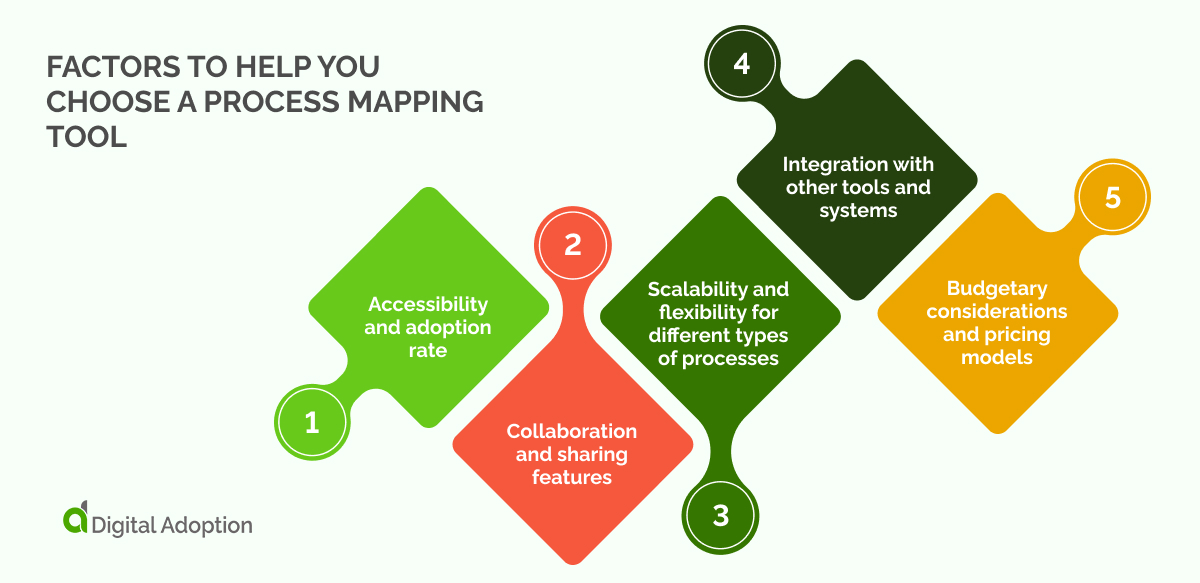
Before choosing a new process mapping tool, consider these factors. They will help you ensure ROI, ease of use, and alignment with organizational goals.
Accessibility and adoption rate
Consider the tool’s users. Are the user’s designers or dedicated operational teams? Will it be used organization-wide or just within one department? What is the adoption rate feedback from different software users?
The answers to these questions will determine the usability level needed for a process mapping tool. They may influence the balance between the ideal characteristics of process maps and the UI/UX of the software used to create them.
Collaboration and sharing features
Process mapping tools with real-time collaboration features are ideal for teams documenting and improving organizational procedures. These tools enable team members to work on process maps virtually, incorporating a broader range of perspectives throughout the improvement process.
Scalability and flexibility for different types of processes
Various process mapping tools provide varying degrees of flexibility and customization for creating and updating process maps. If you expect your organization to grow or your process standardization efforts are likely to expand, choose a process mapping solution that allows for easy map adjustments and accommodates additional users.
Integration with other tools and systems
Process mapping tools should integrate with other software and systems so team members can easily access and use them to maximize process maps. Choosing a solution that integrates different databases and systems will be ideal for robust data analysis and more effective process standardization.
Budgetary considerations and pricing models
Cost is always a significant factor when comparing different process mapping software solutions. Consider whether you will implement the software organization-wide, the number of users you need to license, and the expected cost savings your organization will achieve through process maps.
Ultimately, budget constraints might influence the decision-making process more than other factors. However, opting for a scalable solution can allow you to start with a lower price tier and upgrade later as your organization’s needs grow.
Consider these factors to get the process mapping tool that fits your needs, supports your staff, and promotes fast adoption rates and quick ROI.
Focus on usability when choosing a process mapping tool
Many process mapping tools offer impressive features, but no investment will return the value you want if your staff can’t optimize its use.
Pay attention to user reviews of process mapping tools, focusing on the ease of use, short learning curve, and user satisfaction.
Conduct user testing with a small group of staff during a free trial period, with employees of different experience levels, to ensure staff can use the software. Collect feedback and use it to decide whether staff enjoy and find value in a process mapping tool before you invest.
Focusing on usability can help you extract value and ROI from a new process mapping tool. It can also increase digital adoption rates and help you implement new processes more quickly, increasing efficiency and ballooning revenue.