FACT CHECKED
What is ERP transformation, and why do so many programs miss expected value?

ERP transformation is a business change program built around enterprise resource planning systems, not just a software replacement. It changes how work gets done across finance, procurement, HR, supply chain, and operations. The system matters, but the real objective is a new operating model with better controls, better visibility, and more consistent execution.
That distinction matters because ERP programs are still judged too often by technical milestones. The data migration completed. The new platform went live. The legacy system was retired. But the board is not asking whether the project launched. It is asking whether the investment is producing measurable business results.

That is where many programs stall. The workflows look good in design workshops and testing cycles, then break down in day-to-day use. Employees struggle with new approvals, new field requirements, and new process logic. Managers see process variation reappear after go-live. Support volumes rise. Manual workarounds return. The software is live, but the value case weakens.
If you are addressing introductory search intent, ERP full form is enterprise resource planning. In practice, ERP transformation means redesigning how that planning and execution happens across the enterprise.
It also helps to set expectations early. ERP transformation is not the same as ERP modernization, ERP migration, or replacing a few disconnected systems. Modernization may improve architecture. Migration may move you from on-premise to cloud. Point-system replacement may reduce complexity in a narrow area. Transformation is broader. It changes workflows, accountability, controls, and how people make decisions inside and around the ERP.
ERP transformation vs. ERP upgrade: what changes in practice?
An ERP upgrade improves the system. ERP transformation changes the business.
An upgrade might deliver a newer interface, better performance, or vendor-supported features. A transformation program changes how purchasing requests are submitted, how approvals move, how finance closes the books, how HR initiates transactions, and how operations handle exceptions. Roles shift. Controls change. Decision rights move. Standardization replaces local workarounds.
That is why ERP transformation has a higher payoff ceiling and a higher execution risk. You are not only changing technology. You are changing behavior across the processes that run the business.
Why ERP programs fail after go-live
Most ERP programs do not fail because the platform is incapable. They fail because execution becomes inconsistent after launch.
The common patterns are familiar. Training decays quickly after rollout. Process variation returns by region or function. Cross-application handoffs create friction. Employees leave the ERP to check email, open collaboration tools, review tickets, confirm CRM data, or reference HR records. Leaders can see login data, but they cannot always see whether users completed workflows correctly.
That is an adoption problem. And in 2026, it is also an AI accountability problem. Gartner research finds 95% of CIOs expect significant AI value from their investments, yet according to a 2024 Gartner survey of more than 3,000 managers, only 8% of employees use AI in ways that meaningfully improve their work. ERP is where that gap becomes painfully visible because these workflows are complex, regulated, and central to business performance.
What drives ERP transformation in 2026?
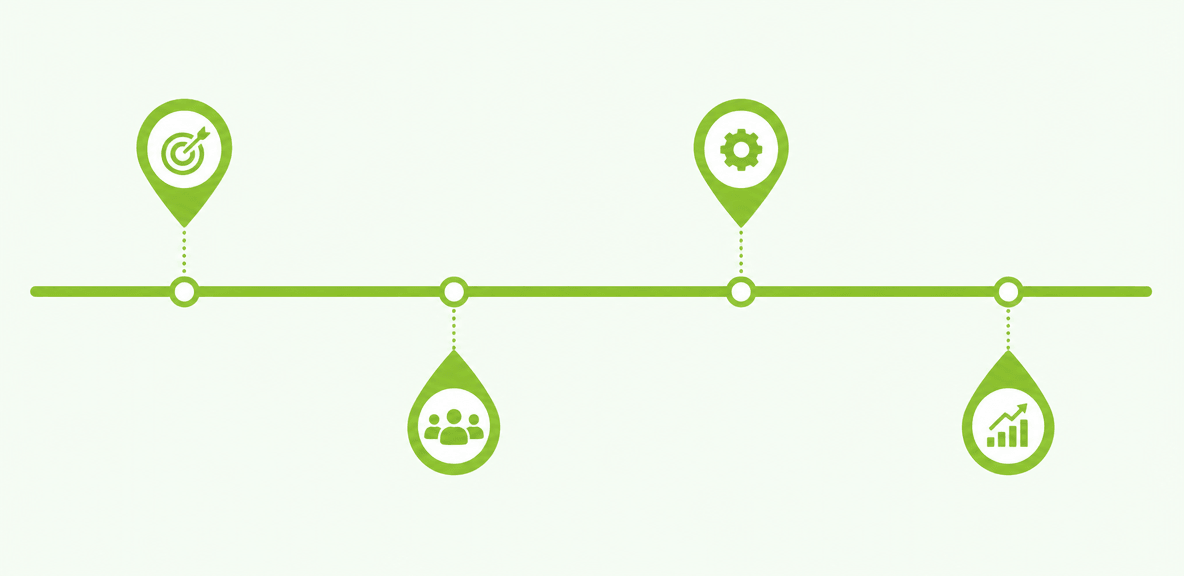
ERP transformation in 2026 is driven by pressure to standardize operations, improve compliance, control costs, harmonize post-merger processes, increase data visibility, and prepare the enterprise for AI-enabled work. Those goals are not new. What has changed is the level of scrutiny around measurable outcomes.
Boards and executive teams no longer accept deployment as proof of success. They want to see workflow completion, license utilization, time-to-productivity, support trends, and operating metrics that show the new model is working.
Research supports that shift. A 2024 Gartner survey identifies the top barriers to AI adoption as lack of training (30%), change resistance (30%), poor AI quality (29%), and no process integration (26%). That is a useful reminder for ERP leaders. The challenge is often not software capability alone. It is process integration and behavior change at scale.
ERP strategy is what connects those board-level goals to the day-to-day reality inside SAP, Oracle, and other enterprise platforms. Without that bridge, transformation becomes a technical program with business language around it. With it, the program becomes a measurable change in how work gets executed.
The AI layer changing ERP expectations
AI has raised the stakes for ERP transformation. Leaders now expect copilots, automation, and AI-driven assistance to accelerate work across approvals, data entry, reconciliations, service interactions, and exception handling.
But even if your copilot works perfectly inside its own environment, it still needs context it cannot get on its own. ERP work is highly screen- and workflow-dependent. The AI needs to know what form is open, which fields are populated, what approval stage the user is in, and what adjacent application triggered the task. That requires screen-level context and workflow reach across applications.
This is why many AI promises around ERP feel incomplete in practice. The AI may generate or recommend well, but enterprise work does not stop at recommendation. It must continue into execution.
Why large ERP environments are uniquely complex
Large ERP environments are harder than a typical SaaS rollout because they carry years of business logic.
Customizations accumulate. Legacy processes survive in local variations. Approval chains differ by region, entity, and role. Master data quality varies. Adjacent systems remain essential even after standardization efforts. And many workflows still depend on human judgment at key points.
That complexity means ERP transformation cannot be reduced to a launch plan. It needs an execution plan for real users operating across real systems.
How to build an ERP transformation strategy that survives real-world execution
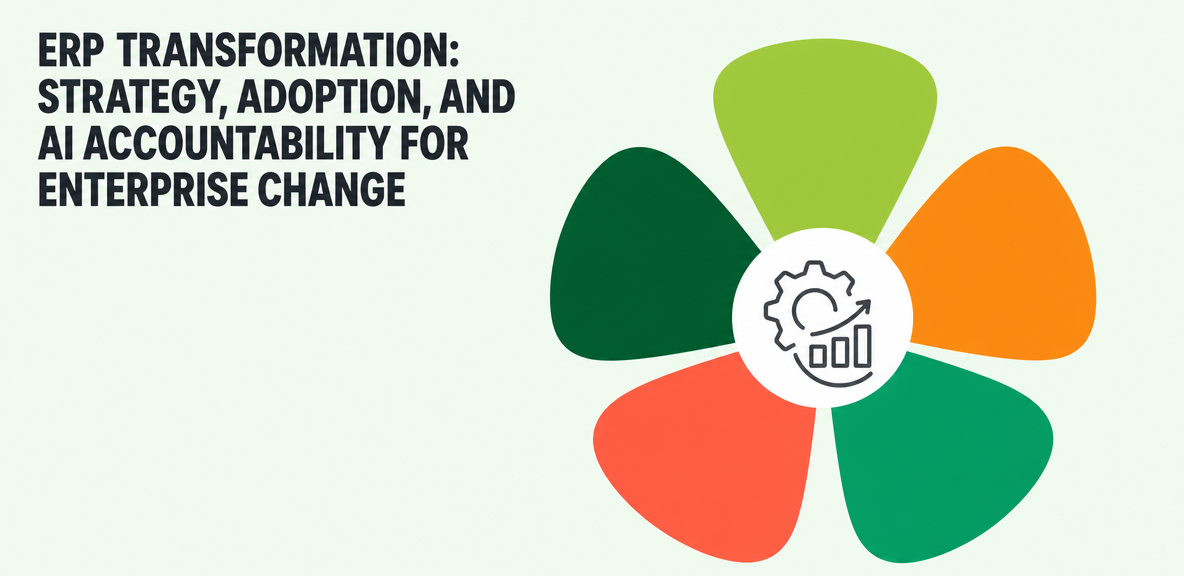
A practical ERP strategy starts with business outcomes, assesses current-state processes, prioritizes high-friction workflows, establishes governance, and sequences rollout by risk and value. It also includes something too many programs treat as secondary: adoption measurement.
Architecture, integrations, data migration, and PMO milestones are necessary. They are not sufficient. If you cannot measure whether people are completing the new workflows correctly, you cannot prove transformation is working.
The strongest programs align executive sponsors, process owners, IT, security, and functional leaders around a shared operating model and a shared scorecard. That scorecard should cover operational outcomes and user execution, not only project delivery milestones.
1. Define the future state in business terms
Start with measurable business outcomes, not platform features.
That can mean faster procurement cycles, fewer manual corrections, reduced support volume, shorter onboarding time for new process participants, stronger compliance, or more consistent close activities. These measures give the program a business case that survives past go-live.
A simple rule helps here: if the future state cannot be measured in workflow performance, cost, risk, or productivity, it is not defined clearly enough.
2. Identify workflow friction before rollout
Map where employees struggle today. Look at forms, approvals, field validation, handoffs, exception handling, and cross-system dependencies.
This matters because friction rarely appears in architecture diagrams. It appears when a manager cannot find the right procurement path, when a finance user enters incomplete data, or when an approval stalls because the next step lives outside the ERP. Those are the moments that determine whether the new model gets adopted.
3. Build change management into the program from day one
ERP transformation succeeds when communication, role-based readiness, and reinforcement are built into the program from the start.
Gartner research shows organizations that invest in change management alongside AI see significantly stronger revenue growth impact than those that do not. The principle applies directly here. Employees do not adopt new workflows because the system is live. They adopt when they understand what changed, why it changed, and how to execute correctly in the moment of work.
4. Create an accountability model for adoption and ROI
Track the metrics that show whether the transformation is taking hold.
That includes adoption by workflow, completion rates, time saved, friction points, support tickets, and the business outcome indicators tied to your future-state goals. These measures create the board-ready answer to a familiar question: is the investment producing results, or just activity?
Where ERP transformation breaks down and how leading enterprises close the gap
ERP transformation usually breaks down in the spaces between systems, teams, and intended behavior.
Employees do not work inside ERP alone. They move between Outlook, Slack, ITSM platforms, CRM, HCM, and the ERP itself. Each handoff creates hidden friction. Each context switch increases the chance of abandonment, delay, or error. And once AI is introduced, the accountability gap gets larger unless you can see how people actually complete work across those boundaries.
S&P Global research finds that 42% of companies abandoned the majority of their AI initiatives in 2025. That statistic is not ERP-specific, but it is relevant. It shows how quickly enterprise value cases weaken when adoption and integration fail to hold.
The hidden risk: cross-application workflows
Many ERP tasks begin outside the ERP.
A request starts in Outlook. A manager is notified in Slack. A service issue is logged in an ITSM tool. Customer details sit in CRM. Employee data sits in HCM. The transaction still must be completed in SAP or another ERP, then passed to another system for follow-up.
This is where process breaks often occur. The workflow crosses applications, but the user is left to bridge the gap manually. That creates inconsistency, slowdowns, and poor visibility into where the process failed.
How the action bar supports ERP execution and accountability
This is the point where the execution and accountability layer matters.
The WalkMe action bar helps organizations guide users, unify context across applications, execute workflows at the UI level, and prove adoption outcomes. It does that through four practical capabilities.
First, screen-level context intelligence. WalkMe reads what the employee sees in real time, which helps surface the right guidance or AI prompt based on the actual screen state.
Second, cross-application unification. The same action bar follows the employee across ERP and adjacent systems, so context does not disappear at each boundary.
Third, workflow execution at the UI level. WalkMe can click, fill, and navigate where APIs do not exist and where enterprise work actually happens.
Fourth, adoption analytics and ROI evidence. Leaders can see workflow completion, friction points, and usage patterns that help prove whether the ERP program and its AI layer are delivering value.
This is not a substitute for good process design. It is the layer that helps good process design survive contact with real-world execution.
What this looks like in AI-enabled ERP environments
In AI-enabled ERP environments, WalkMe is complementary to copilots. It does not replace them.
A copilot may draft, summarize, recommend, or answer questions inside its own environment. But ERP work often requires real-time context from the live screen and execution reach across applications. The WalkMe action bar provides that context and reach. It gives AI the visibility and workflow continuity it cannot access on its own.
That is how organizations move from AI potential to AI performance inside ERP processes.
What are realistic expectations for ERP transformation ROI, risk, and long-term value?
ERP transformation does not fix broken process design, weak sponsorship, poor master data, or unclear ownership on its own. Senior leaders know this, and credible planning should say it plainly.
Value realization is phased. Some gains appear early in reduced support needs, improved workflow consistency, or shorter time-to-productivity. Others take longer and show up in compliance performance, cycle time reduction, and better use of enterprise licenses and process capacity. None should be assumed at go-live.
What ERP transformation can and cannot solve
ERP transformation can improve consistency, visibility, control, and operational execution when the underlying process is sound.
It cannot compensate for unresolved ownership questions, unnecessary process complexity, or poor data discipline. The right platform and execution layer improve adoption and accountability, but leadership alignment and process simplification still matter.
From ERP transformation to agentic ERP
Agentic ERP is an emerging direction where AI can support and execute more of the work that now depends on manual action.
But enterprise readiness comes first. Governed autonomous execution requires context, deterministic workflow controls, auditability, and clear boundaries. The future is not unconstrained AI acting everywhere. It is AI acting where the enterprise can trust the path, measure the outcome, and govern the risk.
The UI is the ultimate API in that future. Much of ERP work still lives in interfaces, approvals, and exception flows that were built for humans. Organizations that build the right UI-level foundation now will be in a stronger position as agentic ERP matures.
How to evaluate partners and approaches
When comparing ERP strategy support from platform providers, systems integrators, and advisory firms such as Deloitte ERP practices, assess more than implementation depth.
Ask how each approach will measure adoption after go-live. Ask how workflow friction will be identified across applications. Ask how AI performance will be proven, not assumed. And ask whether the plan includes an execution and accountability layer, or only a launch plan.
ERP transformation is now inseparable from accountability. If proving AI ROI is the next conversation you are having with your board, the WalkMe action bar is where that proof starts.
People Also Ask
-
What is ERP transformation?ERP transformation is a business change program that uses enterprise resource planning systems to redesign processes, controls, roles, and execution across functions such as finance, procurement, HR, supply chain, and operations. It is broader than a technical implementation.
-
What is the ERP full form?ERP stands for enterprise resource planning.
-
How is ERP transformation different from an ERP upgrade?An ERP upgrade improves the existing system, often through new features, performance improvements, or vendor-supported releases. ERP transformation changes how the business operates, including workflows, approvals, controls, and decision-making across teams.
-
What are the biggest challenges in ERP transformation?The biggest challenges usually include process complexity, training decay, change resistance, regional variation, cross-application handoffs, poor visibility into workflow completion, and difficulty proving ROI after go-live.
-
How do you measure ERP transformation ROI?Measure ERP transformation ROI through operational and adoption metrics over time. Common measures include workflow completion rates, time-to-productivity, support tickets, friction points, cycle times, manual correction rates, compliance outcomes, and license utilization.
-
What is agentic ERP?Agentic ERP refers to an emerging model where AI can assist with or execute ERP-related work across workflows. In enterprise settings, it should be approached as governed autonomous execution with clear controls, screen-level context, audit trails, and deterministic workflow paths.